AUD/USD treads water ahead of Australian Trade Balance data
- AUD/USD failed to move too far in either direction on Wednesday.
- Australian Trade Balance figures are due early Thursday.
- US government shutdown has crimped the flow of critical inflation and jobs data.

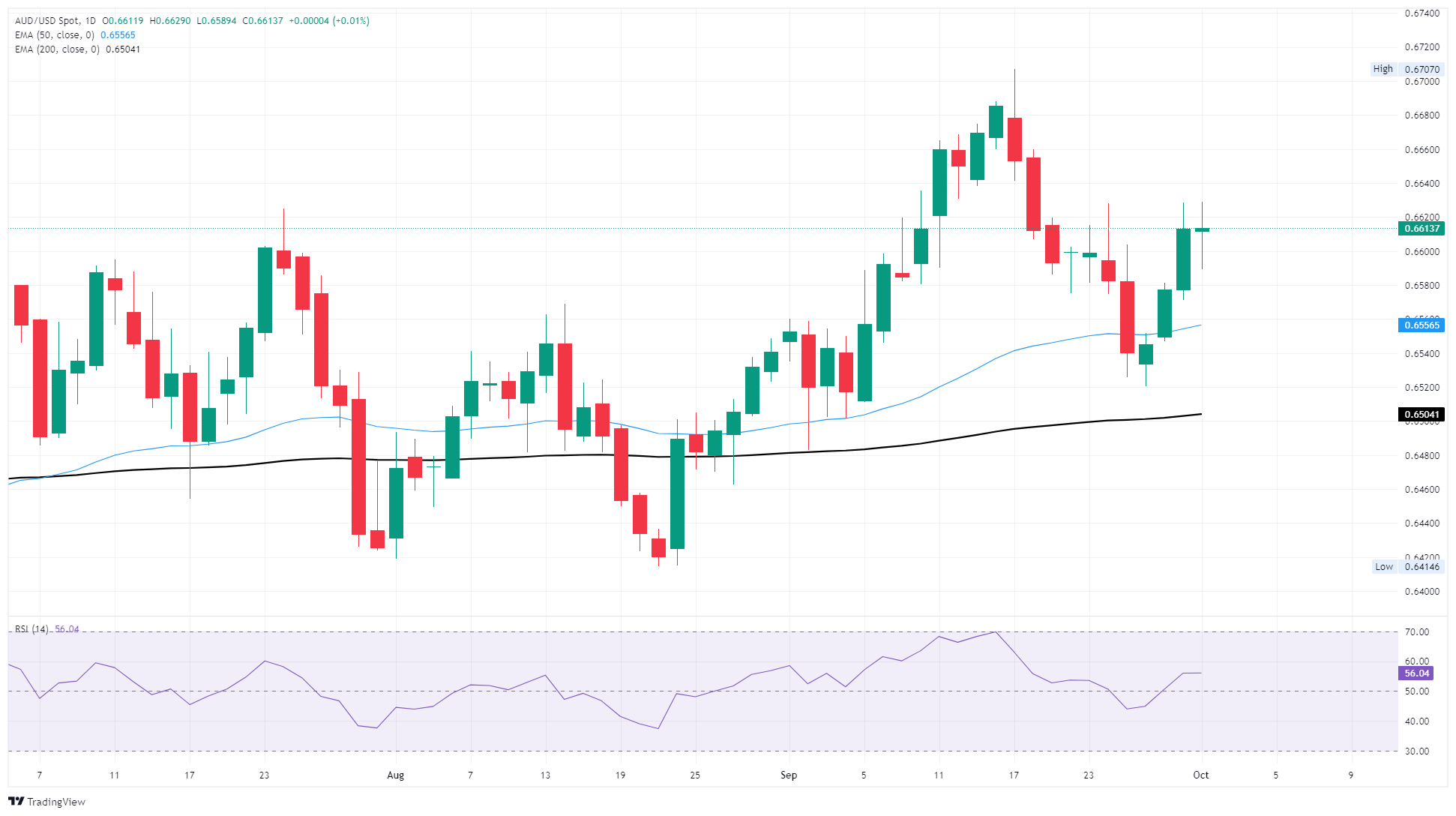
AUD/USD took a breather on Wednesday, churning in place near 0.6620 after a three-day gain streak that saw the US Dollar (USD) rebound from a three-week low of 0.6520 against the Australian Dollar (AUD). The US government has entered it’s fourth federal shutdown during Donald Trump’s two terms as president, and the Bureau of Labor Statistics (BLS) has warned that it will not be able to deliver the latest Nonfarm Payrolls (NFP) jobs data amid a federal shuttering.
Australia’s Trade Balance is expected to have dipped to 6.5 billion in August. Imports declined 1.3% in July, alongside a 3.3% uptick in Exports during the same period, bringing Australia’s July Trade Balance to 7.31 billion MoM. Australian Trade Balance data drops at 01:30 GMT. Australian S&P Purchasing Managers Index (PMI) data will also land on late on Thursday at 23:00 GMT. Australian Services PMIs are expected to hold steady at 52.0 for September.
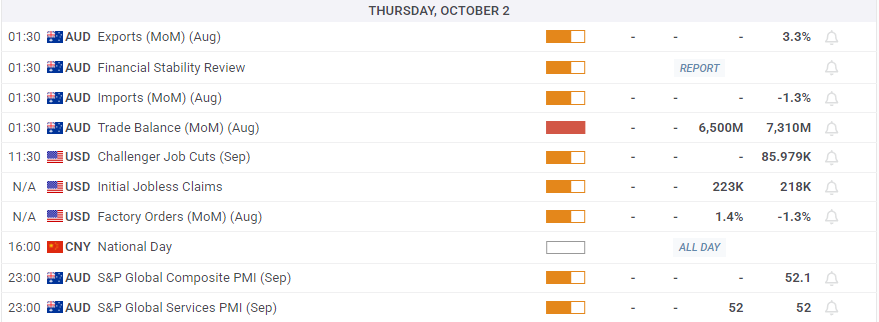
This week’s hotly anticipated US Nonfarm Payrolls (NFP) jobs report is at risk of being delayed or suspended. According to the US Bureau of Labor Statistics (BLS), a government shutdown will result in official dataset releases being suspended until federal operations resume.
ADP Employment Change figures came in much lower than the street expected, showing a contraction of -32K in September versus the expected 50K. August’s initial print of 54K was also revised sharply lower to -3K. ADP jobs figures suffer from constant revisions, but the figure has generally missed expectations for all but three of the monthly figures published since the start of 2025.
With the NFP print in jeopardy, investors are leaning further on private data such as ADP. According to the CME’s FedWatch Tool, rate trader bets of another quarter-point interest rate cut on October 29 surged to 99% post-ADP on Wednesday. Rate markets are also pricing in nearly 90% odds of a third-straight rate trim on December 10, and a further 93% that the Fed will deliver a fourth interest rate cut by next April at the absolute latest.
AUD/USD daily chart
Australian Dollar FAQs
One of the most significant factors for the Australian Dollar (AUD) is the level of interest rates set by the Reserve Bank of Australia (RBA). Because Australia is a resource-rich country another key driver is the price of its biggest export, Iron Ore. The health of the Chinese economy, its largest trading partner, is a factor, as well as inflation in Australia, its growth rate and Trade Balance. Market sentiment – whether investors are taking on more risky assets (risk-on) or seeking safe-havens (risk-off) – is also a factor, with risk-on positive for AUD.
The Reserve Bank of Australia (RBA) influences the Australian Dollar (AUD) by setting the level of interest rates that Australian banks can lend to each other. This influences the level of interest rates in the economy as a whole. The main goal of the RBA is to maintain a stable inflation rate of 2-3% by adjusting interest rates up or down. Relatively high interest rates compared to other major central banks support the AUD, and the opposite for relatively low. The RBA can also use quantitative easing and tightening to influence credit conditions, with the former AUD-negative and the latter AUD-positive.
China is Australia’s largest trading partner so the health of the Chinese economy is a major influence on the value of the Australian Dollar (AUD). When the Chinese economy is doing well it purchases more raw materials, goods and services from Australia, lifting demand for the AUD, and pushing up its value. The opposite is the case when the Chinese economy is not growing as fast as expected. Positive or negative surprises in Chinese growth data, therefore, often have a direct impact on the Australian Dollar and its pairs.
Iron Ore is Australia’s largest export, accounting for $118 billion a year according to data from 2021, with China as its primary destination. The price of Iron Ore, therefore, can be a driver of the Australian Dollar. Generally, if the price of Iron Ore rises, AUD also goes up, as aggregate demand for the currency increases. The opposite is the case if the price of Iron Ore falls. Higher Iron Ore prices also tend to result in a greater likelihood of a positive Trade Balance for Australia, which is also positive of the AUD.
The Trade Balance, which is the difference between what a country earns from its exports versus what it pays for its imports, is another factor that can influence the value of the Australian Dollar. If Australia produces highly sought after exports, then its currency will gain in value purely from the surplus demand created from foreign buyers seeking to purchase its exports versus what it spends to purchase imports. Therefore, a positive net Trade Balance strengthens the AUD, with the opposite effect if the Trade Balance is negative.
Author

Joshua Gibson
FXStreet
Joshua joins the FXStreet team as an Economics and Finance double major from Vancouver Island University with twelve years' experience as an independent trader focusing on technical analysis.