AUD/USD threatens psychological resistance as US Dollar bulls back down
- AUD/USD recovers as bulls eagerly approach psychological resistance at 0.6500.
- US Jobless Claims on Thursday take the spotlight following Wednesday’s disappointing ADP report.
- Australia’s trade balance data could provide additional insight into the resilience of the export industry to tariffs.

The Australian Dollar (AUD) is gaining confidence against the US Dollar (USD) on Wednesday, with bulls eagerly approaching a critical barrier of resistance.
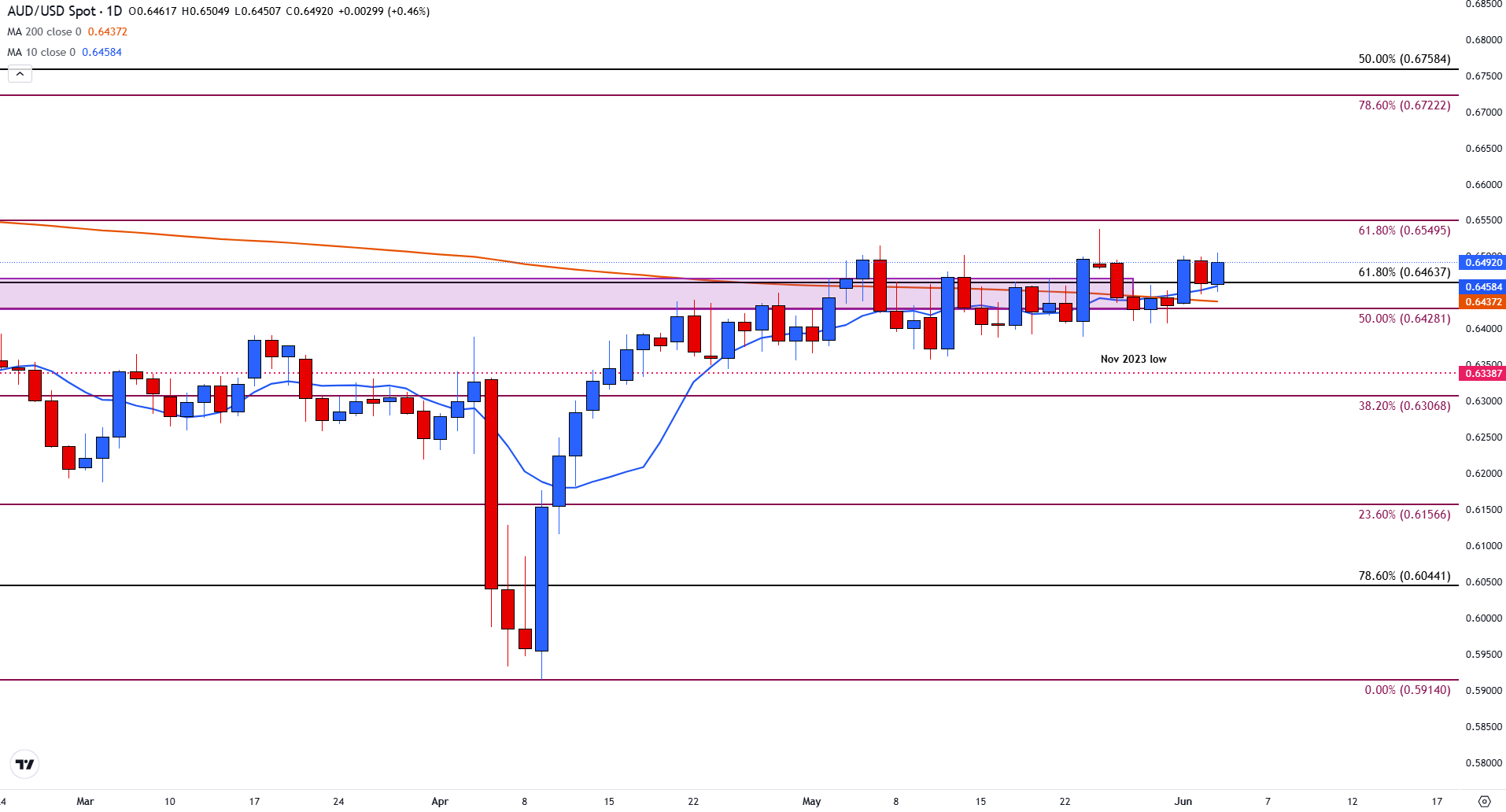
With AUD/USD trading above 0.6493 at the time of writing, the 0.6500 psychological level is on the horizon, which has proven to be a challenging level to clear over recent weeks.
After falling to a low of 0.5914 in April, the Australian Dollar experienced a sharp rally, pushing prices above the 200-day Simple Moving Average (SMA). As the 200-day Simple Moving Average (SMA) continues to provide support for the short-term move at 0.6437, the 0.6500 zone came into focus in May, limiting the upside potential for AUD/USD on several occasions.
To continue progressing along an upward trajectory over the upcoming months, a clear break above the 0.6500 level is required, which is often provided by a fundamental catalyst.
AUD/USD daily chart
Australia’s Trade Balance and US Jobless Claims will influence AUD/USD direction
On Thursday, the economic calendar includes high-impact economic data releases scheduled for Australia and the United States, which could potentially push prices out of this range.
At 01:30 GMT, the Australian Bureau of Statistics will release the Trade Balance data for April, with Australia expected to report a MoM surplus of A$6.1 million. A positive value would suggest that Australia’s export industry remained resilient despite the implementation of tariffs on imports to the US, which may support a positive outlook for the Australian economy and for the Australian Dollar. The opposite would apply if the April figures miss expectations by a large margin and data suggest that the export industry could be more vulnerable to the effects of tariffs than initially expected.
Meanwhile, investors will be monitoring the weekly release of US Initial Jobless Claims, which are expected to show the previous week falling to 230K, down from 240K reported last week. Wednesday’s ADP numbers showed that 37,000 jobs were added to the US private sector in May, missing expectations of an increase of 115,000 jobs.
With the May release of Nonfarm Payrolls (NFP), which provides insight into the health of the broader US labour market, any changes in the labour situation is often reflected in the USD exchange rate since this has a direct impact on interest rate expectations and the Federal Reserve’s (Fed) projected monetary policy stance.
Economic Indicator
Trade Balance (MoM)
The trade balance released by the Australian Bureau of Statistics is the difference in the value of its imports and exports of Australian goods. Export data can give an important reflection of Australian growth, while imports provide an indication of domestic demand. Trade Balance gives an early indication of the net export performance. If a steady demand in exchange for Australian exports is seen, that would turn into a positive growth in the trade balance, and that should be positive for the AUD.
Read more.Next release: Thu Jun 05, 2025 01:30
Frequency: Monthly
Consensus: 6,100M
Previous: 6,900M
Source: Australian Bureau of Statistics
Australian Dollar FAQs
One of the most significant factors for the Australian Dollar (AUD) is the level of interest rates set by the Reserve Bank of Australia (RBA). Because Australia is a resource-rich country another key driver is the price of its biggest export, Iron Ore. The health of the Chinese economy, its largest trading partner, is a factor, as well as inflation in Australia, its growth rate and Trade Balance. Market sentiment – whether investors are taking on more risky assets (risk-on) or seeking safe-havens (risk-off) – is also a factor, with risk-on positive for AUD.
The Reserve Bank of Australia (RBA) influences the Australian Dollar (AUD) by setting the level of interest rates that Australian banks can lend to each other. This influences the level of interest rates in the economy as a whole. The main goal of the RBA is to maintain a stable inflation rate of 2-3% by adjusting interest rates up or down. Relatively high interest rates compared to other major central banks support the AUD, and the opposite for relatively low. The RBA can also use quantitative easing and tightening to influence credit conditions, with the former AUD-negative and the latter AUD-positive.
China is Australia’s largest trading partner so the health of the Chinese economy is a major influence on the value of the Australian Dollar (AUD). When the Chinese economy is doing well it purchases more raw materials, goods and services from Australia, lifting demand for the AUD, and pushing up its value. The opposite is the case when the Chinese economy is not growing as fast as expected. Positive or negative surprises in Chinese growth data, therefore, often have a direct impact on the Australian Dollar and its pairs.
Iron Ore is Australia’s largest export, accounting for $118 billion a year according to data from 2021, with China as its primary destination. The price of Iron Ore, therefore, can be a driver of the Australian Dollar. Generally, if the price of Iron Ore rises, AUD also goes up, as aggregate demand for the currency increases. The opposite is the case if the price of Iron Ore falls. Higher Iron Ore prices also tend to result in a greater likelihood of a positive Trade Balance for Australia, which is also positive of the AUD.
The Trade Balance, which is the difference between what a country earns from its exports versus what it pays for its imports, is another factor that can influence the value of the Australian Dollar. If Australia produces highly sought after exports, then its currency will gain in value purely from the surplus demand created from foreign buyers seeking to purchase its exports versus what it spends to purchase imports. Therefore, a positive net Trade Balance strengthens the AUD, with the opposite effect if the Trade Balance is negative.
Author

Tammy Da Costa, CFTe®
FXStreet
Tammy is an economist and market analyst with a deep passion for financial markets, particularly commodities and geopolitics.