AUD/USD tests support as focus shifts to Fed decision and RBA policy paths
- Mixed US Retail Sales data shifts focus to the Fed's updated dot plot and Powell’s rate guidance.
- AUD/USD tests key moving average support near 0.6500 as traders assess widening monetary policy divergence.
- The Australian Dollar awaits fresh signals on whether the RBA will extend its rate-cut cycle amid growing fiscal constraints.


The pair is falling back toward 0.6500 on Tuesday as traders digest mixed US Retail Sales data, monitor rising geopolitical tensions, and prepare for Wednesday's Federal Reserve (Fed) policy decision and Summary of Economic Projections.
The Australian Dollar (AUD) is drawing modest support from elevated commodity prices and a broadly weaker US Dollar (USD). However, the upside remains capped by mounting global uncertainty and concerns over Australia's weakening domestic outlook.
Mixed US Retail Sales shift focus to Fed dot plot and Powell’s rate guidance
Cautious sentiment dominates as markets respond to conflicting signals in the latest US Retail Sales report. Headline sales dropped 0.9% MoM in May, missing forecasts of a 0.7% decline.
The GDP-relevant control group rose 0.4%, underscoring underlying consumer resilience. With the Fed expected to keep rates unchanged, the focus shifts to the updated dot plot and Chair Jerome Powell's guidance on the path of rates into late 2025.
AUD under pressure as RBA rate cut bets rise, fiscal constraints highlight growing policy divergence
In Australia, attention turns to a significant fiscal speech from Treasurer Jim Chalmers, set for delivery on Wednesday at the National Press Club. According to Reuters, Chalmers will outline structural challenges, including sluggish productivity and long-term budget sustainability.
Chalmers' tone may reinforce the view that fiscal support will remain limited, shifting the burden of stimulus to the Reserve Bank of Australia (RBA). Markets are already pricing in additional RBA easing, and if the Fed maintains a higher-for-longer stance while the RBA moves toward rate cuts, a growing policy divergence could ultimately weigh on the AUD and cap upside in the AUD/USD pair..If the Fed maintains a higher-for-longer stance while the RBA moves toward rate cuts, a growing policy divergence could ultimately weigh on the AUD and limit upside in the AUD/USD pair.
AUD/USD remains in the confines of a rising wedge
The AUD/USD pair remains confined within a rising wedge formation, with prices trading around the 10-day Simple Moving Average (SMA) at 0.6508 and below the key 61.8% Fibonacci retracement level, located near 0.6550 (measured from the decline from September to April).
The pair has edged down to 0.6511, testing the lower boundary of the wedge while holding above the key psychological support at 0.6500 and the 200-day SMA at 0.6428.
The Relative Strength Index (RSI) sits at a neutral 55, indicating steady momentum without overbought conditions.
AUD/USD daily chart
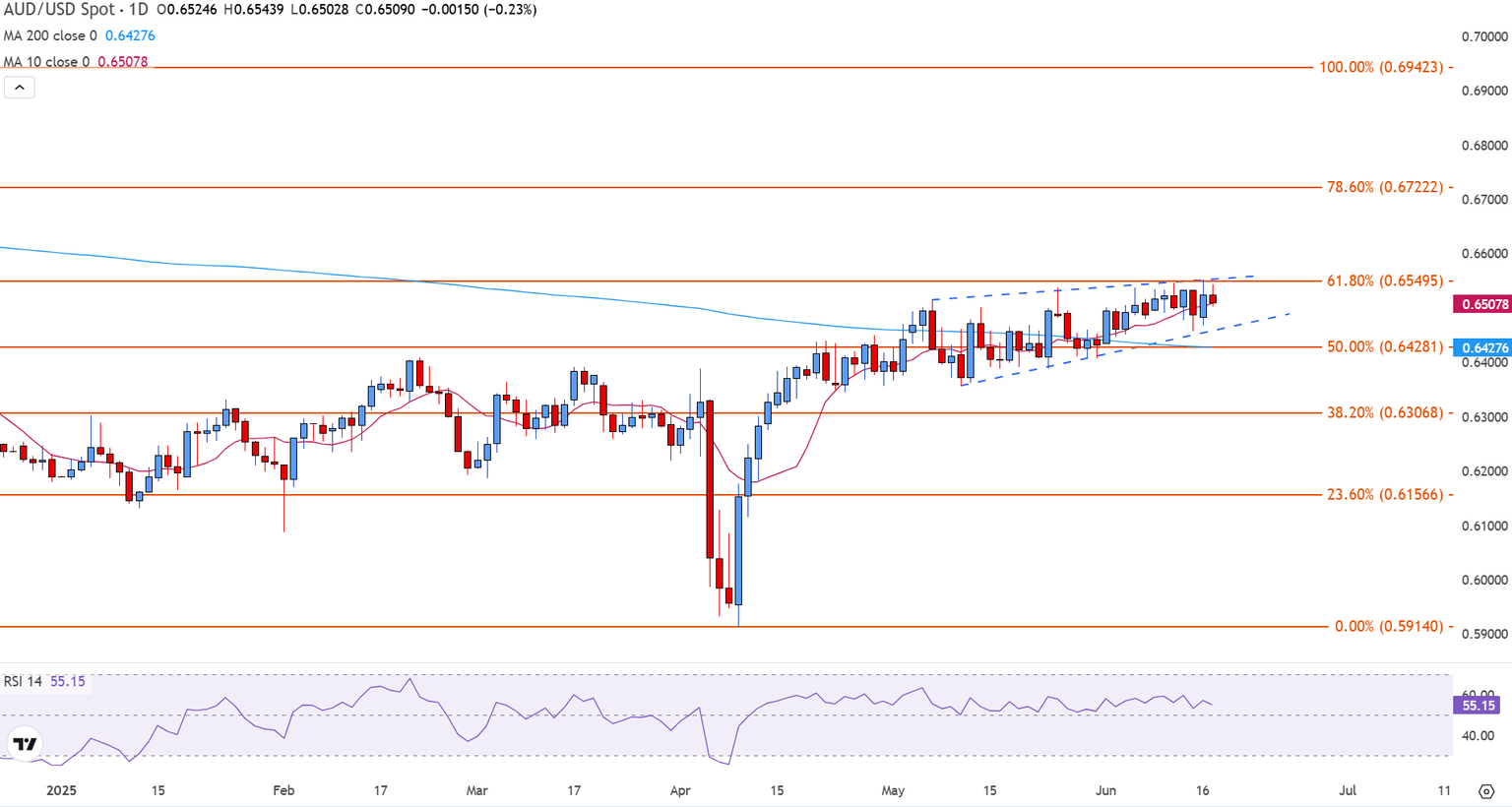
A decisive break above 0.6550 would open the door toward the 78.6% Fibonacci level at 0.6722, while a downside break below 0.6500–0.6480 would expose the next major support near 0.6428, where the 50% retracement and long-term moving average converge.
Dot Plot FAQs
The “Dot Plot” is the popular name of the interest-rate projections by the Federal Open Market Committee (FOMC) of the US Federal Reserve (Fed), which implements monetary policy. These are published in the Summary of Economic Projections, a report in which FOMC members also release their individual projections on economic growth, the unemployment rate and inflation for the current year and the next few ones. The document consists of a chart plotting interest-rate projections, with each FOMC member’s forecast represented by a dot. The Fed also adds a table summarizing the range of forecasts and the median for each indicator. This makes it easier for market participants to see how policymakers expect the US economy to perform in the near, medium and long term.
The US Federal Reserve publishes the “Dot Plot” once every other meeting, or in four of the eight yearly scheduled meetings. The Summary of Economic Projections report is published along with the monetary policy decision.
The “Dot Plot” gives a comprehensive insight into the expectations from Federal Reserve (Fed) policymakers. As projections reflect each official’s projection for interest rates at the end of each year, it is considered a key forward-looking indicator. By looking at the “Dot Plot” and comparing the data to current interest-rate levels, market participants can see where policymakers expect rates to head to and the overall direction of monetary policy. As projections are released quarterly, the “Dot Plot” is widely used as a guide to figure out the terminal rate and the possible timing of a policy pivot.
The most market-moving data in the “Dot Plot” is the projection of the federal funds rate. Any change compared with previous projections is likely to influence the US Dollar (USD) valuation. Generally, if the “Dot Plot” shows that policymakers expect higher interest rates in the near term, this tends to be bullish for USD. Likewise, if projections point to lower rates ahead, the USD is likely to weaken.
Author
Tammy Da Costa, CFTe®
FXStreet
Tammy is an economist and market analyst with a deep passion for financial markets, particularly commodities and geopolitics.