AUD/USD steadies ahead of trade data from Australia and US NFPs
- US Nonfarm Payrolls (NFP) sets the stage for Fed rate expectations, serving as a key catalyst for the AUD/USD pair.
- Aussie Dollar turns cautious ahead of Australian trade data and China’s services PMIs.
- AUD/USD stalls below 0.6600 after rising above wedge resistance


The Australian Dollar is trading flat against the US Dollar on Wednesday as both economies wait for the release of critical economic data on Thursday.
At the time of writing, AUD/USD is hovering around 0.6584, with traders positioning ahead of upcoming catalysts that could drive volatility.
Aussie Dollar turns cautious ahead of Australian trade data and China’s services PMI
Traders are cautious ahead of Australia’s May Trade Balance, expected to show a surplus of 5.09 billion AUD, slightly below April’s 5.41 billion AUD.
Meanwhile, China’s Caixin Services Purchasing Manufacturing Index (PMI) for June is forecast at 51, down marginally from 51.1 in May.
This matters because AUD/USD is highly sensitive to trade and Chinese growth data, and Thursday’s releases could set the tone ahead of key US labour market data due later in the day.
A downside surprise in either figure may pressure the Aussie, while stronger-than-expected numbers could offer support for AUD/USD.
Thursday’s Nonfarm Payrolls (NFP) report may set the tone for Fed expectations and AUD/USD direction
But the real spotlight will fall on the US Nonfarm Payrolls (NFP). The report is expected to show that 110,000 jobs were added to the US economy in June, down from 139,000 in May. Meanwhile, the unemployment rate is expected to increase slightly to 4.3%, up from 4.2% in May.
The report is highly anticipated, especially after Wednesday's ADP Employment Change report, which came in well below expectations with a net loss of 33K jobs.
The Federal Reserve has held interest rates between 4.25% and 4.50%, while the Reserve Bank of Australia recently cut rates to 3.85%, citing domestic weakness. The divergence in policy paths has capped Aussie upside in recent weeks.
Speaking at the European Central Bank (ECB) forum on Tuesday, Powell stated that "It's going to depend on the data, and we are going meeting by meeting. I wouldn't take any meeting off the table or put it directly on the table. It's going to depend on how the data evolves.”
These comments suggest that the outcome of the June Nonfarm Payrolls could set the tone for the upcoming Fed interest rate decision.
AUD/USD stalls below 0.6600 after rising above wedge resistance
AUD/USD is holding just above the 61.8% Fibonacci retracement level of the September-April decline near 0.6550, with price action finding temporary support above the rising wedge formation.
The pair remains above both the 50-day Exponential Moving Average (EMA) at 0.6464 and the 200-day EMA at 0.6432, reinforcing the bullish bias.
AUD/USD daily chart
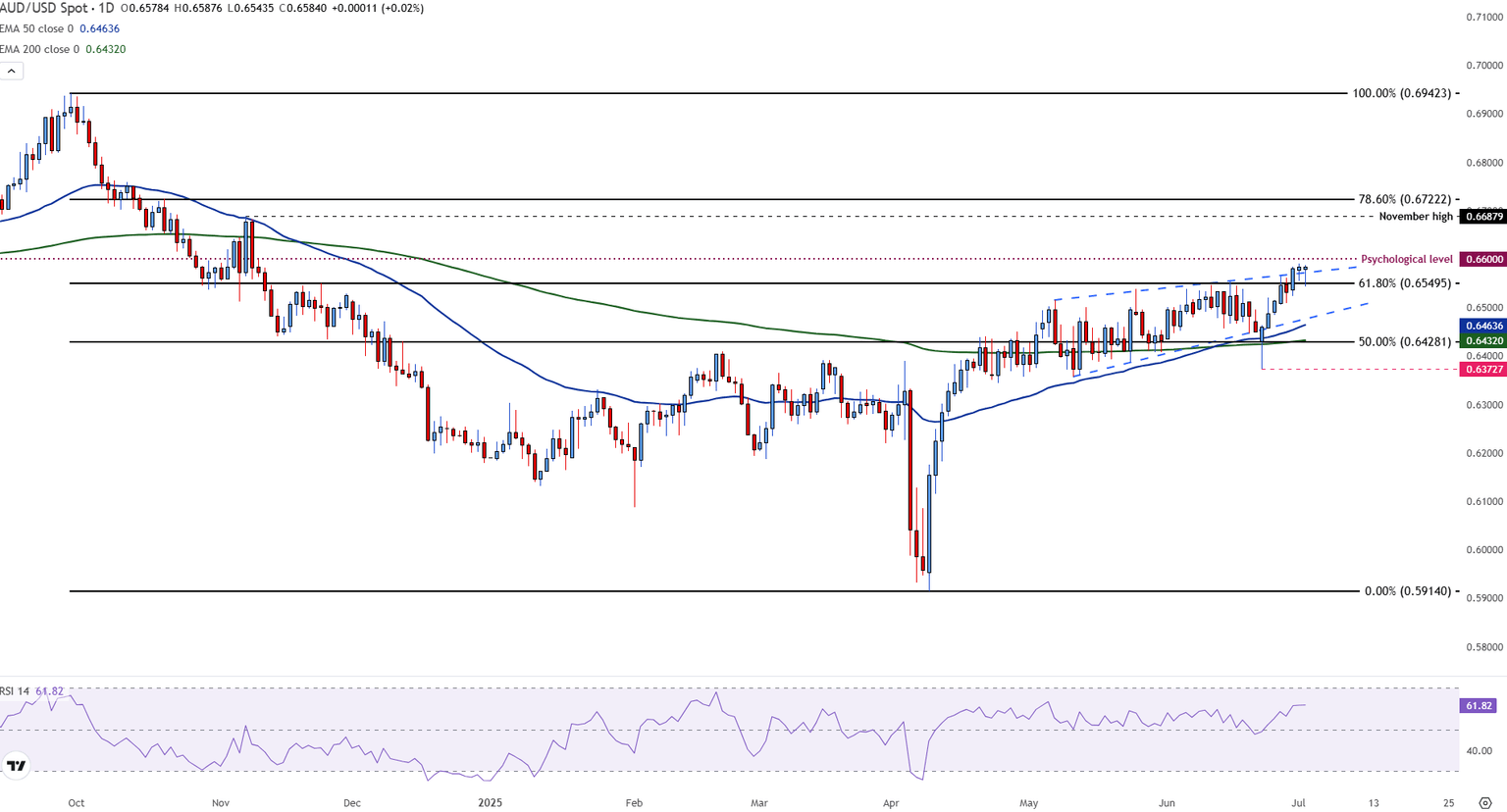
At the time of writing, the psychological level of 0.6600 is acting as immediate resistance. A sustained break above this threshold could open the path toward the November high at 0.6688, aligned with the 78.6% retracement at 0.6722.
On the downside, initial support lies near 0.6550, followed by the confluence zone around 0.6463–0.6428. A break below 0.6400 would invalidate the bullish structure and expose the pair to deeper losses.
The Relative Strength Index (RSI) is hovering near 62, suggesting room for further upside before overbought conditions emerge.
Australian Dollar FAQs
One of the most significant factors for the Australian Dollar (AUD) is the level of interest rates set by the Reserve Bank of Australia (RBA). Because Australia is a resource-rich country another key driver is the price of its biggest export, Iron Ore. The health of the Chinese economy, its largest trading partner, is a factor, as well as inflation in Australia, its growth rate and Trade Balance. Market sentiment – whether investors are taking on more risky assets (risk-on) or seeking safe-havens (risk-off) – is also a factor, with risk-on positive for AUD.
The Reserve Bank of Australia (RBA) influences the Australian Dollar (AUD) by setting the level of interest rates that Australian banks can lend to each other. This influences the level of interest rates in the economy as a whole. The main goal of the RBA is to maintain a stable inflation rate of 2-3% by adjusting interest rates up or down. Relatively high interest rates compared to other major central banks support the AUD, and the opposite for relatively low. The RBA can also use quantitative easing and tightening to influence credit conditions, with the former AUD-negative and the latter AUD-positive.
China is Australia’s largest trading partner so the health of the Chinese economy is a major influence on the value of the Australian Dollar (AUD). When the Chinese economy is doing well it purchases more raw materials, goods and services from Australia, lifting demand for the AUD, and pushing up its value. The opposite is the case when the Chinese economy is not growing as fast as expected. Positive or negative surprises in Chinese growth data, therefore, often have a direct impact on the Australian Dollar and its pairs.
Iron Ore is Australia’s largest export, accounting for $118 billion a year according to data from 2021, with China as its primary destination. The price of Iron Ore, therefore, can be a driver of the Australian Dollar. Generally, if the price of Iron Ore rises, AUD also goes up, as aggregate demand for the currency increases. The opposite is the case if the price of Iron Ore falls. Higher Iron Ore prices also tend to result in a greater likelihood of a positive Trade Balance for Australia, which is also positive of the AUD.
The Trade Balance, which is the difference between what a country earns from its exports versus what it pays for its imports, is another factor that can influence the value of the Australian Dollar. If Australia produces highly sought after exports, then its currency will gain in value purely from the surplus demand created from foreign buyers seeking to purchase its exports versus what it spends to purchase imports. Therefore, a positive net Trade Balance strengthens the AUD, with the opposite effect if the Trade Balance is negative.
Author
Tammy Da Costa, CFTe®
FXStreet
Tammy is an economist and market analyst with a deep passion for financial markets, particularly commodities and geopolitics.