AUD/USD slides to fresh two-month-lows around 0.7120s on market mood, firm US dollar
- Fears of China’s Covid-19 outbreak would trigger additional lockdowns spurred a dismal market mood.
- Russia retaliates against Poland and Bulgaria to halt gas exports by April 27th.
- The US Dollar Index (DXY) records for a second-consecutive day a new YTD high at 102.36.
- The Australian economic docket to unveil inflation figures.
- AUD/USD Price Forecast: Downward biased, and a test of the 0.7100 is on the cards.

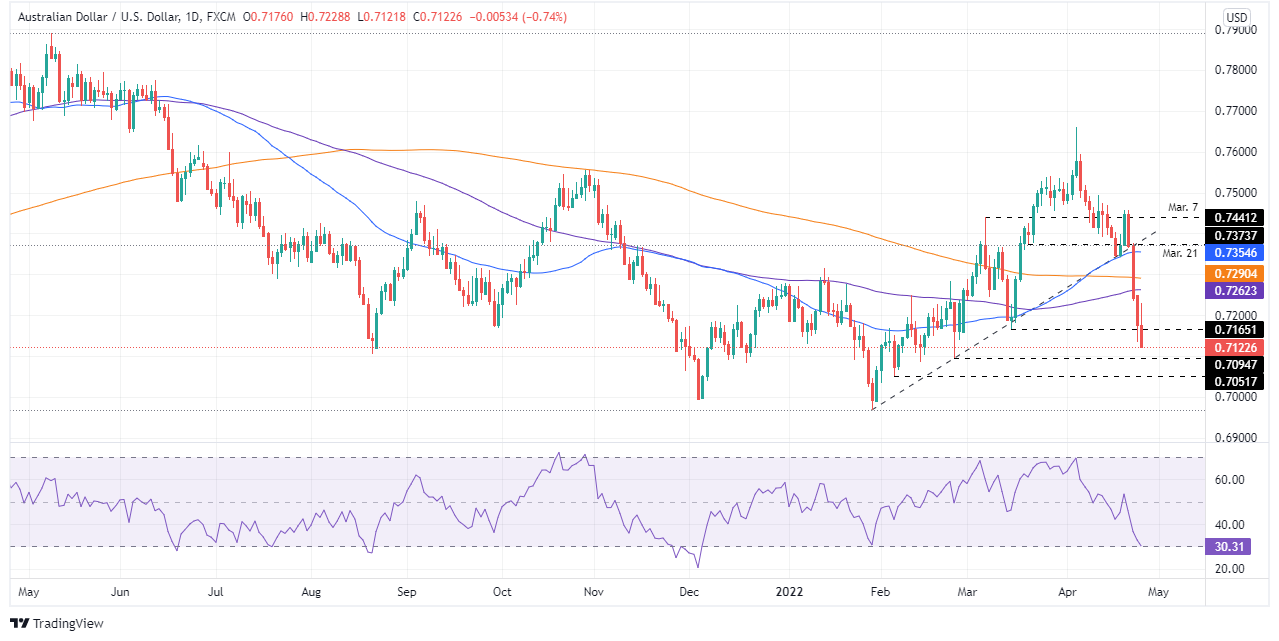
The AUD/USD falls for the fourth consecutive day and records a fresh two-month low around 0.7134, courtesy of a dismal market mood and a resilient US dollar, which extends its gains. At 0.7122, the AUD/USD is aiming toward the 0.7100 level now that March’s 15 cycle low at 0.7165 has been broken.
A dismal market mood boosts the safe-haven currencies
US equities remain trading with losses as the New York session is about to end, while the CBOT Volatility Index (VIX), also called the “fear index,” rose close to 19%, up at 32.09. The aforementioned is the reflection of a dampened market mood. The spread of the China Covid-19 outbreak from Shanghai to some districts of Beijing threatens to spur additional lockdowns, which consequently will disrupt the supply chain. Meanwhile, the Ukraine-Russia conflict escalated as Gazprom halted gas deliveries to Bulgaria, while Polish firm PGNIG said Russia would stop gas deliveries starting April 27th, according to Reuters.
In the FX space, the safe-haven peers benefitted from a pure market sentiment play. The US Dollar Index, a measurement of the greenback’s value against a basket of G8 currencies, recorded a new YTD peak at around 102.36. in the meantime, the US 10-year Treasury yield fell eight basis points and ended around 2.741%.
On Tuesday, the US economic docket featured the CB Consumer Confidence for April, which came at 107.3, lower than the 108 foreseen. Despite being a worse than expected report, Lynn Franco, Senior director of economic indicators at the Conference Board( CB), said that “the Present Situation Index declined, but remains quite high, suggesting the economy continued to expand in the early second quarter.” Furthermore, Franco added that “expectations, while still weak, did not deteriorate further amid high prices, especially at the gas pump, and the war in Ukraine. Vacation intentions cooled but intentions to buy big-ticket items like automobiles, and many appliances rose somewhat.”
Earlier, March’s Durable Good Orders rose by 0.8% m/m, lower than the 1%, but better than the 1.7% contraction of February.
The week ahead, the Australian economic docket will feature inflation figures on Wednesday. The Australian Inflation Rate is expected to jump 1.7% q/q, while on a yearly basis, it is anticipated an uptick from 3.5% to 4.6%. In the US docket on Thursday would be the release of the Q1 GDP and March’s Core PCE inflation on Friday.
AUD/USD Price Forecast: Technical outlook
The AUD/USD broke below March’s 15 daily low at 0.7165, so the pair’s bias is downwards. The AUD/USD first support would be February’s 24 cycle low at 0.7094. A breach of the latter would expose February’s 4 pivot low at 0.7051, followed by January’s 22 swing and YTD low at 0.6967.
Author

Christian Borjon Valencia
FXStreet
Markets analyst, news editor, and trading instructor with over 14 years of experience across FX, commodities, US equity indices, and global macro markets.