AUD/USD Price Forecast: Revisits monthly high around 0.6390
- AUD/USD advances to near 0.6390 despite the escalating trade war between the US and China.
- US President Trump announced a 90-day pause on reciprocal tariffs for all of his trading partners, except China.
- Trump’s tariff agenda has kept the US Dollar on the backfoot.

The AUD/USD pair extends its winnings streak for the fifth trading day on Tuesday and revisits the monthly high of 0.6380. The Aussie pair performs strongly in the last few trading days even though the intensifying trade war between the United States (US) and China has dampened the outlook of the Australian economy.
Historically, the Australian Dollar (AUD) underperforms when the economic outlook of China deteriorates, given the high dependence of the Australian economy on its exports to the Asian giant.
US President Donald Trump has declared a 90-day pause on the execution of reciprocal tariffs for all of his trading partners, except China. The world’s second largest nation retaliated against Trump’s reciprocal tariffs by imposing additional duties on goods imported from the US.
Meanwhile, the US Dollar (USD) struggles to hold its recent lows as financial market participants expect that Trump’s economic policies are painful for the US economy in the near term. Trump’s tariff policies are expected to boost inflationary pressures and slow down economic growth. The US Dollar Index (DXY), which tracks the Greenback’s value against six major currencies, trades cautiously slightly above the three-year low of 99.00.
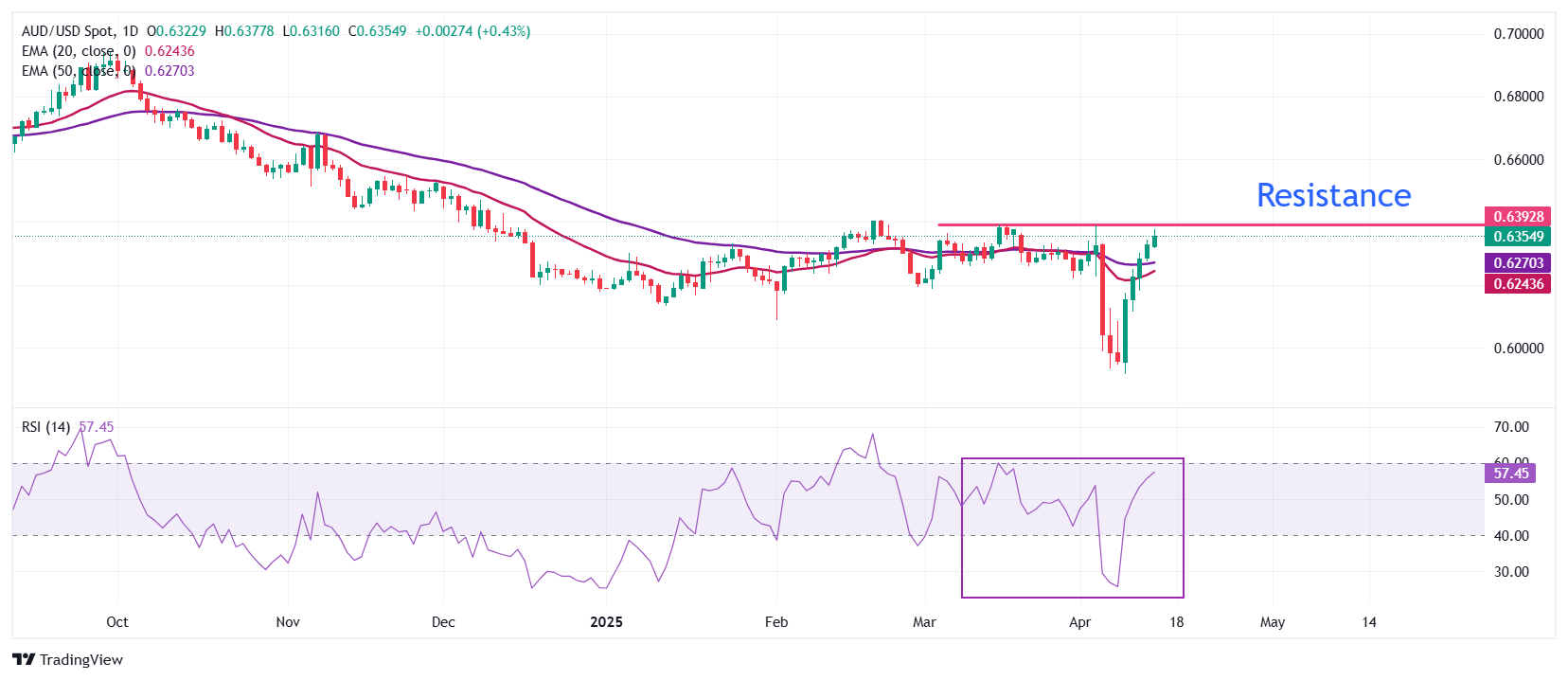
AUD/USD extends its upside to near the March 18 high of 0.6390, the highest level seen in over a month. The near-term outlook of the pair is upbeat as it holds the 20- and 50-day Exponential Moving Averages (EMAs), which trade around 0.6244 and 0.6270, respectively.
The 14-day Relative Strength Index (RSI) rises to near 58.00 after a V-shape recovery from below 40.00. Such a scenario indicates a strong bullish reversal.
More upside would appear if the pair breaks above the March 18 high of 0.6390. The scenario will open doors for the pair towards the December 5 high of 0.6456 and the round-level resistance of 0.6500.
On the flip side, a downside move below the March 4 low of 0.6187 will expose the pair towards the February low of 0.6087, followed by the psychological support of 0.6000.
AUD/USD daily chart
Australian Dollar FAQs
One of the most significant factors for the Australian Dollar (AUD) is the level of interest rates set by the Reserve Bank of Australia (RBA). Because Australia is a resource-rich country another key driver is the price of its biggest export, Iron Ore. The health of the Chinese economy, its largest trading partner, is a factor, as well as inflation in Australia, its growth rate and Trade Balance. Market sentiment – whether investors are taking on more risky assets (risk-on) or seeking safe-havens (risk-off) – is also a factor, with risk-on positive for AUD.
The Reserve Bank of Australia (RBA) influences the Australian Dollar (AUD) by setting the level of interest rates that Australian banks can lend to each other. This influences the level of interest rates in the economy as a whole. The main goal of the RBA is to maintain a stable inflation rate of 2-3% by adjusting interest rates up or down. Relatively high interest rates compared to other major central banks support the AUD, and the opposite for relatively low. The RBA can also use quantitative easing and tightening to influence credit conditions, with the former AUD-negative and the latter AUD-positive.
China is Australia’s largest trading partner so the health of the Chinese economy is a major influence on the value of the Australian Dollar (AUD). When the Chinese economy is doing well it purchases more raw materials, goods and services from Australia, lifting demand for the AUD, and pushing up its value. The opposite is the case when the Chinese economy is not growing as fast as expected. Positive or negative surprises in Chinese growth data, therefore, often have a direct impact on the Australian Dollar and its pairs.
Iron Ore is Australia’s largest export, accounting for $118 billion a year according to data from 2021, with China as its primary destination. The price of Iron Ore, therefore, can be a driver of the Australian Dollar. Generally, if the price of Iron Ore rises, AUD also goes up, as aggregate demand for the currency increases. The opposite is the case if the price of Iron Ore falls. Higher Iron Ore prices also tend to result in a greater likelihood of a positive Trade Balance for Australia, which is also positive of the AUD.
The Trade Balance, which is the difference between what a country earns from its exports versus what it pays for its imports, is another factor that can influence the value of the Australian Dollar. If Australia produces highly sought after exports, then its currency will gain in value purely from the surplus demand created from foreign buyers seeking to purchase its exports versus what it spends to purchase imports. Therefore, a positive net Trade Balance strengthens the AUD, with the opposite effect if the Trade Balance is negative.
BRANDED CONTENT
Choosing a broker that aligns with your trading needs can significantly impact performance. Our list of the best regulated brokers highlights the best options for seamless and cost-effective trading.
Author

Sagar Dua
FXStreet
Sagar Dua is associated with the financial markets from his college days. Along with pursuing post-graduation in Commerce in 2014, he started his markets training with chart analysis.