|

AUD/USD Price Analysis: Keeps rebound from 0.7200 immediate support

  • AUD/USD picks up bids to refresh intraday high, aims to reverse previous day’s pullback from monthly top.
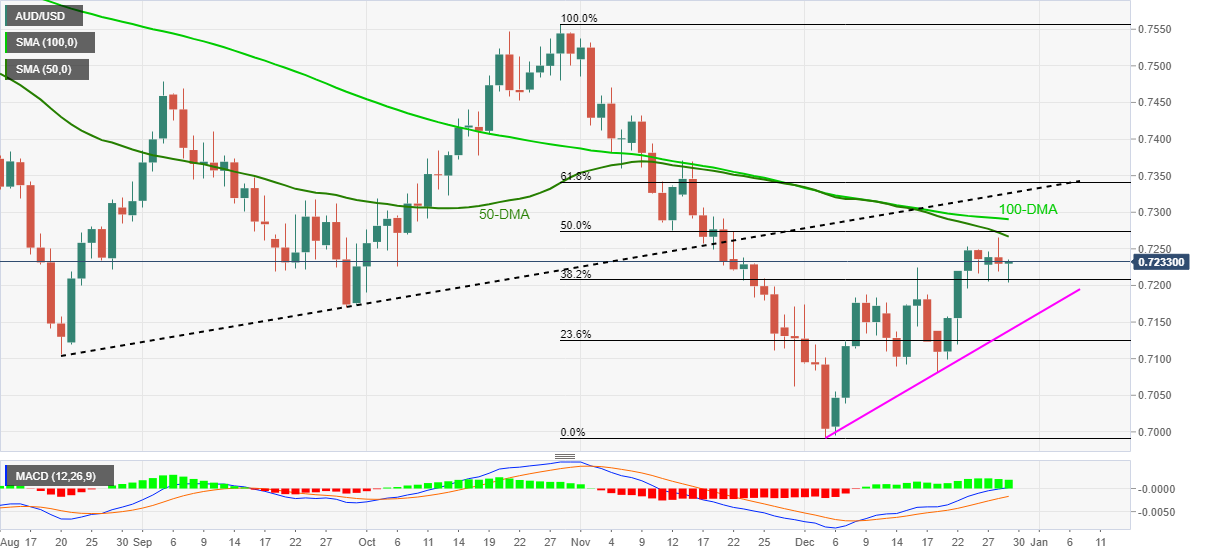
  • Bullish MACD, sustained bounce off 38.2% Fibonacci retracement level keep short-term buyers hopeful.
  • Key SMAs challenge further upside, three-week-old support line lures bears.

AUD/USD consolidates losses from a five-week top while refreshing intraday high around 0.7235 during early Wednesday morning in Asia.

In doing so, the Aussie pair keeps the bounce off 38.2% Fibonacci retracement (Fibo.) of October-December declines amid bullish MACD.

However, 50-DMA and 100-DMA, respectively near 0.7270 and 0.7290, challenge short-term advances of the pair ahead of flashing the 0.7300 threshold on the chart.

In a case where AUD/USD bulls keep reins past 0.7300, the previous support line from August, close to 0.7325, will be in focus.

Alternatively, a downside break of 0.7200 will have multiple supports around 0.7190 before directing the AUD/USD sellers towards September’s low of 0.7170.

Overall, AUD/USD bulls are in for a bumpy ride to the road during the final days of 2021.

AUD/USD; Daily chart
Trend: Limited upside potential

Additional important levels

Overview
Today last price0.7233
Today Daily Change0.0003
Today Daily Change %0.04%
Today daily open0.723
 
Trends
Daily SMA200.715
Daily SMA500.7272
Daily SMA1000.7292
Daily SMA2000.7451
 
Levels
Previous Daily High0.7265
Previous Daily Low0.7218
Previous Weekly High0.7253
Previous Weekly Low0.7081
Previous Monthly High0.7537
Previous Monthly Low0.7063
Daily Fibonacci 38.2%0.7236
Daily Fibonacci 61.8%0.7247
Daily Pivot Point S10.721
Daily Pivot Point S20.7191
Daily Pivot Point S30.7164
Daily Pivot Point R10.7257
Daily Pivot Point R20.7284
Daily Pivot Point R30.7303

Author

Anil Panchal

Anil Panchal

FXStreet

Anil Panchal has nearly 15 years of experience in tracking financial markets. With a keen interest in macroeconomics, Anil aptly tracks global news/updates and stays well-informed about the global financial moves and their implications.


More from Anil Panchal
Share:

Editor's Picks

AUD/USD remains depressed near 0.6950 after RBA minutes

AUD/USD attracts follow-through selling during Tuesday’s Asian session, looking to extend the overnight rejection slide from 0.7000, or a two-week top, following the release of RBA meeting Minutes. The US Dollar retains a bullish undertone near its highest level since April 2025 as energy-driven inflation risks keep December Fed rate hike bets firmly on the table. Adding to this, geopolitical risks further underpin the safe-haven USD.

USD/JPY extends retreat below 158.50 as intervention risks loom

USD/JPY is dropping below 158.50 in the Asian session on Tuesday, snapping a two-day winning streak and pulling back from an over two-week top touched the previous day, despite Japan's soft PPI inflation print. Bulls turn cautious amid speculation that authorities will step in to prop up the Japanese Yen, which, in turn, weighs on the pair.

Gold: Bears struggle to breach below $4,150

Gold now gives away its initial gains and resumes its decline, revisiting the $4,160 region per troy ounce on Tuesday. The precious metal’s pullback comes despite the fresh downward trend in the Greenback in combination with a mixed performance of US Treasury yields across the board and easing tensions on the geopolitical front.

Bitcoin rebounds despite cautious sentiment

Bitcoin rebounds over 2%, trading above $83,500 on Tuesday, recovering the previous day’s losses. Persistent geopolitical tensions and mixed signals continue to weigh on risk appetite, keeping investors cautious despite BTC’s recovery.

US – Midterm update: Democratic lead holds three weeks before election

With three weeks until the US midterm election on 3 November, prediction markets are more or less unchanged. Polymarket continues to put the probability of a Democratic sweep at 60-65%. The House is seen as a fairly safe Democratic win, with a probability of around 90%.

Has Bitcoin really escaped the macro forces it was built to fight?
Over 17 years ago, Satoshi Nakamoto designed Bitcoin (BTC) on the back of a global financial crisis as an alternative to the global monetary system outside the control of central banks, governments and traditional intermediaries. This raises a key question: has Bitcoin really become independent of the macroeconomic forces it was built to challenge?















