|

AUD/USD Price Analysis: Bears are targeting the 0.7280s

  • AUD/USD bears stay in control with eyes on the 0.7300 figure. 
  • A break below 0.7300 opens risk to the 0.7280s for the sessions ahead.

AUD/USD fell on Wednesday and extended losses in Thursday's Asian session following a surprisingly strong US Consumer Price Index report and a shockingly poor Aussie jobs event.  AUD/USD has fallen from 0.7393 to a low of 0.7315 since the start of yesterday's trade. 

The momentum indicators are pointing toward further declines ahead which leave the 0.7300 figure vulnerable. A break of the level could expose the start of October's territories to around 0.7280 for which is illustrated in the following daily chart analysis:

AUD/USD daily charts
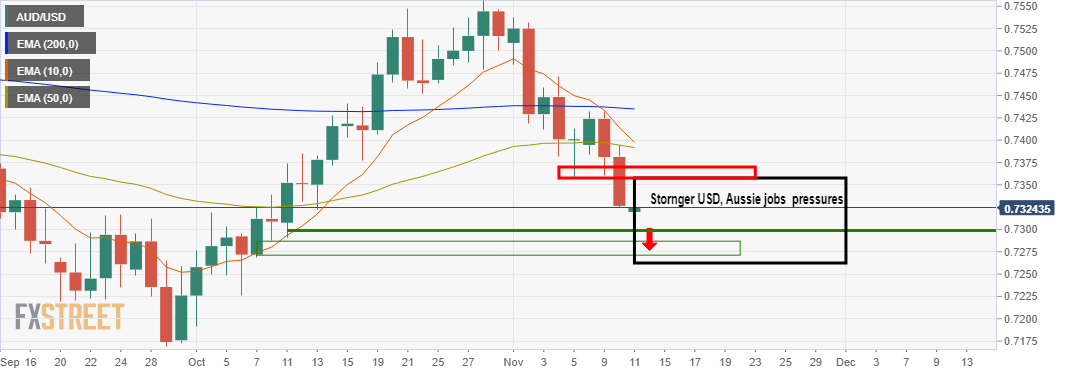
The price is now below the 50-EMA on the daily time frame as pressures mounted below the 200-EMA at the start of the month. However, there are also the probabilities of an upside correction first:

The imbalance left prices shooting lower as far as they have and beyond the daily ATR. An upward correction can be expected in due course. However, the momentum is with the bears at the moment. 

Author

Ross J Burland

Ross J Burland, born in England, UK, is a sportsman at heart. He played Rugby and Judo for his county, Kent and the South East of England Rugby team.


More from Ross J Burland
Share:

Editor's Picks

AUD/USD sits near monthly top, above 0.7000 as renewed USD buying caps gains

AUD/USD holds a positive bias for the fourth straight day, trading above 0.7000 in the Asian session on Wednesday and near the monthly high set the previous day after RBA Deputy Governor Andrew Hauser's hawkish remarks. Meanwhile, the US Dollar attracts some buyers as energy-driven inflation fears keep bets for at least one Fed rate hike in 2026 firmly on the table. Moreover, geopolitical uncertainty is acting as a tailwind for the safe-haven buck and caps gains for the Aussie.

USD/JPY eyes 158.50 amid modest USD strength; remains confined in a familiar range

USD/JPY attracts some dip-buyers during the Asian session on Wednesday, though it remains confined within a multi-week range as the uncertainty over the timing of the next BoJ rate hike keep Japanese Yen bulls on the defensive. Meanwhile, hawkish Fed expectations, bolstered by inflation risks stemming from volatile oil prices, underpin the US Dollar. However, looming intervention fears could limit JPY losses and cap the currency pair.

Gold struggles near weekly low, just above $4,100 amid USD uptick

Gold remains depressed for the fourth straight day, flirting with the weekly low during Wednesday’s Asian session, with bears awaiting a sustained break below $4,100 before placing fresh bets. Energy-driven inflation fears keep Fed hike bets firmly on the table, reviving US Dollar demand and undermining the non-yielding bullion. However, an unconfirmed report of US-Iran diplomacy could cap the safe-haven buck, which could offer some support to the precious metal.

Ethereum bounces off $2,400 for a sixth day despite ETF outflows
Ethereum (ETH) bounced again near the $2,400 level on Tuesday, the sixth straight day, as its on-chain cost basis and key moving averages have stood as key support levels. The sub-$2,400 level has proven to be a strong support for the top altcoin over the past week amid macro pressures. Buyers have repeatedly stepped in to defend prices whenever it falls below the level.
SpaceX's earnings don't matter. What they unlock does

The Elon Musk-founded SpaceX reports third-quarter results after Tuesday's session. The figure that decides the next month for the stock isn't in them. On Thursday, the second full trading day after the release, up to 1.3 billion shares held by employees and early investors become eligible for sale.

The US Dollar fell. Gold didn't rally. That tells you everything
Gold (XAU/USD) is struggling to capitalize on a weaker US Dollar (USD), after repeatedly failing to establish itself above the $4,200 level. The precious metal remains confined to a relatively narrow trading range despite a combination of developments that would normally support higher prices.