AUD/USD now under 0.7100 as broader risk asset sell-off deepens
- AUD/USD continued to decline in recent trade in tandem with the broader risk asset sell-off and is now under 0.7100.
- The pair broke below a key level of long-term support earlier in the session, exacerbating the selling pressure.


Since breaking below a key level of long-term uptrend support (in the 0.7180 area), AUD/USD has fallen sharply and, in recent trade, dipped below the 0.7100 level for the first time in more than one month. The pair, which currently trades in the 0.7090s, currently trades about 1.2% lower, with the Aussie one of the worst performing G10 currencies alongside NOK and SEK, though other risk-sensitive G10 currencies (GBP, CAD, NZD) are also fairing poorly.
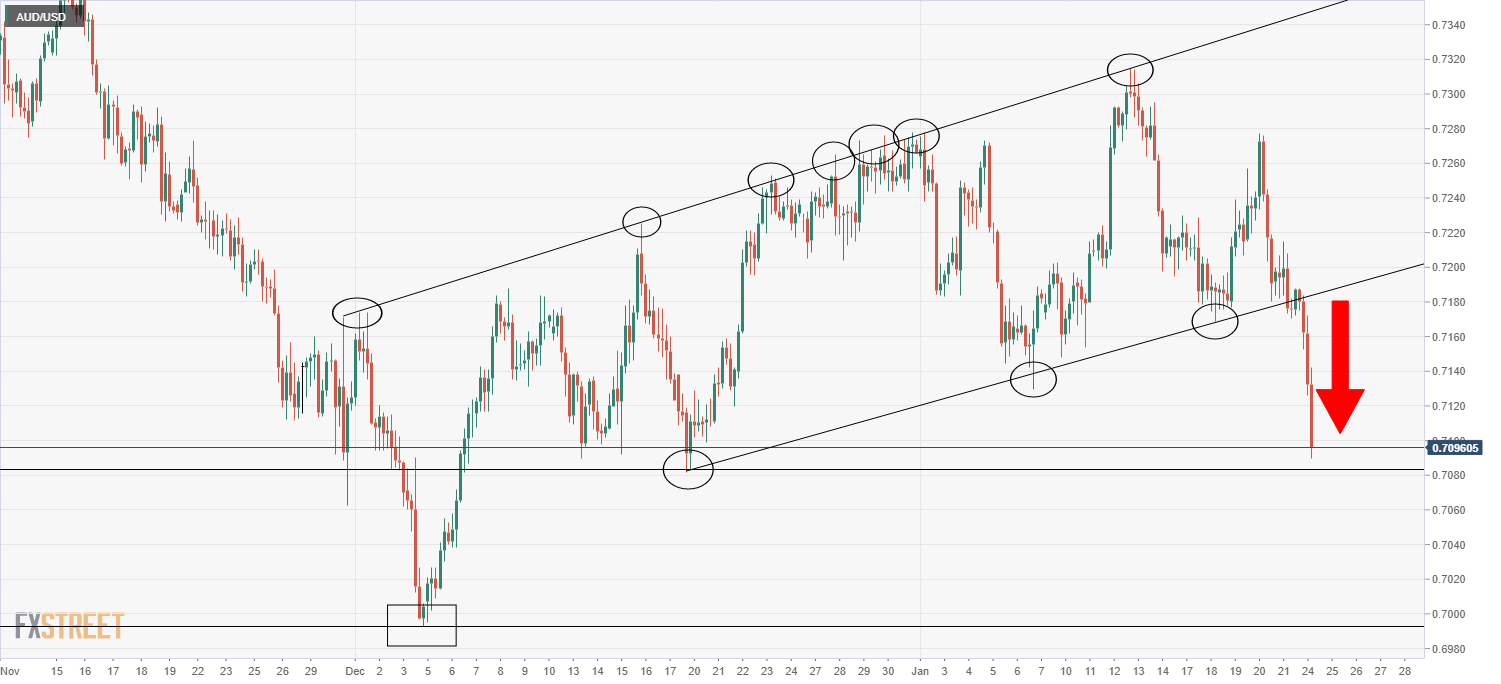
The risk-off mood to FX market trade is a function of broader risk aversion, with US and European equities experiencing a sharp downturn and most risk-sensitive commodities also being hit. The S&P 500 is nearly 2.5% lower on the day, the Stoxx 600 is nearly 4.0% down on the day, WTI is nearly $2.0 lower and spot copper prices are about 2.5% lower. Market commentators are citing a combination of concerns over NATO/Ukrainian tensions with Russia and the rising risk of a war in Eastern Europe, as well as concerns about Fed tightening. A note from Goldman Sachs on Monday that got a lot of attention speculated the bank might hike interest rates at all of its remaining meetings in 2022.
Focus will switch back to domestic Australian themes during Tuesday’s Asia Pacific session when the all-important Q4 2021 Consumer Price Inflation report is released. Some think the data could bolster expectations for a hawkish RBA policy turn at upcoming meetings. According to Reuters, the median economist forecast is for the headline CPI rate to rise to 3.2% and for the core rate to rise to 2.4%, which would be the highest since 2014. Analysts at two Australian banks said they see the RBA’s preferred “trimmed mean” measure of inflation hitting 2.5%, putting back at the centre of the central bank’s 2-3% target inflation range two years ahead of current forecasts.
Analysts at one of the banks said that this will result in the RBA revising higher their CPI forecasts, with the new forecasts to show trimmed mean inflation remaining at the midpoint of the inflation target for the duration of the forecast horizon. “Come the RBA's February meeting, QE is clearly gone,” analysts at the bank said, adding that as “for the rates view, much depends on its (the RBA’s) willingness to tolerate inflation at or above target as it waits until wages growth is closer to 3% plus”.
Author
Joel Frank
Independent Analyst
Joel Frank is an economics graduate from the University of Birmingham and has worked as a full-time financial market analyst since 2018, specialising in the coverage of how developments in the global economy impact financial asset