|

AUD/USD hovers around 200-DMA post US GDP data, ahead of US PCE

  • AUD/USD marginally dips amid contrasting US reports and steady Australian data.
  • US shows mixed economic signs: Strong GDP growth, stagnant Durable Goods Orders, rising unemployment claims.
  • Investors weigh Fed rate cut odds against US economic trends, focusing on core PCE Index, Pending Home Sales.

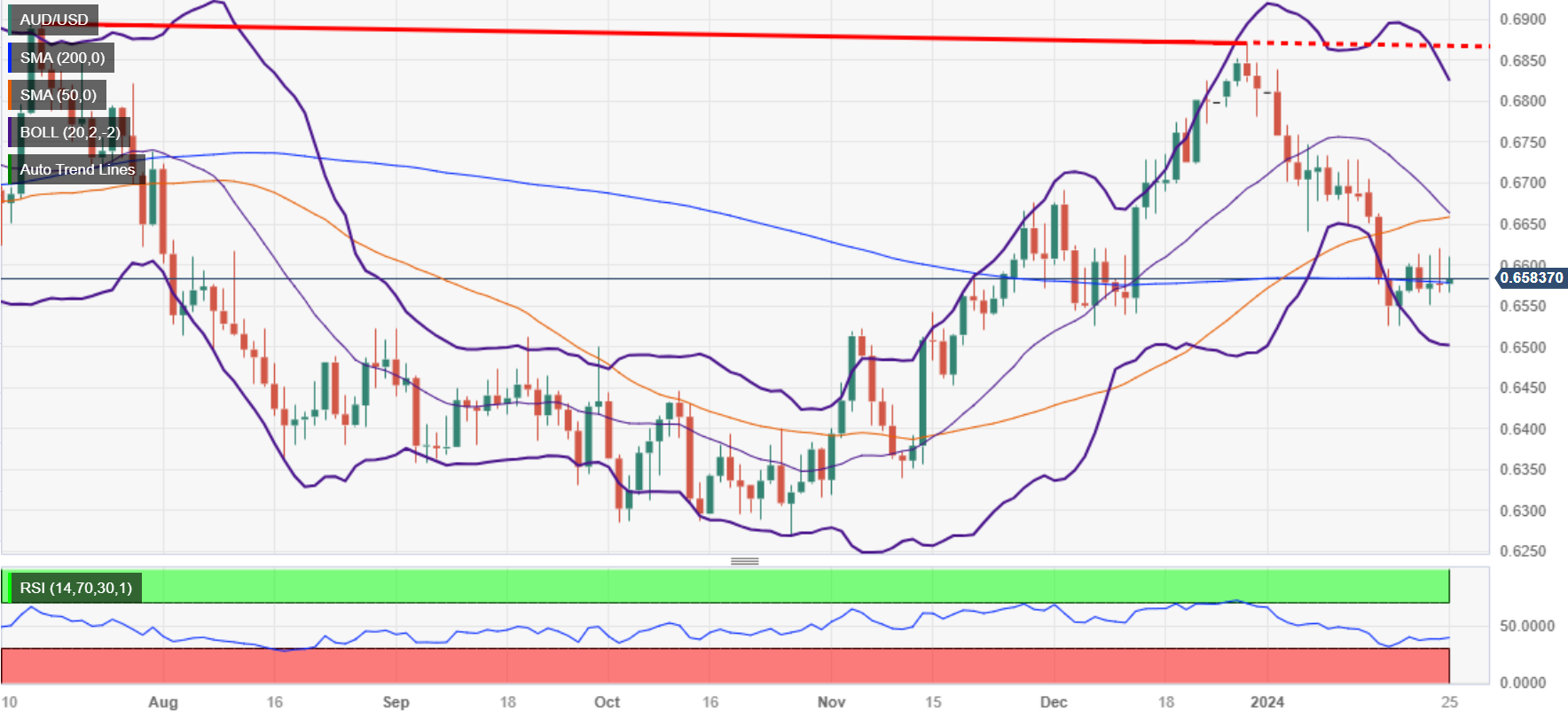
The AUD/USD is virtually unchanged during the North American session, although the US economy grew at a faster pace than expected. Nevertheless, other data suggest the labor market is cooling while demand for durable goods is taking its toll. Therefore, the pair exchanges hands at 0.6574, down 0.05%, just below the 200-day moving average (DMA).

Aussie Dollar at the brisk of sliding below key support, traders eye US PCE

The US economy last quarter of 2023 grew by 3.3% QoQ, below Q3’s 4.9% and exceeded forecasts of 2%, revealed the US Bureau of Economic Analysis (BEA). At the same time, the US Department of Commerce revealed that Durable Goods Orders came flat at 0%, down from 5.5% increase in November, overshadowing a goodish US GDP report. Meanwhile, labor market data revealed by the US Bureau of Labor Statistics announced that unemployment claims for the week ending January 20, jumped from 189K to 214K, above estimates of 200K.

Given the backdrop, the Greenback (USD) gained some traction lately. Following the data slipped towards Thursday’s daily low of 103.12 via the US Dollar Index (DXY), though it climbed to current levels at 103.58, up 0.32%.

Despite that, investors are still expecting the Federal Reserve will cut rates by more than 140 basis points to 4.04% by the end of the year. Nevertheless, for the Fed’s March meeting, traders trimmed the odds from 53.6% a week ago to 46.2%.

The lack of economic data to be released in the Aussie calendar lets traders adrift to the dynamics surrounding the buck. On the US front, the docket will feature the  Fed’s preferred gauge for inflation, the core Personal Consumption Expenditures (PCE) Price Index, along with Pending Home Sales for December.

AUD/USD Price Analysis: Technical outlook

The AUD/USD pair is directionless, at around the 200-DMA, waiting for a solid catalyst that could either resume the downtrend or trigger a rally. On the bearish side, the first support is the January 18 low of 0.6525, followed by the 0.6500 figure. A further downside is seen at the November 10 low of 0.6338. Conversely, if buyers lift prices above 0.6600, that could exacerbate an advance to the 50-day moving average (DMA) at 0.6650, followed by 0.6700.
AUD/USD

Overview
Today last price0.6577
Today Daily Change0.0000
Today Daily Change %0.00
Today daily open0.6577
 
Trends
Daily SMA200.6676
Daily SMA500.6656
Daily SMA1000.6524
Daily SMA2000.6579
 
Levels
Previous Daily High0.6621
Previous Daily Low0.6566
Previous Weekly High0.6705
Previous Weekly Low0.6525
Previous Monthly High0.6871
Previous Monthly Low0.6526
Daily Fibonacci 38.2%0.6587
Daily Fibonacci 61.8%0.66
Daily Pivot Point S10.6555
Daily Pivot Point S20.6533
Daily Pivot Point S30.65
Daily Pivot Point R10.661
Daily Pivot Point R20.6643
Daily Pivot Point R30.6665

Author

Christian Borjon Valencia

Markets analyst, news editor, and trading instructor with over 14 years of experience across FX, commodities, US equity indices, and global macro markets.


More from Christian Borjon Valencia
Share:

Editor's Picks

AUD/USD remains confined in a range above 0.7100

AUD/USD extends its consolidative price move above 0.7100 through the Asian session on Tuesday, shrugging off hawkish comments from RBA Assistant Governor Sarah Hunter as traders keenly await the crucial Trump-Xi summit later this week. Meanwhile, escalating tensions in the Middle East and the Fed's hawkish outlook remain supportive of the bullish US Dollar undertone, capping spot prices.

USD/JPY bulls seem cautious below 157.50 as JPY intervention risks loom

USD/JPY consolidates below mid-157.00s during the Asian session on Tuesday as intervention fears help limit losses for the Japanese Yen. However, the BoJ's dovish rate hike to a 31-year high keeps JPY bulls on the back foot. At the same time, the US Dollar retains its bullish undertone amid the Fed's hawkish outlook and escalating Middle East tensions, acting as a tailwind for the pair.

Gold benefits from falling US bond yields; remains below $4,400 amid bullish USD

Gold regains positive traction during the Asian session on Tuesday, though it lacks bullish conviction and remains below $4,400. Falling oil prices ease inflation fears, dragging US bond yields lower and supporting the non-yielding yellow metal. Meanwhile, the Fed's hawkish stance, along with escalating Middle East tensions, keeps the US Dollar near its highest level since late July and acts as a headwind for the bullion.

Ethereum rallies above $2,700 as investors shrug off bearish sentiment
Ethereum (ETH) climbed above $2,700 on Monday after investors defended the realized price level despite negative sentiment over the Clarity Act's failure and the Federal Reserve rate hike. After the Clarity Act failed to advance in the Senate, ETH dipped below $2,400 last week. But right below that price is the top altcoin's realized price, or average on-chain cost basis, at $2,310.
The week ahead: Fuel prices in focus as we lead up to key eco releases

Financial markets are in a strange position as we move to the final weeks of Q3, uncertainty and volatility continue to grip markets, but the oil price is falling; and European and US stocks are poised to open higher later on Monday. Market stresses are concentrated in sovereign bonds, and European and US yields had another scare late on Friday, and moved higher.

BoJ Recap: Not as hawkish as expected

The Bank of Japan (BoJ) raised its short-term interest-rate target to 1.25% from 1.00% in a 7-2 vote, marking another step in the normalisation of monetary policy and widely matching what everyone has been expecting for weeks.