AUD/USD holds steady near key technical levels
- AUD/USD found slim gains on Tuesday, keeping the pair bolstered near key levels.
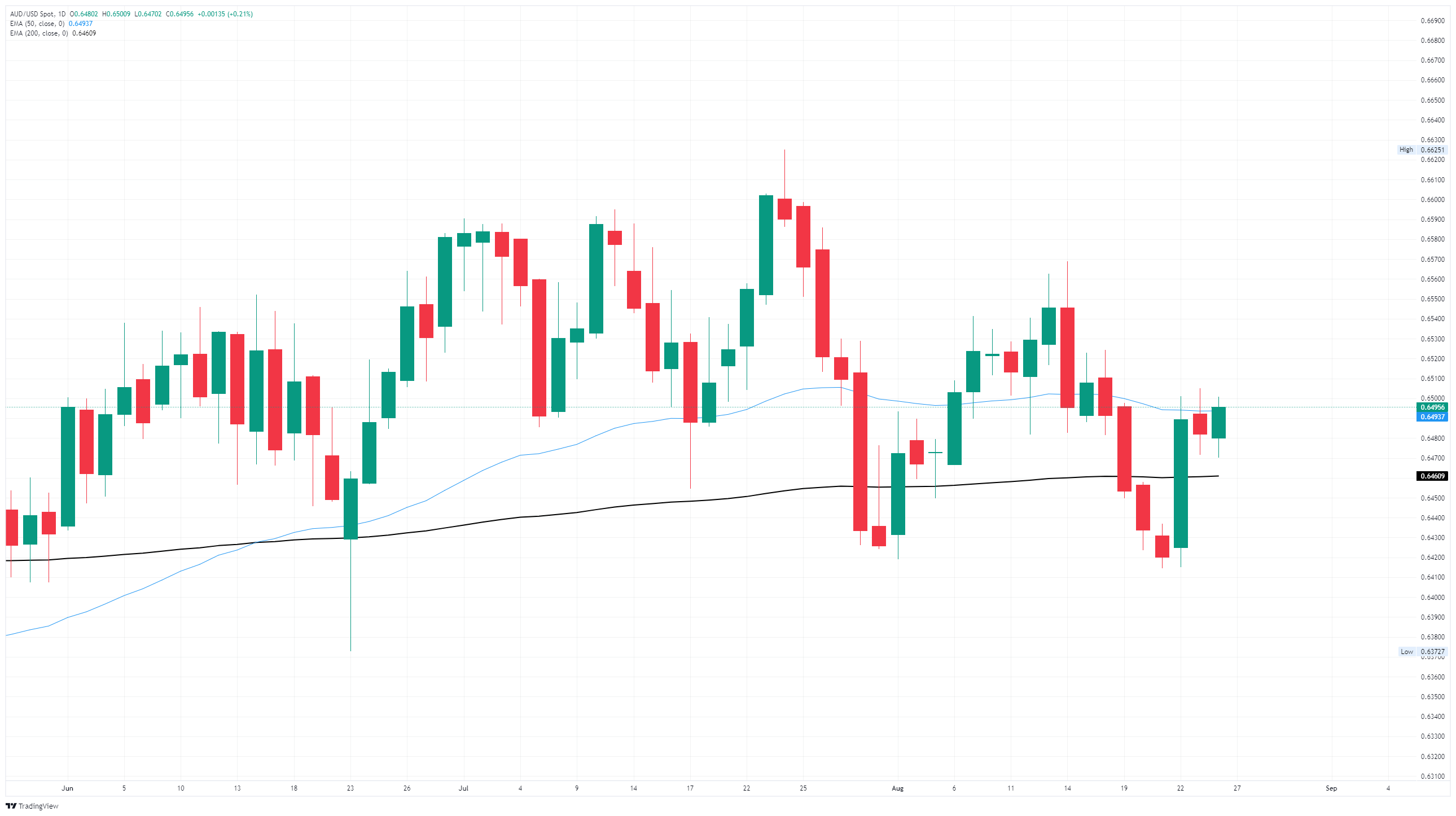
- The Aussie-Dollar pair remains trapped just above the 200-day EMA, but below 0.6500.
- The latest Australian monthly CPI inflation print is due early Wednesday.

AUD/USD is holding steady between familiar technical levels after catching a thin bid on Tuesday. US economic releases will take a breather on Wednesday, giving Aussie traders a chance to catch their breath, at least after the next round of Australian Consumer Price Index (CPI) inflation data.
The latest US Personal Consumption Expenditures Price Index (PCE) inflation figures loom large later this week, pushing investor sentiment into the middle ahead of the key data print. Before then, US data remains fairly limited, and data reactions will likely stay constrained.
Coming up: Australian CPI inflation
Australia's monthly CPI inflation print for July will land early on Wednesday. Australian inflation is expected to rise, forecast to climb to 2.3% compared to the previous 1.9%. After the RBA's latest Meeting Minutes released early Tuesday, Wednesday's CPI print will wrap up the Aussie's significant representation on this week's data docket.
AUD/USD price forecast
In the hourly window, AUD/USD found a solid base near 0.6415, forming a footing from which it staged a bounce. It cracked through a descending trendline and pushed past 0.6440, even settling beyond the 50-hour simple moving average. That rally brought the pair up toward the 0.6490 zone, where 50% Fibonacci retracement resistance now looms, as traders assess whether bulls can drive it to the next stops at 0.6520 and higher toward 0.6540. But the downside risk remains in play: a failure above 0.6490 could reassert pressure, with support curling around 0.6470 and 0.6440, and deeper vulnerability targeting the low-0.6400s.
On the daily chart, the outlook is more zoned in. AUD/USD continues to oscillate within a 0.6400–0.6600 range, with neither fresh bulls nor bears grabbing the wheel. The pair is hovering near the lower-to-mid-range, buoyed partly by a softer U.S. dollar and improving risk appetite. Yet it still needs a strong catalyst to break free, whether through a big swing in Chinese data, a dovish U.S. Fed signal, or a surprise move from the RBA.
AUD/USD daily chart
Australian Dollar FAQs
One of the most significant factors for the Australian Dollar (AUD) is the level of interest rates set by the Reserve Bank of Australia (RBA). Because Australia is a resource-rich country another key driver is the price of its biggest export, Iron Ore. The health of the Chinese economy, its largest trading partner, is a factor, as well as inflation in Australia, its growth rate and Trade Balance. Market sentiment – whether investors are taking on more risky assets (risk-on) or seeking safe-havens (risk-off) – is also a factor, with risk-on positive for AUD.
The Reserve Bank of Australia (RBA) influences the Australian Dollar (AUD) by setting the level of interest rates that Australian banks can lend to each other. This influences the level of interest rates in the economy as a whole. The main goal of the RBA is to maintain a stable inflation rate of 2-3% by adjusting interest rates up or down. Relatively high interest rates compared to other major central banks support the AUD, and the opposite for relatively low. The RBA can also use quantitative easing and tightening to influence credit conditions, with the former AUD-negative and the latter AUD-positive.
China is Australia’s largest trading partner so the health of the Chinese economy is a major influence on the value of the Australian Dollar (AUD). When the Chinese economy is doing well it purchases more raw materials, goods and services from Australia, lifting demand for the AUD, and pushing up its value. The opposite is the case when the Chinese economy is not growing as fast as expected. Positive or negative surprises in Chinese growth data, therefore, often have a direct impact on the Australian Dollar and its pairs.
Iron Ore is Australia’s largest export, accounting for $118 billion a year according to data from 2021, with China as its primary destination. The price of Iron Ore, therefore, can be a driver of the Australian Dollar. Generally, if the price of Iron Ore rises, AUD also goes up, as aggregate demand for the currency increases. The opposite is the case if the price of Iron Ore falls. Higher Iron Ore prices also tend to result in a greater likelihood of a positive Trade Balance for Australia, which is also positive of the AUD.
The Trade Balance, which is the difference between what a country earns from its exports versus what it pays for its imports, is another factor that can influence the value of the Australian Dollar. If Australia produces highly sought after exports, then its currency will gain in value purely from the surplus demand created from foreign buyers seeking to purchase its exports versus what it spends to purchase imports. Therefore, a positive net Trade Balance strengthens the AUD, with the opposite effect if the Trade Balance is negative.
Author

Joshua Gibson
FXStreet
Joshua joins the FXStreet team as an Economics and Finance double major from Vancouver Island University with twelve years' experience as an independent trader focusing on technical analysis.