AUD/USD eases slightly, but remains firmly in bull country
- AUD/USD backslid around 0.5% on Thursday.
- Despite an intraday cool-off, the Aussie remains comfortably bullish, trading near multi-year highs.

The Australian Dollar rallied to a fresh three-and-a-half-year high above 0.7140 this week after the Reserve Bank of Australia (RBA) reinforced its hawkish stance. Governor Michele Bullock warned the board remains prepared to raise rates further if inflation proves persistent, describing any inflation "with a three in front of it" as unacceptable. Deputy Governor Hauser echoed this stance a day earlier, noting inflation remains too high and continues to pose a challenge for the rate-setting board. The RBA hiked its cash rate by 25 basis points to 3.85% earlier this month, and markets now price a 74% chance of another increase in May, with 38 basis points of additional tightening expected through year-end. Consumer inflation expectations jumped to 5% in February, the highest since mid-2025, adding to the hawkish narrative. However, a weaker Chinese Consumer Price Index (CPI) and persistent producer price deflation signaled softer demand for Australian exports, capping gains.
On the US Dollar side, January Non-Farm Payrolls (NFP) came in at 130K (above the 70K consensus) while unemployment fell to 4.3%, tempering expectations for near-term Federal Reserve (Fed) rate cuts. Looking ahead, Friday's delayed US CPI release for January will be the key driver, with economists forecasting headline CPI at 0.29% month-on-month and core CPI at 0.39% month-on-month. A softer print could widen the Fed-RBA policy divergence further in favor of the Australian Dollar.
Technicals punch in a potential hard ceiling near 0.7150
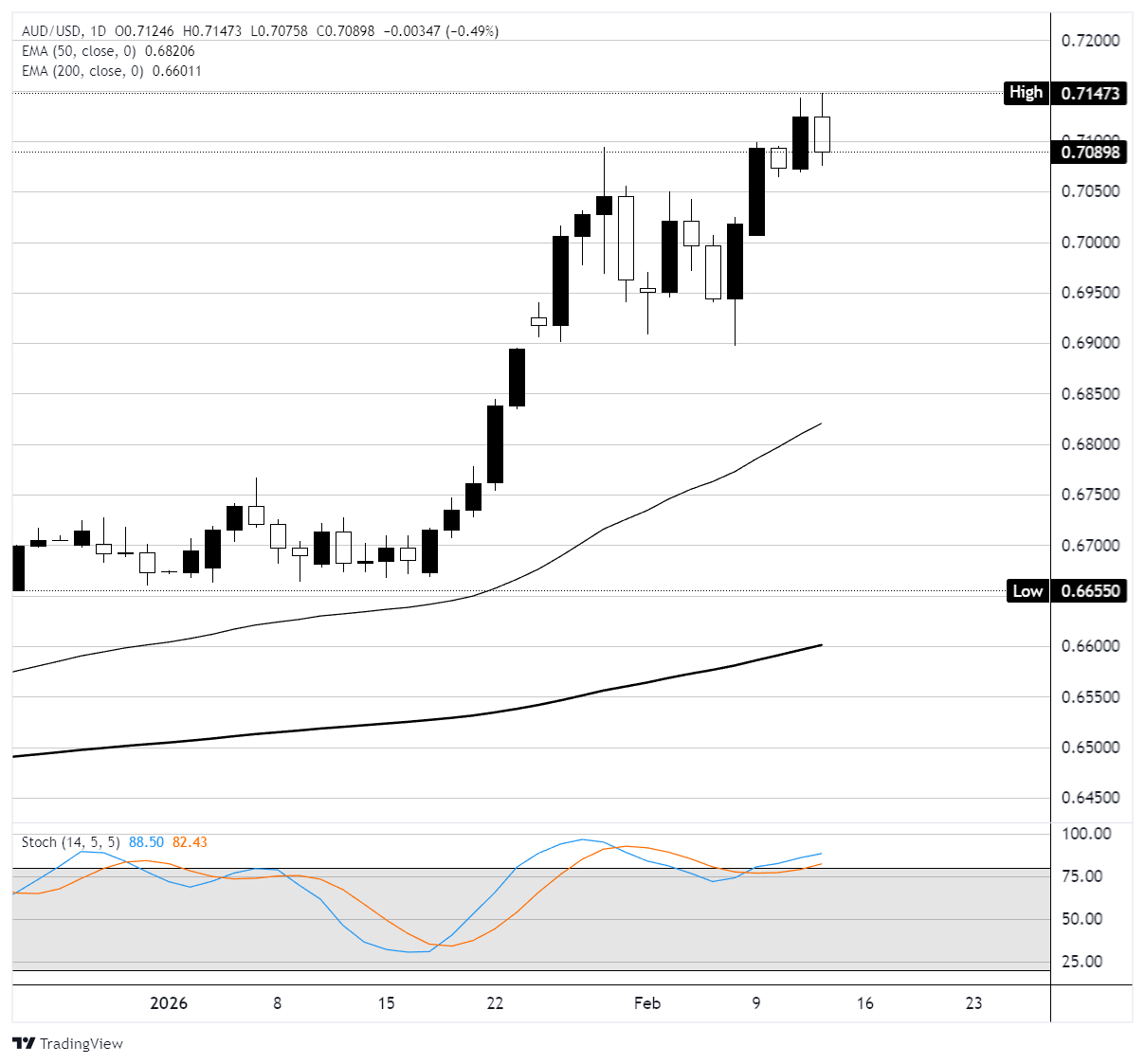
On the daily chart, AUD/USD is holding near 0.7118 after printing a session high of 0.7148, its highest level since February 2023. The pair has rallied for six consecutive weeks and trades well above the 50-week and 100-week Exponential Moving Averages (EMA), confirming a strong bullish trend. The Average Directional Index (ADX) has risen to 23 on the weekly timeframe, its highest reading in weeks, signaling trend strength is building. The Relative Strength Index (RSI) is continuing to climb, though approaching overbought territory on the daily chart.
On the 4H timeframe, the pair pulled back from the 0.7148 high to test support near the former resistance zone at 0.7100, which now acts as a near-term pivot. The September 2024 swing high at 0.6932 has been decisively broken and serves as a key support level on any deeper retracement. Immediate resistance sits at the 0.7148 session high, with a break above targeting the psychological 0.7200 handle and the 0.7250 zone. A failure to hold 0.7100 could see a pullback toward the 0.7050 to 0.7000 demand zone, where buyers are likely to re-emerge given the broader bullish structure.
AUD/USD daily chart
Australian Dollar FAQs
One of the most significant factors for the Australian Dollar (AUD) is the level of interest rates set by the Reserve Bank of Australia (RBA). Because Australia is a resource-rich country another key driver is the price of its biggest export, Iron Ore. The health of the Chinese economy, its largest trading partner, is a factor, as well as inflation in Australia, its growth rate and Trade Balance. Market sentiment – whether investors are taking on more risky assets (risk-on) or seeking safe-havens (risk-off) – is also a factor, with risk-on positive for AUD.
The Reserve Bank of Australia (RBA) influences the Australian Dollar (AUD) by setting the level of interest rates that Australian banks can lend to each other. This influences the level of interest rates in the economy as a whole. The main goal of the RBA is to maintain a stable inflation rate of 2-3% by adjusting interest rates up or down. Relatively high interest rates compared to other major central banks support the AUD, and the opposite for relatively low. The RBA can also use quantitative easing and tightening to influence credit conditions, with the former AUD-negative and the latter AUD-positive.
China is Australia’s largest trading partner so the health of the Chinese economy is a major influence on the value of the Australian Dollar (AUD). When the Chinese economy is doing well it purchases more raw materials, goods and services from Australia, lifting demand for the AUD, and pushing up its value. The opposite is the case when the Chinese economy is not growing as fast as expected. Positive or negative surprises in Chinese growth data, therefore, often have a direct impact on the Australian Dollar and its pairs.
Iron Ore is Australia’s largest export, accounting for $118 billion a year according to data from 2021, with China as its primary destination. The price of Iron Ore, therefore, can be a driver of the Australian Dollar. Generally, if the price of Iron Ore rises, AUD also goes up, as aggregate demand for the currency increases. The opposite is the case if the price of Iron Ore falls. Higher Iron Ore prices also tend to result in a greater likelihood of a positive Trade Balance for Australia, which is also positive of the AUD.
The Trade Balance, which is the difference between what a country earns from its exports versus what it pays for its imports, is another factor that can influence the value of the Australian Dollar. If Australia produces highly sought after exports, then its currency will gain in value purely from the surplus demand created from foreign buyers seeking to purchase its exports versus what it spends to purchase imports. Therefore, a positive net Trade Balance strengthens the AUD, with the opposite effect if the Trade Balance is negative.
Author

Joshua Gibson
FXStreet
Joshua joins the FXStreet team as an Economics and Finance double major from Vancouver Island University with twelve years' experience as an independent trader focusing on technical analysis.
















