AUD/USD dips beneath 0.6700 on risk aversion
- AUD/USD falls more than 1.30% in the week on risk-off mood.
- China’s weaker-than-expected growth figures in Q2 and Iron ore prices are a headwind for the Aussie.
- Strong Aussie jobs data could lead to RBA rate hike; US job indicators show weakness.

The Aussie Dollar edged lower during the North American session, extending its losses by more than 0.20% against the US Dollar. The AUD/USD pair is set to finish the week with more than 1.30% losses and trades at 0.6693.
Aussie Dollar affected by Iron ore prices, China’s soft data
Risk aversion is the game's name on Friday, with most high-beta currencies feeling the pain of traders looking for safety. China’s second-quarter growth data disappointed investors, a headwind for the Australian Dollar due to its closest ties with the second-largest economy in the world.
In the meantime, commodity prices are affecting antipodeans, including the Kiwi. Iron ore prices are plunging 1.70%, extending their losses for the last two weeks to more than 3.70%.
Aside from this, the Greenback continued to recover after dipping to lows last seen on March 21 around the 103.60 area. The US Dollar Index (DXY) posted gains of 0.11% at the time of writing, up at 104.29 as it tests the crucial 200-day moving average (DMA). A further upside is seen if that level is cleared.
Macroeconomically, the latest Aussie jobs data was solid, and it could prompt the Reserve Bank of Australia (RBA) to raise rates in August. On the US front, jobs data continues to show signs of “weakness,” though Federal Reserve policymakers had refrained from hinting at a timetable of possible rate cuts, adding they need more confidence before easing policy.
Ahead on the day, traders will eye speeches of New York Fed President John Williams, and Atlanta’s Raphael Bostic.
AUD/USD Price Analysis: Technical outlook
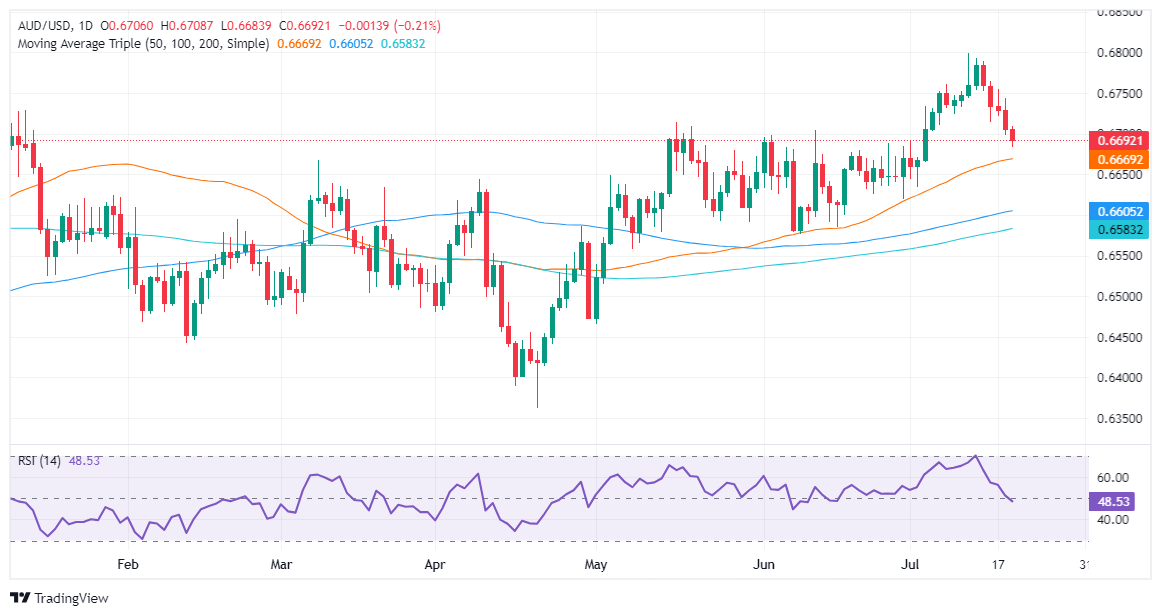
After falling beneath the 0.6700 figure, the AUD/USD is set to challenge the 50-DMA at 0.6668 on further weakness, as negative momentum piled. Sellers are in charge, according to the Relative Strength Index (RSI), which has fallen below the 50-neutral line, opening the door for further downside.
Once traders drag prices below 0.6668, the next support levels to eye would be June 28’s low of 0.6619 and the 100-DMA at 0.6604. Key resistance lies at 0.6700, followed by the July 18 peak at 0.6743.
Australian Dollar FAQs
One of the most significant factors for the Australian Dollar (AUD) is the level of interest rates set by the Reserve Bank of Australia (RBA). Because Australia is a resource-rich country another key driver is the price of its biggest export, Iron Ore. The health of the Chinese economy, its largest trading partner, is a factor, as well as inflation in Australia, its growth rate and Trade Balance. Market sentiment – whether investors are taking on more risky assets (risk-on) or seeking safe-havens (risk-off) – is also a factor, with risk-on positive for AUD.
The Reserve Bank of Australia (RBA) influences the Australian Dollar (AUD) by setting the level of interest rates that Australian banks can lend to each other. This influences the level of interest rates in the economy as a whole. The main goal of the RBA is to maintain a stable inflation rate of 2-3% by adjusting interest rates up or down. Relatively high interest rates compared to other major central banks support the AUD, and the opposite for relatively low. The RBA can also use quantitative easing and tightening to influence credit conditions, with the former AUD-negative and the latter AUD-positive.
China is Australia’s largest trading partner so the health of the Chinese economy is a major influence on the value of the Australian Dollar (AUD). When the Chinese economy is doing well it purchases more raw materials, goods and services from Australia, lifting demand for the AUD, and pushing up its value. The opposite is the case when the Chinese economy is not growing as fast as expected. Positive or negative surprises in Chinese growth data, therefore, often have a direct impact on the Australian Dollar and its pairs.
Iron Ore is Australia’s largest export, accounting for $118 billion a year according to data from 2021, with China as its primary destination. The price of Iron Ore, therefore, can be a driver of the Australian Dollar. Generally, if the price of Iron Ore rises, AUD also goes up, as aggregate demand for the currency increases. The opposite is the case if the price of Iron Ore falls. Higher Iron Ore prices also tend to result in a greater likelihood of a positive Trade Balance for Australia, which is also positive of the AUD.
The Trade Balance, which is the difference between what a country earns from its exports versus what it pays for its imports, is another factor that can influence the value of the Australian Dollar. If Australia produces highly sought after exports, then its currency will gain in value purely from the surplus demand created from foreign buyers seeking to purchase its exports versus what it spends to purchase imports. Therefore, a positive net Trade Balance strengthens the AUD, with the opposite effect if the Trade Balance is negative.
Author
Christian Borjon Valencia
FXStreet
Markets analyst, news editor, and trading instructor with over 14 years of experience across FX, commodities, US equity indices, and global macro markets.