AUD/USD climbs on improved risk appetite and dampening demand for US Dollar
- AUD/USD rises as US-Japan trade deal lends support to risk-sensitive currencies.
- Monetary policy divergence and rate expectations for the RBA and the Fed bring PMI data into focus.
- AUD/USD bulls test key resistance at 0.6600 as price holds within the bounds of an ascending channel.

The Australian Dollar (AUD) is extending its gains against the US Dollar (USD) on Wednesday, supported by renewed global risk appetite and tailwinds from the newly announced US-Japan trade agreement.
At the time of writing, the AUD/USD is trading at an eight-month high near 0.6600 as investors respond to improved sentiment and shifting policy expectations.
A notable shift in tone has emerged across markets, with optimism replacing concerns about the recent trade war.
AUD/USD rises as US-Japan trade deal lends support to risk-sensitive currencies
The US-Japan trade deal, which includes tariff reductions and a $550 billion Japanese investment pledge, has helped lift risk-sensitive currencies, including the AUD/USD pair.
For the Australian Dollar, this backdrop is especially favorable. The currency typically performs well in “risk-on” environments, and with tensions easing on multiple fronts, appetite for higher-yielding currencies has grown.
Australia’s relatively steady monetary stance also adds to AUD's resilience. The Reserve Bank of Australia (RBA) has held rates at 3.85%, while the US Federal Reserve faces growing scrutiny of its paused interest rate level.
Political pressure and softening economic data, such as disappointing housing figures, have cast doubt on the Fed’s ability to maintain its hawkish stance for much longer.
Attention now turns to upcoming domestic data. At 23:00 GMT on Wednesday, Australia will publish its preliminary S&P Global Purchasing Managers Index (PMI) readings for July.
These provide an early read on business activity, with a reading above 50 indicating expansion. The Services PMI will be closely watched, given the sector’s central role in the Australian economy. Strong results could reinforce AUD strength by easing expectations for near-term RBA rate cuts, while weak data might highlight cracks in demand.
Markets are also awaiting Thursday’s speech by RBA Governor Michelle Bullock at the Anika Foundation event in Sydney.
With speculation building around a potential rate cut in August, any forward guidance on monetary policy could be a key catalyst for AUD volatility.
Meanwhile, the United States will release its own preliminary PMI figures for July, alongside the New Home Sales report.
Still, concerns persist. Wednesday’s Existing Home Sales report came in below expectations, showing a decline to 3.93 million annualized units and a 2.7% monthly contraction.
High mortgage rates and affordability issues continue to weigh on the housing market, fueling speculation that the Fed may be forced to soften its tone.
Should upcoming US data underperform while Australian data surprises to the upside, the AUD/USD pair could see further bullish extension.
The evolving macro landscape, coupled with diverging policy paths, sets the stage for continued volatility in the days ahead.
AUD/USD technical outlook: Bulls eye key resistance at 0.6600
From a technical standpoint, AUD/USD is extending its upside within a well-defined ascending channel. The pair is currently testing the key psychological resistance at 0.6600, a level last seen in November last year.
This comes after the pair recently bounced off the 61.8% Fibonacci retracement level of the September–April decline at 0.6550, suggesting that bulls are attempting to build momentum for a sustained breakout.
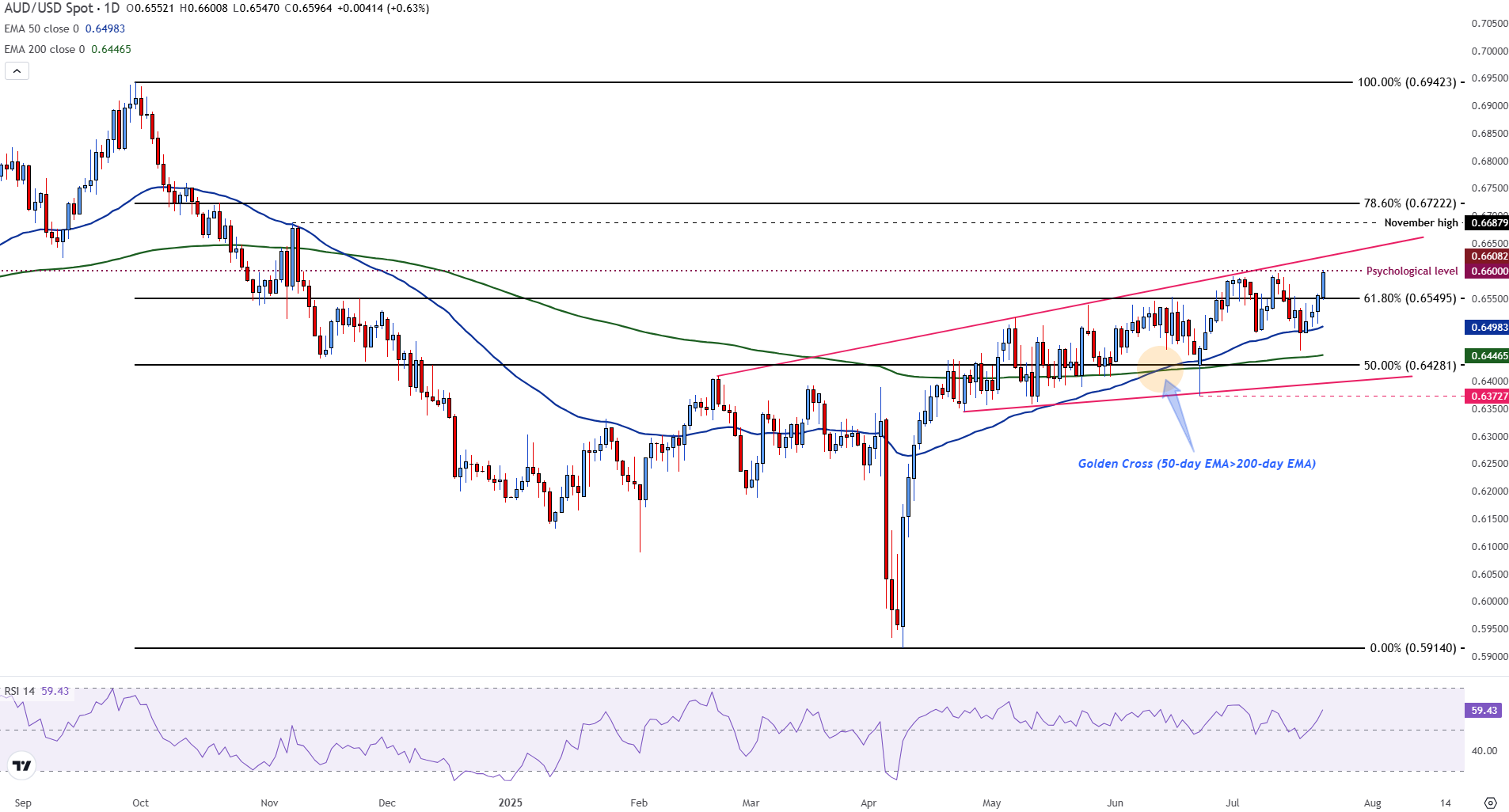
AUD/USD daily chart
Momentum remains constructive, with the Relative Strength Index (RSI) climbing toward 59, signaling a bullish bias without entering overbought territory. Importantly, a Golden Cross, where the 50-day Exponential Moving Average (EMA) crosses above the 200-day EMA, currently remains intact, reinforcing a longer-term bullish signal.
Should buyers clear the 0.6600 threshold decisively, the next major upside target is near 0.6722. On the downside, initial support lies back at 0.6550, with stronger support at the confluence of the 50-day EMA 0.6498 and the channel’s lower trendline. A break below that area would shift the bias back toward neutral terrain.
Australian Dollar FAQs
One of the most significant factors for the Australian Dollar (AUD) is the level of interest rates set by the Reserve Bank of Australia (RBA). Because Australia is a resource-rich country another key driver is the price of its biggest export, Iron Ore. The health of the Chinese economy, its largest trading partner, is a factor, as well as inflation in Australia, its growth rate and Trade Balance. Market sentiment – whether investors are taking on more risky assets (risk-on) or seeking safe-havens (risk-off) – is also a factor, with risk-on positive for AUD.
The Reserve Bank of Australia (RBA) influences the Australian Dollar (AUD) by setting the level of interest rates that Australian banks can lend to each other. This influences the level of interest rates in the economy as a whole. The main goal of the RBA is to maintain a stable inflation rate of 2-3% by adjusting interest rates up or down. Relatively high interest rates compared to other major central banks support the AUD, and the opposite for relatively low. The RBA can also use quantitative easing and tightening to influence credit conditions, with the former AUD-negative and the latter AUD-positive.
China is Australia’s largest trading partner so the health of the Chinese economy is a major influence on the value of the Australian Dollar (AUD). When the Chinese economy is doing well it purchases more raw materials, goods and services from Australia, lifting demand for the AUD, and pushing up its value. The opposite is the case when the Chinese economy is not growing as fast as expected. Positive or negative surprises in Chinese growth data, therefore, often have a direct impact on the Australian Dollar and its pairs.
Iron Ore is Australia’s largest export, accounting for $118 billion a year according to data from 2021, with China as its primary destination. The price of Iron Ore, therefore, can be a driver of the Australian Dollar. Generally, if the price of Iron Ore rises, AUD also goes up, as aggregate demand for the currency increases. The opposite is the case if the price of Iron Ore falls. Higher Iron Ore prices also tend to result in a greater likelihood of a positive Trade Balance for Australia, which is also positive of the AUD.
The Trade Balance, which is the difference between what a country earns from its exports versus what it pays for its imports, is another factor that can influence the value of the Australian Dollar. If Australia produces highly sought after exports, then its currency will gain in value purely from the surplus demand created from foreign buyers seeking to purchase its exports versus what it spends to purchase imports. Therefore, a positive net Trade Balance strengthens the AUD, with the opposite effect if the Trade Balance is negative.
Author

Tammy Da Costa, CFTe®
FXStreet
Tammy is an economist and market analyst with a deep passion for financial markets, particularly commodities and geopolitics.