AUD/USD ascends on mixed US data, ends week with losses
- AUD/USD prints gains on Friday after US Producer Price Index (PPI) data showed inflation easing.
- The US Core PPI rose by 0.2% MoM as expected, while annual PPI declined to 1.8%, increasing the likelihood of a Fed rate cut.
- Swaps markets show a 95.6% chance of a 25 bps Fed rate cut in November, up from 83.3%.

The Australian Dollar recovered some ground against the Greenback on Friday after a measure of prices paid by producers reaffirmed that inflation is coming down, warranting further easing by the Federal Reserve. The AUD/USD trades at 0.6748, registering modest gains of over 0.12%, though it is set to post weekly losses of over 0.60%.
AUD/USD climbs as US PPI data reinforces expectations for a 25 bps Fed rate cut in November
Data from the US Bureau of Labor Statistics (BLS) showed that the Producer Price Index (PPI) for September was 0% unchanged, below August’s 0.2% Month-on-Month increase. Excluding volatile items, the so-called Core PPI expanded by 0.2% Month-on-Month as expected, down from 0.3% a prior month.
On an annual basis, PPI increased by 1.8%, down from 1.9%, while underlying prices rose by 2.8%, up from 2.6%, and missed the 2.7% mark. Today’s data and yesterday’s CPI report hint that the Fed could cut rates at the November meeting.
The swaps markets show the Fed’s odds for a 25 bps rate cut at 95.6%, substantially up from 83.3% a day ago, when traders trimmed their positions on hawkish remarks by Atlanta’s Fed Raphael Bostic, who said he is open to cut or hold rates at the upcoming two meetings.
In other data, the University of Michigan (UoM) revealed that Consumer Sentiment deteriorated slightly from 70.1 to 68.9 and missed the consensus. Americans turned pessimistic due to higher living costs, while they upward revised inflation expectations from 2.7% to 2.9% over one year.
Chicago Fed President Austan Goolsbee crossed the wires on Bloomberg, praising the progress on inflation and the labor market. He added that despite the goodish September jobs report, there are no signs of overheating.
Next week, the Australian economic docket will be scarce. Tier The Reserve Bank of Australia (RBA) Assistant Governor Sarah Hunter will cross the wires on October 15, followed by the release of jobs data on October 16.
On the US front, the calendar will feature Fed speakers, the Balance of Trade, Retail Sales, Initial Jobless Claims, Industrial Production and housing data.
AUD/USD Price Forecast: Technical outlook
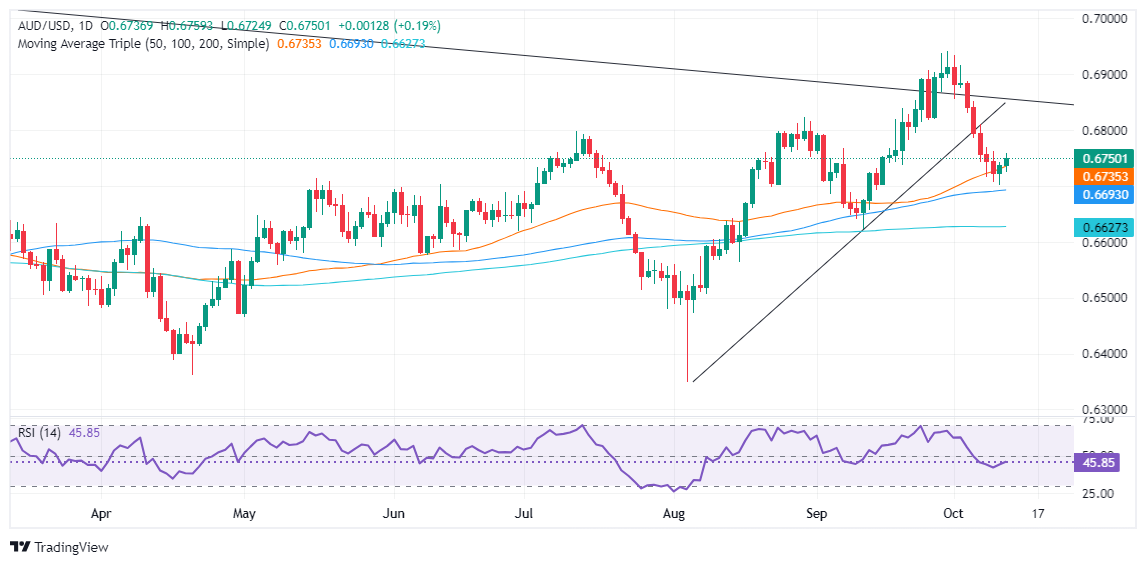
From a technical standpoint, AUD/USD is in consolidation but with a slight upward bias. For buyers to resume the uptrend, they need to break above the October 9 high at 0.6761, allowing them to challenge the weekly peak at 0.6809.
Conversely, if sellers step in and push the exchange rate below the 50-day moving average (DMA) at 0.6733, it could open the door for a decline toward the 100-DMA at 0.6691.
Australian Dollar PRICE Today
The table below shows the percentage change of Australian Dollar (AUD) against listed major currencies today. Australian Dollar was the strongest against the Japanese Yen.
| USD | EUR | GBP | JPY | CAD | AUD | NZD | CHF | |
|---|---|---|---|---|---|---|---|---|
| USD | -0.05% | -0.07% | 0.39% | 0.17% | -0.20% | -0.28% | 0.12% | |
| EUR | 0.05% | -0.05% | 0.38% | 0.17% | -0.16% | -0.28% | 0.10% | |
| GBP | 0.07% | 0.05% | 0.45% | 0.24% | -0.10% | -0.21% | 0.19% | |
| JPY | -0.39% | -0.38% | -0.45% | -0.24% | -0.56% | -0.67% | -0.36% | |
| CAD | -0.17% | -0.17% | -0.24% | 0.24% | -0.34% | -0.43% | -0.03% | |
| AUD | 0.20% | 0.16% | 0.10% | 0.56% | 0.34% | -0.13% | 0.27% | |
| NZD | 0.28% | 0.28% | 0.21% | 0.67% | 0.43% | 0.13% | 0.41% | |
| CHF | -0.12% | -0.10% | -0.19% | 0.36% | 0.03% | -0.27% | -0.41% |
The heat map shows percentage changes of major currencies against each other. The base currency is picked from the left column, while the quote currency is picked from the top row. For example, if you pick the Australian Dollar from the left column and move along the horizontal line to the US Dollar, the percentage change displayed in the box will represent AUD (base)/USD (quote).
Author

Christian Borjon Valencia
FXStreet
Markets analyst, news editor, and trading instructor with over 14 years of experience across FX, commodities, US equity indices, and global macro markets.