|

AUD/NZD loses key levels on quiet Monday, focus on Australian GDP data

  • On Monday, the AUD/NZD dipped below key technical levels, with the 100 and 200-day SMAs breached.
  • Current focus is on GDP data from Australia, expected to remain steady.
  • New Zealand’s manufacturing activity Q1 data on Friday will be closely watched.

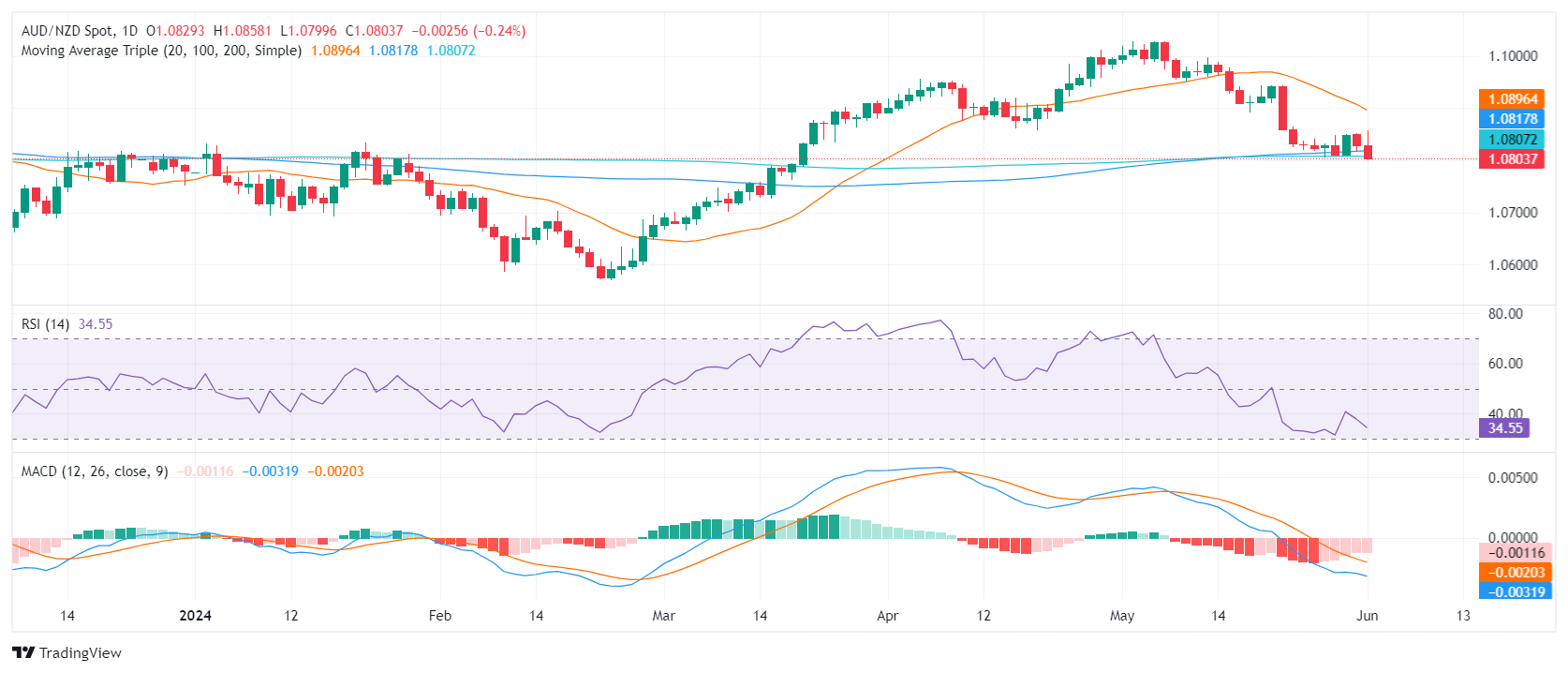
The AUD/NZD echoed a bearish technical outlook on Monday, falling below key levels towards 1.0805 as markets await mid-tier data from both nations on a quiet economic schedule at the beginning of the week.

In Australia, markets will anticipate Wednesday's Gross Domestic Product (GDP) data. A steady growth of 0.2% QoQ is expected, while a 1.2% YoY rate is projected, a slight dip compared to the Q4 YoY rate of 1.5%. That being said, the AUD’s losses may be limited, thanks to the strong Australian Q1 CPI inflation data and another robust April reading, which hints at the Reserve Bank of Australia (RBA) being one of the last G10 central banks to cut rates in this cycle.

On the other hand, New Zealand will focus on releasing its Q1 manufacturing activity data on Friday. Should the manufacturing output reflect the same upward trend, it might further slow the Reserve Bank of New Zealand’s RBNZ's rate cuts. The market now forecasts a 75% probability of the first cut happening as late as November.

AUD/NZD technical analysis

Technical indicators have turned bearish. On Monday, sellers oversaw the breaching of the 100 and 200-day Simple Moving Averages (SMAs). The RSI heads towards the oversold territory, echoing a similar sentiment, while the MACD histogram continues to confirm this downward momentum with its persistent formation of red bars.

Despite the bearish patterns unfolding, the focus will be whether the downward trend can be sustained or if there will be an upward correction as markets continue to assess the upcoming economic data releases.

AUD/NZD daily chart
Author

Patricio Martín

Patricio is an economist from Argentina passionate about global finance and understanding the daily movements of the markets.


More from Patricio Martín
Share:

Editor's Picks

EUR/USD clings to gains around 1.1800

EUR/USD manages to regain composure and retests the 1.1800 region in quite a positive start to the week. The pair’s bounce follows the US Dollar’s offered stance post-SCOTUS ruling ahead of important US data and Fedspeak on Tuesday.

GBP/USD treads water near 1.3500 as BoE-Fed divergence debate stalls

GBP/USD spent Monday spinning in place as market participants await a fresh catalyst to break the pair out of its recent range. The BoE's February hold came with a surprisingly dovish 5-4 split, and UK Consumer Price Index data last week showed inflation easing to 3.0%, reinforcing the case for earlier rate cuts, with most economists now looking to April or March for the next move. 

Gold climbs above $5,200 on geopolitical tensions, trade uncertainty

Gold price jumps to around $5,230 during the early Asian session on Tuesday. The rally of the precious metal is bolstered by heightened geopolitical tensions and global trade uncertainty following US tariff decisions. Traders brace for the US January Producer Price Index report on Friday for fresh impetus. 

Solana DeFi platform Step Finance to close operations following treasury hack

The Solana based decentralized finance platform Step Finance announced it will end all operations effective immediately following a breach that drained its treasury.

Supreme Court nixes tariffs, Trump teases 15% global tariff

On February 20th, the Supreme Court ruled that Trump’s global tariffs under IEEPA authority were unconstitutional, effectively nullifying the framework. However, the relief was short-lived. Within hours, Trump floated a 15% blanket tariff under an alternative legal authority.

XRP recovers slightly as bearish sentiment dominates crypto market

Ripple is rising above $1.40 at the time of writing on Monday amid fresh tariff-triggered headwinds in the broader cryptocurrency market. The sell-off to $1.33, the token’s intraday low, can be attributed to macroeconomic uncertainty, geopolitical tensions and risk-averse sentiment among other factors.















