AUD/JPY Price Forecast: Seems vulnerable near 93.00; bears might aim to challenge YTD low
- AUD/JPY struggles to build on a two-day-old recovery momentum from a multi-month trough.
- BoJ rate hike bets and rising trade tensions benefit the safe-haven JPY and weigh on spot prices.
- The US-China trade war supports prospects for further losses amid a bearish technical setup.

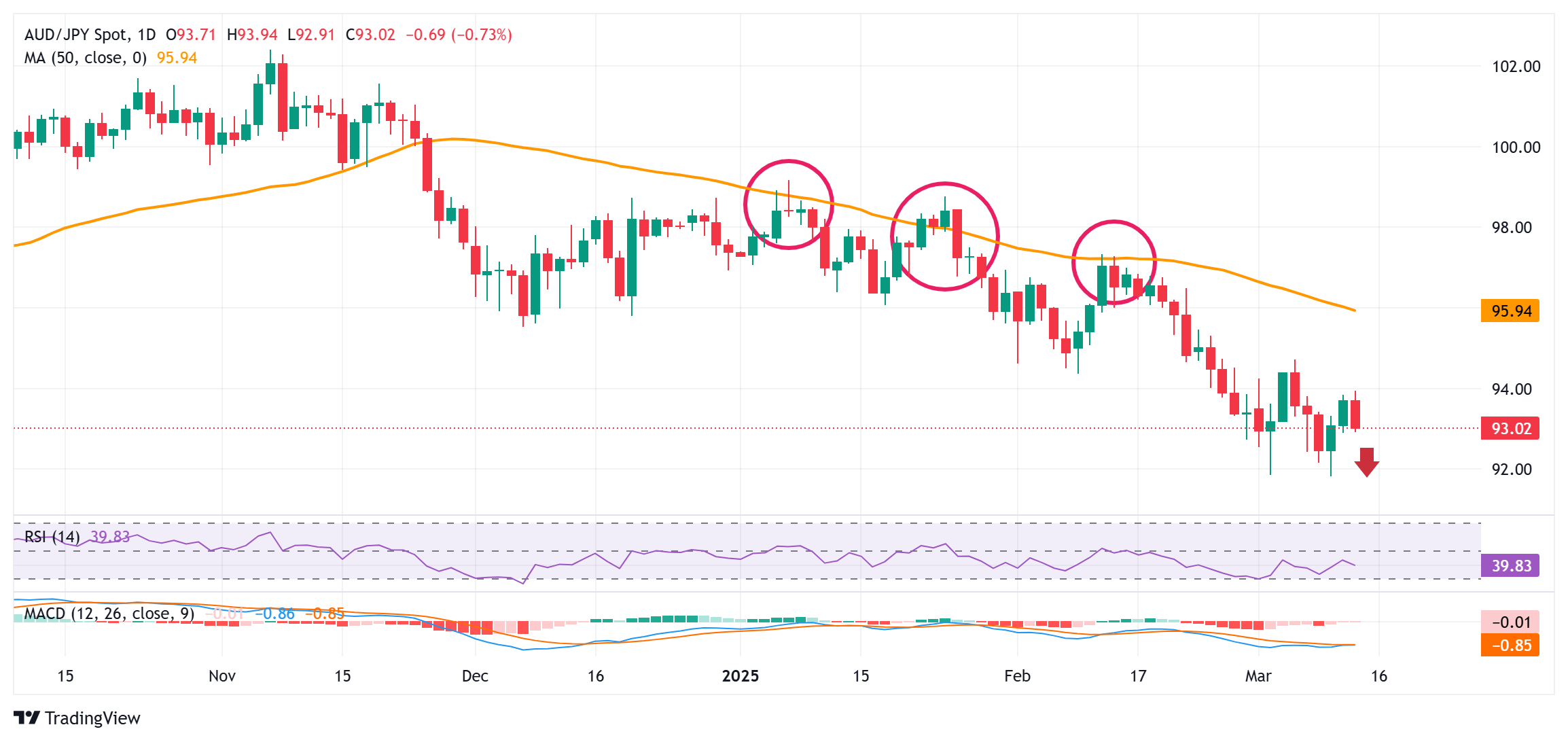
The AUD/JPY cross attracts fresh selling in the vicinity of the 94.00 mark, or the weekly top touched earlier this Thursday, and extends its steady intraday descent through the first half of the European session. Spot prices slide below the 93.00 mark in the last hour and for now, seem to have stalled a two-day-old recovery from the lowest level since August 2024 touched on Tuesday.
Against the backdrop of bets that the Bank of Japan (BoJ) will hike interest rates again, concerns about the potential economic fallout from US President Donald Trump's aggressive tariff policies boost demand for the safe-haven Japanese Yen (JPY). Apart from this, the risk of a further escalation of trade war between the US and China – the world's two largest economies – weighs on the Australian Dollar (AUD) and exerts additional pressure on the AUD/JPY cross.
From a technical perspective, the recent repeated failures near the 50-day Simple Moving Average (SMA) and bearish oscillators on the daily chart suggest that the path of least resistance for spot prices remains to the downside. Hence, some follow-through weakness towards the 93.50 intermediate support, en route to the 92.00 mark and the 91.80 area or a multi-month low, looks like a distinct possibility amid bets that the Reserve Bank of Australia (RBA) will cut rates further.
On the flip side, any meaningful recovery now seems to confront immediate resistance near the 93.70 region. This is followed by the weekly top, around the 94.00 mark, which if cleared decisively should pave the way for a further near-term appreciation. The AUD/JPY cross might then aim to surpass the monthly peak, around the 94.70-94.75 area, and reclaim the 95.00 psychological mark before climbing further towards the 96.00 neighborhood, or the 50-day SMA barrier.
The latter should act as a key pivotal point, which if cleared decisively might shift the near-term bias in favor of bullish traders and suggest that the AUD/JPY cross has formed a near-term bottom. This, in turn, would set the stage for a move towards the 96.65 intermediate resistance en route to the 97.00 round figure, the 97.75-97.80 region, and the 98.00 mark.
AUD/JPY daily chart
US-China Trade War FAQs
Generally speaking, a trade war is an economic conflict between two or more countries due to extreme protectionism on one end. It implies the creation of trade barriers, such as tariffs, which result in counter-barriers, escalating import costs, and hence the cost of living.
An economic conflict between the United States (US) and China began early in 2018, when President Donald Trump set trade barriers on China, claiming unfair commercial practices and intellectual property theft from the Asian giant. China took retaliatory action, imposing tariffs on multiple US goods, such as automobiles and soybeans. Tensions escalated until the two countries signed the US-China Phase One trade deal in January 2020. The agreement required structural reforms and other changes to China’s economic and trade regime and pretended to restore stability and trust between the two nations. However, the Coronavirus pandemic took the focus out of the conflict. Yet, it is worth mentioning that President Joe Biden, who took office after Trump, kept tariffs in place and even added some additional levies.
The return of Donald Trump to the White House as the 47th US President has sparked a fresh wave of tensions between the two countries. During the 2024 election campaign, Trump pledged to impose 60% tariffs on China once he returned to office, which he did on January 20, 2025. With Trump back, the US-China trade war is meant to resume where it was left, with tit-for-tat policies affecting the global economic landscape amid disruptions in global supply chains, resulting in a reduction in spending, particularly investment, and directly feeding into the Consumer Price Index inflation.
Author

Haresh Menghani
FXStreet
Haresh Menghani is a detail-oriented professional with 10+ years of extensive experience in analysing the global financial markets.

















