|

AUD/JPY Price Analysis: Trades soft near 90.10 zone with bearish outlook intact

  • AUD/JPY trades near the 90.10 area after easing modestly ahead of the Asian session.
  • Momentum indicators are mixed, but moving averages continue to align with bearish pressure.
  • Resistance is seen at 90.49, 90.50, and 90.57, while downside risk builds below the 90.00 handle.

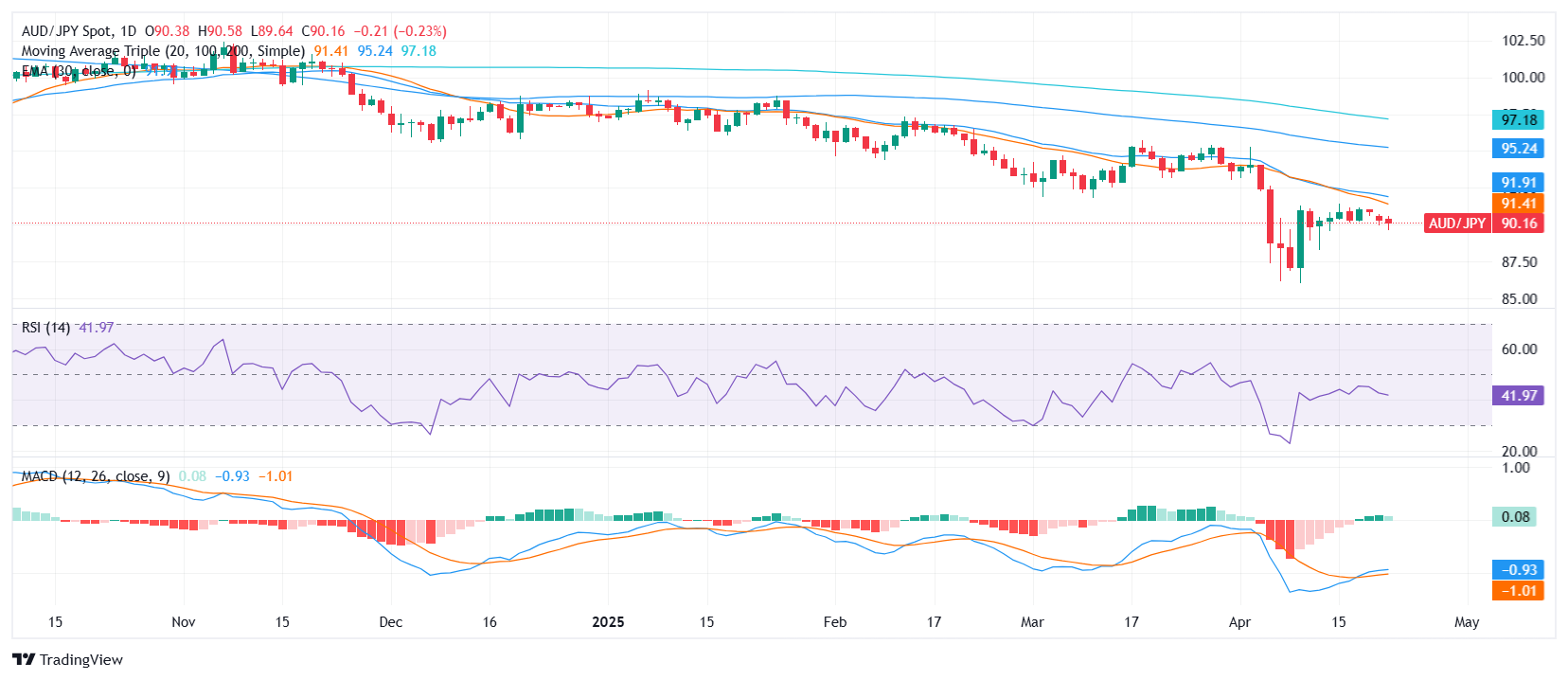
The AUDJPY pair is flashing an overall bearish signal, currently trading around 90.10 after a modest dip during Tuesday’s session. The cross remains mid-range between the day’s low of 89.64 and high of 90.58, suggesting hesitation in either direction as markets await fresh momentum into Asia.

From a technical perspective, short-term indicators show a mixed picture. The Relative Strength Index (RSI) holds neutral near the 42 level, while the MACD is beginning to flash a buy signal. Complementing the indecisiveness, both the Stochastic %K and the Commodity Channel Index (CCI) remain in neutral territory, suggesting consolidation rather than trend continuation in the near term.

Despite the muted momentum, broader trend signals continue to lean bearish. The 20-day, 100-day, and 200-day Simple Moving Averages (SMAs), all located above 91.00, confirm prevailing downside bias. The 10-day EMA and SMA, sitting just above the current price at 90.57 and 90.50 respectively, add immediate resistance.

Traders may look to resistance levels at 90.49, 90.50, and 90.57 should any bullish correction emerge. However, the overall tone remains cautious, with sellers likely to retain control if the pair remains capped below the 91.00 region.

AUD/JPY daily chart
Author

Patricio Martín

Patricio is an economist from Argentina passionate about global finance and understanding the daily movements of the markets.


More from Patricio Martín
Share:

Editor's Picks

AUD/USD hangs near three-week low, below 0.6950 as traders await US NFP report

AUD/USD hits a three-week low during the Asian session on Friday as the RBA’s dovish shift and a rout in equity markets weigh on the risk-sensitive Aussie. However, the recent slump in US bond yields to a two-month low keeps US Dollar bulls on the back foot and limits losses for the currency pair as traders look to the US NFP report for a fresh impetus.

USD/JPY bounces off three-week low; keeps the red near 157.65 as focus remains on US NFP

USD/JPY bounces off the weekly low set during the Asian session, as bears turn cautious ahead of the US NFP report due later this Friday. The upside seems limited as the recent slump in US bond yields and hopes of Iran war de-escalation undermine the US Dollar. Moreover, a hawkish BoJ and intervention risks support the Japanese Yen, capping the pair.

Gold loses the grip; $4,000 comes next on the downside

Gold sets aside two daily advances in a row on Friday, opening the door to a potential test of the key $4,000 mark per troy ounce. The precious metal’s retracement follows a decent improvement in the sentiment surrounding the US Dollar, solid NFP data and higher US Treasury yields across the board.

Democrats win House and Senate in US midterms: Why isn’t all bad news for crypto

The biggest story this week was Tuesday’s US midterm elections, which saw Democrats win control of both the House and the Senate in a clear blue wave. This political shift in the US has triggered sharp price swings across the cryptocurrency market.

Week ahead – Inflation and geopolitics in focus as US political landscape shifts

Post-midterm election euphoria fizzles out as risk aversion prevails. US CPI, PPI and Fedspeak on the radar as Fed hike bets remain supported. Oil retreat pauses on mixed hopes about the ongoing conflicts.

US Dollar breaks below 101.50 as Democrats sweep Congress
The US Dollar (USD) comes under heavy selling pressure on Wednesday, with the US Dollar Index (DXY) falling around 0.5% to trade near 101.35 after sliding below the 101.50 level. The Greenback retreats to its lowest level in four weeks as investors reassess the political and economic outlook following the Democratic Party's sweeping victory in the United States (US) midterm elections.















