Are analysts overestimating US banks’ NII?

This past quarter brought unique challenges to the financial system in the United States, with high market volatility and the first Federal Reserve’s rate cut in over four years. While the bigger-than-expected September rate cut from the Fed came too late to have a significant impact on the American banks’ Q3 results, investors and traders are now focused on how this new phase of the rate cycle might affect bank profitability for the remainder of 2024 and beyond.
In this article, we’ll review the financial results of JPMorgan and Wells Fargo, comparing them to market participants’ expectations and examining how these outcomes may shape projections for the upcoming quarters. We’ll also assess whether current conditions make it a good time to invest in US banks, with a particular focus on the potential influence of Net Interest Income (NII) on their future performance, which measures the difference between what a bank earns from loans and what it pays on deposits.
JPMorgan and Wells Fargo beat expectations
Both JPMorgan and Wells Fargo exceeded market expectations in their third-quarter financial results published last Friday, leading to a surge in their daily stock prices — 4.4% for JP Morgan and 5.6% for Wells Fargo. This positive performance also boosted the S&P banking sector index, which gained 4.2%, reaching its highest level since February 2022, and other financial stocks like Goldman Sachs and Morgan Stanley, which ended up around +2.50% and +2.20% respectively.
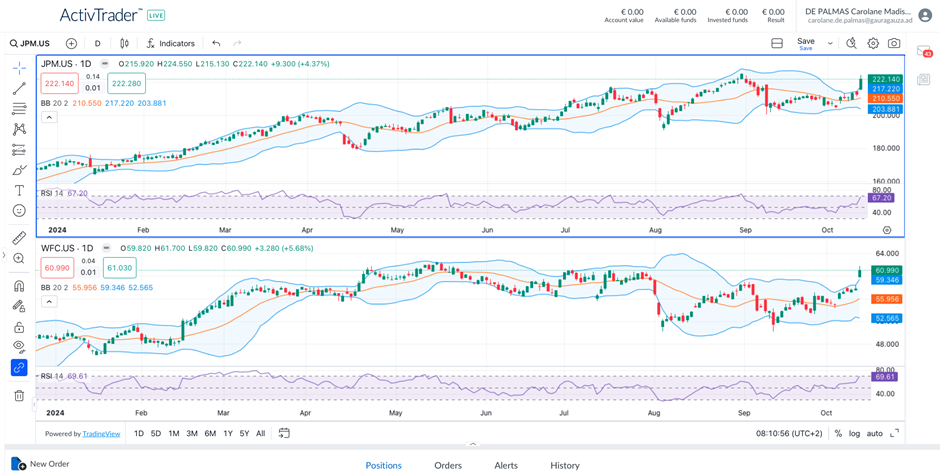
Daily JPMorgan & Wells Fargo Charts - Source: ActivTrader
JPMorgan Chase reported a 3% increase in net interest income (NII) to $23.5 billion, surpassing analyst forecasts of $22.9 billion. Investment banking fees surged 31% (doubling the previous forecast of a 15% increase), and trading revenue grew 8%, driven mostly by equity trading. America’s largest bank has thrived in the rising interest rate environment, reporting a 6% increase in revenue, reaching $43.32 billion. Despite this growth, profits fell 2% from the previous year, falling to $12.9 billion.
Wells Fargo’s net interest income declined by 11% to $11.69 billion in the third quarter compared to the previous year. However, the bank’s CEO highlighted the positive impact of diversified revenue sources and a 16% increase in fee-based income, which helped mitigate the decline in NII. While net income fell to $5.11 billion (or $1.42 per share) from $5.77 billion (or $1.48 per share) a year ago, Wells Fargo still exceeded analyst expectations. The bank also forecasted a stabilisation of interest income in the near future.
Overall, the strong financial performance of JPMorgan and Wells Fargo could reflect the resilience of the US banking sector and could bode well for future prospects if other American banks publish similar financial performances. Goldman Sachs and Bank of America are expected to release their earnings on Tuesday 15th of October, with Morgan Stanley and US Bancorp following on Wednesday 16th of October. Still, some analysts believe that market participants might be a bit too optimistic about the US banks’ NII, and might be underestimating geopolitical risks.
US banks face NII challenges in post-rate hike era
Despite some stronger-than-anticipated numbers, not everything in the earnings reports was positive for JPMorgan and Wells Fargo, as both banks experienced profit declines and continued pressure on net interest income.
Quarterly earnings fell for both financial institutions compared to the same period last year. While JP Morgan managed to raise its annual NII forecast to $92.5 billion, up from $91 billion and surpassing the $91.05 billion estimate by analysts polled by LSEG, Wells Fargo, on the other hand, signalled more challenges ahead for its NII.
The bank warned that net interest income would decline further in the final quarter of 2024, though it did offer a more optimistic outlook for 2025. Wells Fargo projected a 9% drop in NII for 2024, which is more pessimistic than the 8.4% decline anticipated by analysts.
The pressure on net interest income stems largely from the recent rate cuts by the Federal Reserve, which are likely to compress banks’ interest income margins. This is critical for traders because the NII is a key driver of bank profitability. With overall lower benchmark interest rates, banks face reduced earnings on loans, while still needing to offer competitive rates to retain deposits.
Some argue that rate cuts could benefit NII by lowering the interest banks must pay on deposits, such as certificates of deposit and other rate-sensitive accounts. If deposit rates decrease, banks may be able to reduce costs and improve margins. However, the extent to which NII improves depends on how well banks can balance deposit retention with lower payouts, especially in a competitive market.
Traders are particularly interested in this dynamic, as it could reveal which banks are better equipped to manage these changes, and which might struggle under prolonged pressure on their interest income. It is therefore useful to assess how well banks are positioned to manage these financial pressures.
Understanding how NII responds to rate cuts will influence investment strategies and expectations for the banking sector. While rate cuts typically lead to a short-term decline in NII as banks earn less on their existing loan portfolios, over the longer term the impact of rate cuts on NII can vary depending on factors such as the bank’s business model, its ability to manage its balance sheet effectively, and the overall health of the economy.
JPMorgan Chase CEO Jamie Dimon has expressed growing concerns about geopolitical tensions around the world. He highlighted the ongoing conflicts in the Middle East and Russia's invasion of Ukraine as significant factors that could impact the global economy and, consequently, US bank net interest income. Geopolitical tensions can indeed lead to market volatility, trade disruptions, and economic instability. These factors can directly influence NII through factors such as loan demand, credit risk, inflation, currency volatility, and capital flight.
While the US economy remains resilient and inflation is slowing, Dimon warned of other challenges facing the global economy, including large fiscal deficits, infrastructure needs, and the restructuring of trade. He stressed the importance of being prepared for any potential economic environment, given the uncertainty surrounding these geopolitical events.
Stay up to date with what's moving and shaking on the world's markets and never miss another important headline again! Check ActivTrades daily news and analyses here.
Author

Carolane de Palmas
ActivTrades
Carolane graduated with a Masters in Corporate Finance & Financial Markets and got the AMF Certification (Financial Markets Regulator in France). Afterward, she became an independent trader, investing mostly in European and American stocks/indices.