Apple stock sells off as Tim Cook projects $900 million tariff bite
- Apple stock gives way as $900 million tariff cost poses a concern.
- CEO Tim Cook said he could not project tariff effects beyond the June quarter.
- Nonfarm Payrolls for April arrive above consensus, sending indices higher.
- The next support level for AAPL stock comes at $196.
Apple (AAPL) stock is the worst-performing Magnificent 7 mega-caps coming out of earnings so far. Barring Nvidia (NVDA), which doesn't post earnings until the end of May, Apple is the only one of the bunch to demonstrate a clear downside move in the first regular trading session post-earnings. Amazon (AMZN) initially sold off post-earnings on Thursday but has moved back toward even in Friday's session.
Apple's second fiscal quarter results, released after market close on Thursday, showed a successful beat on the top and bottom lines, but the market focused on the tariff issue to the disadvantage of other positive details.
Apple stock opened about 5% lower on Friday but has recovered somewhat to trade 3.5% lower near lunchtime. The broader market is in an upswing after US Nonfarm Payrolls (NFP) for April came in above the forecast. Though March NFP figures saw a major revision to the downside, all three indices gained 1% or more.
Apple stock news
The major discontent from Thursday's earnings release was displeasure over the extent of the pain caused by the Trump administration's tariffs.
"Assuming the current global tariff rates, policies, and applications do not change for the balance of the quarter, and no new tariffs are added, we estimate the impact to add $900 million to our costs," CEO Tim Cook told analysts on the earnings call.
One issue with this announcement is that it does not take into account any downturn in the macroeconomic picture. Multiple large banks, such as JPMorgan, have already predicted that a recession will occur due to the tariffs causing a slowdown in growth. Another drawback of Cook's admission is that he claimed not to have any insight into the effect of tariffs after the current quarter ending in June.
While Apple was able to direct more iPhone production from China to India to circumvent those much higher tariffs in the current quarter, investors are realizing that they have little insights into the second half of the year.
Another drawback of the Q2 result is that Apple's consensus beat was narrow. The company reported GAAP earnings per share (EPS) of $1.65, just 3 cents ahead of the forecast. Revenue of $95.4 billion was $840 million ahead of the consensus.
The real highlight of the quarter was the services division. Revenue in this segment climbed 12% YoY, double the overall level. While wearables, home and accessories revenue fell 5%, iPad revenue also climbed 15% YoY.
Apple stock forecast
Apple stock has lost part of its recent rally, which advanced for eight straight sessions. Currently trading near $205 on Friday, the next support comes at $196, a point of resistance during 2024. The next layer of support comes at $180, which is just above the 61.8% Fibonacci level near $178.
The year-to-date lows surrounding $170 are undergirded by the 78.6% Fibonacci at $168.60.
If Apple stock was to break out of its 2025 downtrend, the first necessary move would be to overcome the descending 50-day Simple Moving Average (SMA) near $215.50 before putting in a new range high above the late March resistance at $225.
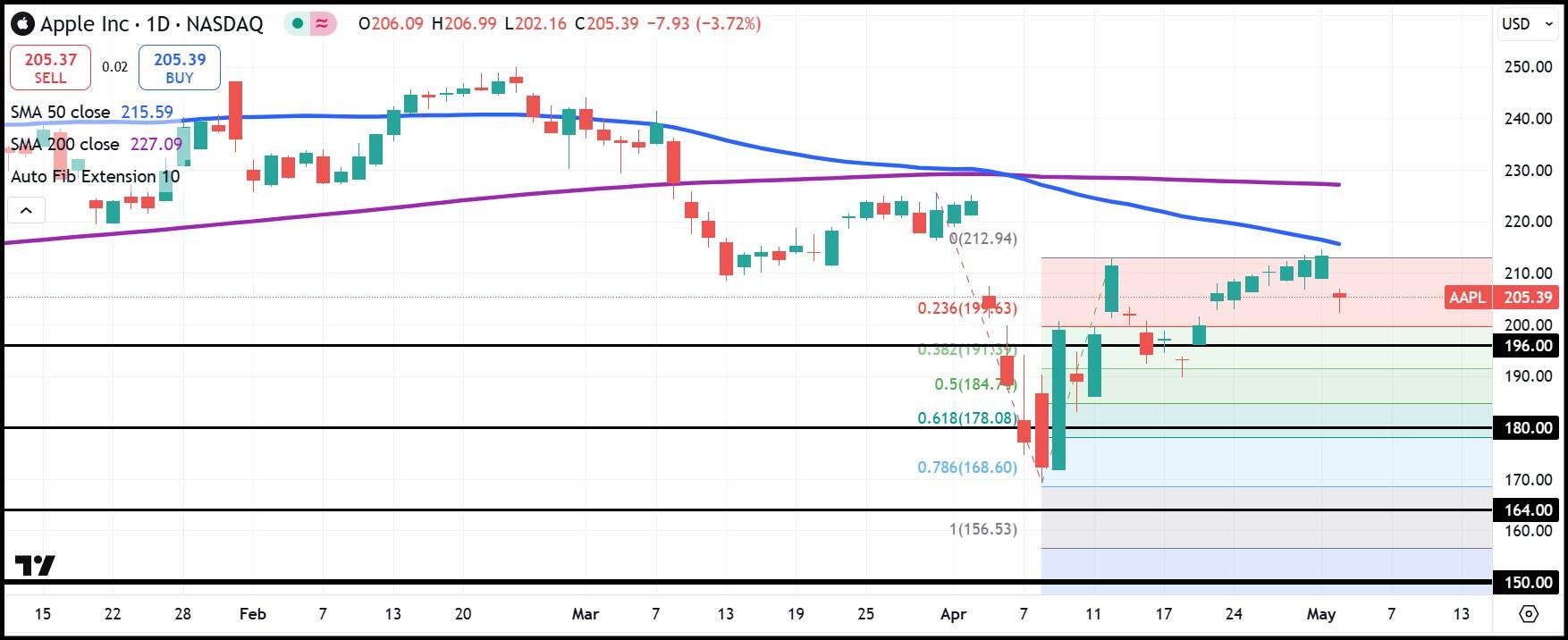
AAPL daily stock chart
Author

Clay Webster
FXStreet
Clay Webster grew up in the US outside Buffalo, New York and Lancaster, Pennsylvania. He began investing after college following the 2008 financial crisis.

















