AMD investors cash in on Tuesday after joining $1 trillion stock club
- AMD's launch into the trillion-dollar club makes its 14th to do so.
- Possible CPU shortage leads AMD to trillion-dollar market cap.
- AMD's surging share price comes in parallel with competitor Intel.
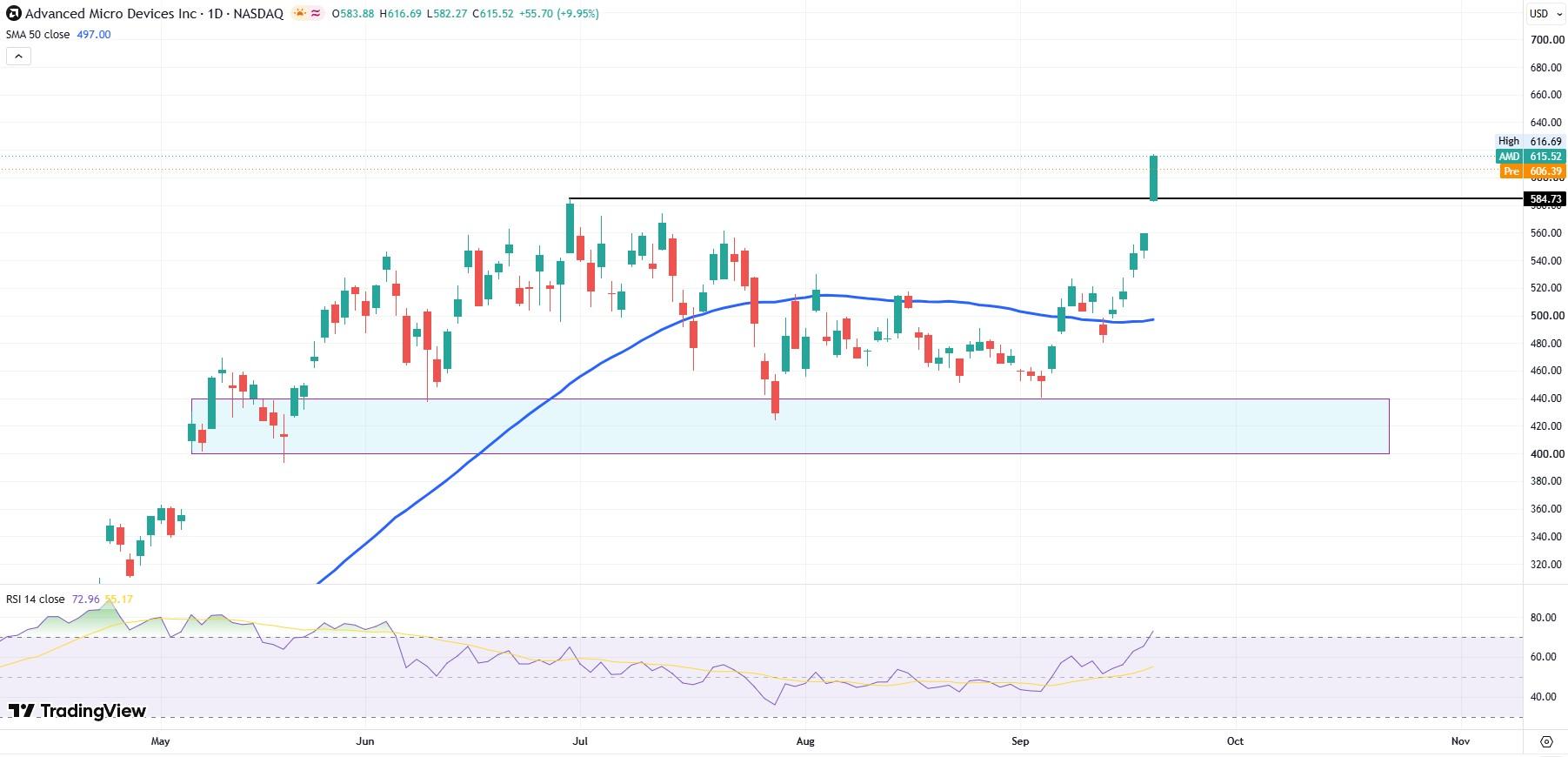
- Supports for AMD sits as $585, the June 30 high.

Advanced Micro Devices (AMD) has become the latest stock to reach the $1 trillion club. On Monday, shares of the semiconductor company surged as much as 10% to reach an all-time high of $615.99. On Tuesday, the stock has shed more than 1% as investors test whether AMD can retain this threshold.
AMD is not the only semiconductor stock in rally mode either. Intel (INTC) turned many heads on Monday as its shares rallied some 13% for much the same reason. There is further speculation this week that the global CPU shortage is worse than expected and could drive prices higher. Intel and AMD are competitors in both AI-focused server CPUs, as well as those used in personal computers.
Premarket indices are largely higher on Tuesday with the Dow Jones Industrial Average (DJIA) leading the pack, while most growth, tech and semiconductor stocks take a breather after Monday's updraft.
A new trillionaire is crowned: AMD
AMD is now the 14th US stock to achieve a trillion-dollar market cap. Micron (MU) was the most recent company, doing so in May of this year.
This achievement is a long time coming for AMD. CEO Lisa Su rescued AMD from near bankruptcy in 2014, and just 12 years later the market cap has exploded about 500X. The long road to trillionaire-status had much to do with ditching unprofitable product lines, focusing on high-margin products, and becoming competitive with Intel on the CPU front.
The immediate reason for rising 30% over the past month to reach the $1 trillion club is the growing realization that the hype around a CPU shortage now appears more real. Intel CEO Lip-Bu Tan told conference attendees last week that he's only able to deliver about half of the CPU demand that has reached the legacy semiconductor's doorstep. Anecdotes of rising CPU prices have also arrived despite heavy activity on the production front.
AMD and Intel continue to produce the lion's share of CPUs, but Microsoft's Cobalt CPU and Amazon's Graviton are also picking up the slack. Despite that, every company with a license from ARM Holdings (ARM) to produce ARM-based CPUs is doing so, and executives still claim they can't meet demand.
In many respects, it looks to the AI investor class that CPUs might get caught up in a shortage-induced price spike in a similar fashion to memory chips.
AMD stock chart
Although AMD has crossed the $1 trillion threshold, it still needs retain a share price of $602.77 to remain in the club, which makes it a psychological threshold for support. That figure is based on the diluted weighted average shares outstanding figure of 1.659 billion that was reported in the June 2026 quarter. AMD is trading near $606 in Tuesday's premarket at the time of writing.
Investors will remember that Walmart (WMT) joined the trillion-dollar club in February of this year, but the Iran war and slacking consumer spending levels have it now trading near $850 billion.
The present daily chart for AMD show that the June 30 resistance just below $585 is where AMD found support on Monday, so that level remains in play. The upward targets are anyone's guess, but the Relative Strength Index (RSI) near 73 provides an overbought reading.
Major support comes in near $500 for the 50-day Simple Moving Average (SMA) and the broad $400-$440 region that was tested over the summer. But those regions are so far away, that we should expect sideways to upward movement in AMD's share price until moving average support proves a closer option.
Expect AMD to trade within the $600 to $650 window until the 50-day SMA rises above $600.
Author

Clay Webster
FXStreet
Clay Webster grew up in the US outside Buffalo, New York and Lancaster, Pennsylvania. He began investing after college following the 2008 financial crisis.