|

AMC Share Price: Stock tumbles as CEO shifts to be the new Chairman of the Board

  • NYSE:AMC fell by 5.36% as the meme stock leader continued to struggle following Tuesday’s pop.
  • AMC CEO Adam Aron is now officially the Chairman of the Board. 
  • Other meme stocks fell alongside AMC, even as the broader markets rallied.

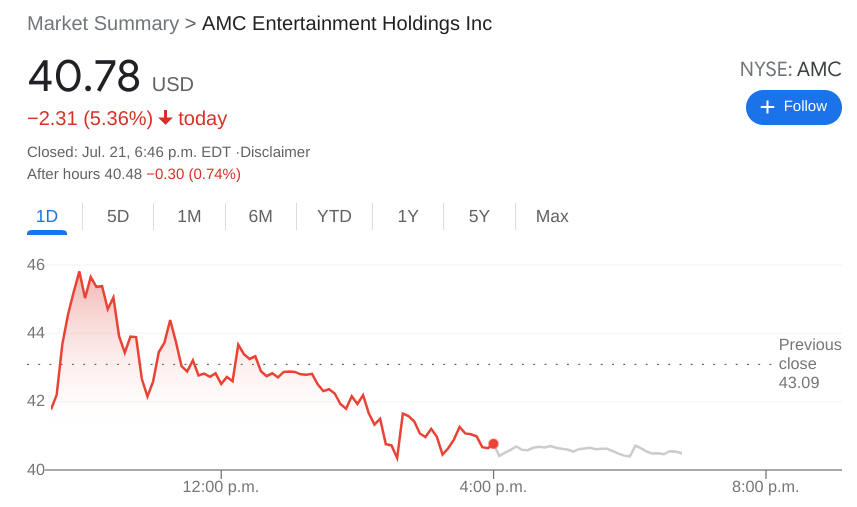
NYSE:AMC failed yet again to gain traction following its 25% jump during Tuesday’s session. On Wednesday, shares of AMC fell by 5.36% and closed the day at $40.78. The decline in price came following an early morning spike, but the stock could not hold up throughout the session and declined into the closing bell. One positive note for investors is that AMC did find support at its 50-day moving average price. AMC investors are trying to shrug off the rising cases of the COVID-19 delta variant, which may threaten to close down theaters once again, just as they have finally reopened. 


Stay up to speed with hot stocks' news!


Popular CEO Adam Aron received a new title on Wednesday, as he was named the new Chairman of the Board. The title change was the reason behind the early morning jump, although perhaps the news wasn’t as bullish as first believed which would account for declines later in the session. Chairman of the Board is the same title that Ryan Cohen holds at GameStop (NYSE:GME), although AMC Apes should not expect the type of transformation for AMC that Cohen is attempting with GameStop.

AMC stock forecast
Speaking of GameStop, shares of the video game retailer also fell by 2.81% on Wednesday, and lost support at its 21-day moving average, which is a sign that more pain could be ahead for those with diamond hands. GameStop has fallen steadily since its annual shareholder meeting back in June, and if you zoom out, the stock has declined over 60% since its all-time high prices in January. 

Author

More from Stocks Reporter
Share:

Editor's Picks

GBP/USD advaces beyond 1.3450 after BoE decision, US Q2 GDP

GBP/USD gains positive momentum on Thursday, surpassing 1.3450 and trading at fresh multi-week highs. The Bank of England decided to maintain the benchmark rate unchanged at 3.75%. The MPC voted 6-3 to keep rates on hold, with the 3 dissenters favoring a rate hike. US Q2 GDP missing expectations helped the pair advance, while renewed US Dollar weakness across the FX board pushed the pair further up ahead of the monthly close.

EUR/USD confortable around 1.1530, highest in six weeks

The EUR/USD pair trades around 1.1530 in the American session on Thursday, reaching fresh six-week highs. The US Dollar is in sell-off mode, with multiple factors weighing on the American currency. Not only did the Federal Reserve vote divided to keep rates on hold on Wednesday, creating doubts about a September hike, but US Q2 GDP missed expectations. A suspected JPY intervention adds pressure on the Greenback.

Gold recovers the $4,100 level as US Dollar weakens further

Gold trades just above $4,100 amid a US Dollar sell-off. The Greenback enjoyed some near-term demand following Wednesday's post-FOMC downfall, but was unable to retain its gains. The preliminary estimate of the US Q2 GDP showed the economy grew at an annual rate of 1.5%, missing the market's expectations of 2.1%.

Bank of Japan set to keep interest rates unchanged after suspected Yen intervention

Investors are turning their attention to the Bank of Japan’s monetary policy announcement on Friday, after the Japanese Yen staged a dramatic rebound during Thursday's American session. The move came amid growing speculation that Japanese authorities intervened in the foreign exchange market after USD/JPY tumbled from above 163.00 to below 158.00 within minutes.

Aave to sunset Sonic, Aptos, zkSync, Scroll reserves, affecting $98 million in supply

Aave is planning to sunset 75 low-activity reserves across its decentralized finance protocol as part of a broader effort to reduce operational, technical and economic risks across its network of deployments.

9-3: Is the Federal Reserve’s vote tally Warsh's new forward guidance?
The rate did not move. Neither did the statement, and that’s the more interesting fact. Set the July 29 Federal Open Market Committee (FOMC) statement beside the one issued on June 17, and the two documents are identical apart from a single verb and a paragraph at the bottom naming three dissenters.