Amazon stock sheds 8% as market in turmoil following jobs report
- Amazon stock sinks as much as 8% on Friday following poor hiring data.
- July Nonfarm Payrolls report showcases large revision to summer hiring.
- Trump institutes new tariff rate, many of them higher than expected.
- Market is unhappy with AWS growth rate as Microsoft bears down on cloud leader.

Amazon (AMZN) stock is reeling on Friday along with much of tech mega-cap tech sector after the July Nonfarm Payrolls (NFP) report showed a drastic decrease in hiring and the Trump administration's higher tariff rates went into effect.
All hell broke loose after the July NFP on Friday morning showed only 73K net new jobs in July, and prior months were revised down 260K fewer jobs than earlier reported. This news sent the US Dollar down 1.3% against the Euro and traders sold equities to crowd into US Treasuries, which saw sharp declines in yield.
To say that risk-off sentiment has surged would be an understatement. While markets had long expected new tariff levels to go into effect on August 1, the Trump administration announced higher than expected tariff levels on several countries late Thursday. The 35% tariff on Canada, up from 25%, and 39% on Switzerland raised eyebrows, while India received a 25% tariff rate, similar to Mexico.
Taken together with the employment report, investors are now returning to their April worries over the carnage unleashed by tariffs in the months ahead.
The NASDAQ has traded down more than 2% at times on Friday morning, while the S&P 500 and Dow Jones Industrial Average (DJIA) have averaged between a 1% and 1.5% decline.
Amazon stock news
Amazon stock was already sinking somewhat in Thursday's post-market despite delivering impressive second-quarter earnings results. Amazon delivered a 26% beat to the Wall Street adjusted earnings per share (EPS) consensus, and revenue came in $5.6 billion ahead of the average estimate.
CEO Andy Jassy also raised guidance for the third quarter, but investors took issue with the AWS result, which was quite impressive but maybe not as impressive as Microsoft's (MSFT) Azure operations. Sentiment that Azure is superseding AWS as the leading cloud provider only grew with this report.
Amazon's AWS saw revenue rise 17.5% YoY in Q2, while Amazon's Intelligent Cloud segment reported revenue rising 26% over a similar period of time. What's more, AWS revenue of $30.9 billion in the quarter was only $1 billion above Microsoft's cloud operations.
The economic news is also weighing down AMZN stock more than some of its competitors. The Trump administration's new tariffs, some of which begin on August 1 while others start a week later, will surely force Amazon to raise prices or at least shift many of its overseas suppliers. This could lead to lower margins in the second half of 2025.
And while Friday's NFP report showed that the economy is still hiring new workers, the revised figures show the labour market is running on fumes. With layoff announcements growing, the possibility of a recession has grown somewhat more likely over the next 18 months.
This has raised the chances that the Federal Reserve (Fed) will cut interest rates in September despite Fed Chair Jerome Powell saying earlier this week that he is still waiting to see how tariffs effect the economy.
Amazon stock forecast
AMZN stock was already sinking some 3% late Thursday before Friday's NFP report ended bullish sentiment. After trading at a clear premium to the 20-day Simple Moving Average (SMA) since the first half of May, the Amazon stock price dove below it on Friday. This is a sign that the downtrend is likely to continue.
Further support can be found at the 200-day SMA near $209 and the 100-day SMA near $204. In the worst case scenario, maybe if Microsoft overtakes AWS as the largest cloud provider, shares would still likely find solace in the $160s or $170s where AMZN found its footing in April.
But Amazon is a favorite company, and bulls will simply hold off for the time being until the share price better reflects the present market's uncertainty. This is more likely to mean that buying picks up in the vicinity around the $200 psychological level.
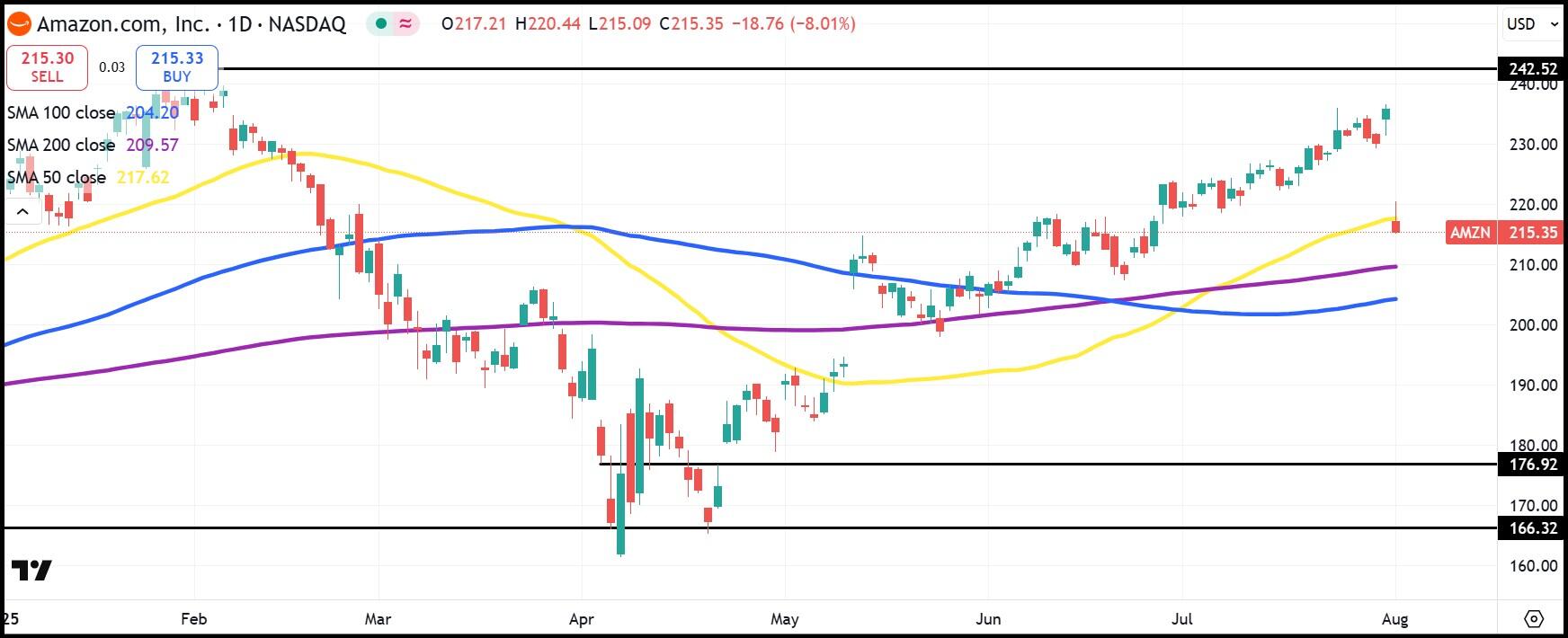
AMZN daily stock chart
Author

Clay Webster
FXStreet
Clay Webster grew up in the US outside Buffalo, New York and Lancaster, Pennsylvania. He began investing after college following the 2008 financial crisis.