Alibaba Stock News and Forecast: BABA bounces off $100 after earnings to close above $108
- BABA shares dropped to $100 near Thursday's open but then rebounded toward $109.
- The Ukraine invasion initially hurt equities, but most tech stocks bounced back in the afternoon.
- Alibaba reported adjusted EPS of $2.67 on revenue of $38.33 billion.
Alibaba (BABA) shares dropped all the way to $100 on Thursday after China's biggest ecommerce company released fiscal Q3 earnings that beat on the bottom line but missed on the top line. The Russian Federation's invasion of Ukraine sent shockwaves through markets on Thursday, and at one point the Russian stock exchange was down 49%. This makes Alibaba's management not entirely culpable for Thursday's share price drop, but shares did rally toward the end of the session alongside the NASDAQ. BABA closed all the way back to $108.93, down 0.7%.
How is Russia-Ukraine war impacting financial markets? Follow our live coverage updates!
Alibaba Stock News: Numbers of reasons converge to slow revenue, earnings growth
Adjusted earnings per share of $2.67 were 5% above the $2.54 consensus figure. Revenue of $38.33 billion was about $500 million short of the average estimate, however. Sales rose about 12% YoY in dollar terms (10% in yuan). This compares with full-year guidance saying BABA should grow revenue between 20% and 23% in 2022. The company estimated that annual active consumers rose to 1.28 billion, an increase of 43 million compared with the most recent prior quarter.
Wall Street was not pleased with the revenue growth, with many analysts saying sales appeared to be slowing long term. The company's cloud unit also failed to live up to expectations. Revenue grew just 20% YoY against global peers growing at a 30-45% clip.
One of the major problems with sales is that Alibaba is still largely focused on its home market. Revenue in China rose just 7% YoY, while foreign revenue rose 18%.
CEO Daniel Zhang said competition in China in the clothing and electronics divisions had hampered growth but that the grocery sector offered better opportunities for ecommerce growth in China.
Adjusted EPS was down more than 20% YoY, but this was expected for several reasons. First, the Chinese economy has been slowing due to Covid-19 lockdowns, which affected revenue as well. Additionally, as part of the Chinese Communist Party's tech crackdown in 2021, Alibaba lost Key Software Enterprise status. This means that the company now has to pay higher tax rates on its earnings which reduces EPS going forward. Another factor that cut into earnings is that the company reduced or outright eliminated fees for some merchants on its platform in order to increase retention. These fees should return, however, in future quarters.
Stifel Nicolaus cut its price target on BABA shares from $150 to $135. Alibaba stock also underperformed the general market as the Nasdaq Composite rose 3.3% compared to BABA's -0.7% performance. The KraneShares CSI China Internet ETF (KWEB), a common reference index for Chinese tech ADRs, rose nearly 1% on the day.
Alibaba Stock Forecast: $100 is the new support
BABA stock sold off initially on Thursday, dropping more than 8% at its nadir. The stock bounced off the $100 level in a swift turnaround though. It seems the psychological importance of $100 is too much for bulls to fathom, and enough of them rode in to the rescue. It should be noted that $100 brings BABA stock all the way back to April 2017 prices – nearly five years ago
If $100 is broken, however, then $86 is the only historical point available for those searching for support. This served as support back in December 2016 as can be seen on the weekly chart below. On the upside, $109.76 may serve as resistance. It acted as a support level in November and December of last year and then again in January. By breaking this important level, BABA is demonstrating its willingness to break much lower if any more bad news comes its way, either from the present economic situation or from future political entanglements with the Chinese government.
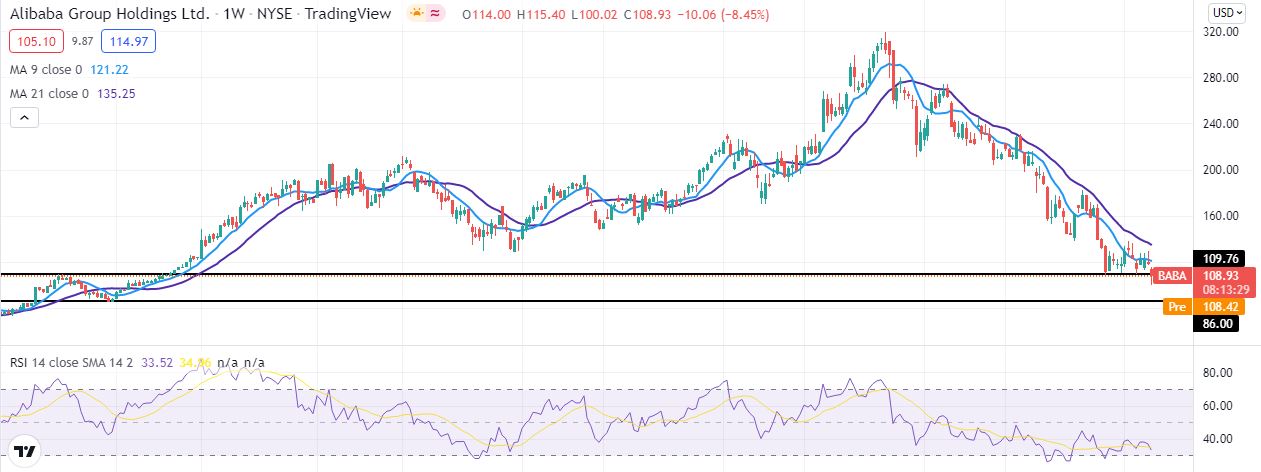
BABA 1-week chart
Like this article? Help us with some feedback by answering this survey:
Author

Clay Webster
FXStreet
Clay Webster grew up in the US outside Buffalo, New York and Lancaster, Pennsylvania. He began investing after college following the 2008 financial crisis.

















