Alibaba Stock Forecast: BABA sinks on earnings release, Disney gains afterhours on earnings beat
- Alibaba management approves another $25 billion worth of buybacks.
- BABA trades lower as profits fall from a year ago, revenue growth slows.
- Alibaba stock continues to trade about 75% off its 2020 high of $319.
- Retail sales have slowed nationwide in China as real estate bubble unwinds.

Alibaba (BABA), still a retail and digital powerhouse in China, hit yet another snag on Wednesday. China’s ecommerce leader reported another ho-hum earnings report, this time for the fiscal third quarter ending in December.
BABA stock shed 5.9% on Wednesday as adjusted earnings per American depository share (EPADS) printed at $2.67. This was slightly higher than consensus but beneath the $2.79 earned one year prior.
The S&P 500 rose 0.82% on Wednesday, while the NASDAQ gained 0.95%. KraneShares CSI China Internet ETF (KWEB) declined 2.1% on the day, while popular Chinese EV stock Nio (NIO) gave up 2.9%. The Walt Disney Company (DIS) rose close to the same percentage afterhours due to an earnings beat as Alibaba shed during the regular session.
Alibaba stock earnings news
Alibaba revenue of $36.67 billion rose a meager 5% YoY and underperformed some consensus estimates while beating others. Management seemed clear-eyed about the once dynamic company’s situation.
"Our top priority is to reignite the growth of our core businesses, e-commerce and cloud computing,” said Alibaba’s new CEO, Eddie Wu. “We will step up investment to improve users’ core experiences to drive growth in Taobao and Tmall Group and strengthen market leadership in the coming year.”
The company is in the process of splitting up into six distinct units, some of which are expected to eventually hold their own IPOs. Two of the most important segments, Cloud Intelligence and the Taobao & Tmall Group, grew their revenue just 3% and 2%, respectively, on an annual basis in Q3.
Diluted earnings per ADS, similar to GAAP results, came in at $0.80 in fiscal Q3. This fell from $1.49 in the previous quarter ending in September.
The domestic retail segment grew revenue just 1% YoY, but the much smaller domestic wholesale business saw sales rise 23%. Meanwhile, the International Digital Commerce segment, which manages Lazada, Alibaba.com and AliExpress, posted a 44% increase in annual revenue.
Interestingly, Alibaba’s board signed off on a $25 billion addition to its stock buyback policy, but the market panned the extremely large announcement. That buyback would reduce current shares outstanding by about 12.5%.
Nasdaq FAQs
What is the Nasdaq?
The Nasdaq is a stock exchange based in the US that started out life as an electronic stock quotation machine. At first, the Nasdaq only provided quotations for over-the-counter (OTC) stocks but later it became an exchange too. By 1991, the Nasdaq had grown to account for 46% of the entire US securities’ market. In 1998, it became the first stock exchange in the US to provide online trading. The Nasdaq also produces several indices, the most comprehensive of which is the Nasdaq Composite representing all 2,500-plus stocks on the Nasdaq, and the Nasdaq 100.
What is the Nasdaq 100?
The Nasdaq 100 is a large-cap index made up of 100 non-financial companies from the Nasdaq stock exchange. Although it only includes a fraction of the thousands of stocks in the Nasdaq, it accounts for over 90% of the movement. The influence of each company on the index is market-cap weighted. The Nasdaq 100 includes companies with a significant focus on technology although it also encompasses companies from other industries and from outside the US. The average annual return of the Nasdaq 100 has been 17.23% since 1986.
How can I trade the Nasdaq 100?
There are a number of ways to trade the Nasdaq 100. Most retail brokers and spread betting platforms offer bets using Contracts for Difference (CFD). For longer-term investors, Exchange-Traded Funds (ETFs) trade like shares that mimic the movement of the index without the investor needing to buy all 100 constituent companies. An example ETF is the Invesco QQQ Trust (QQQ). Nasdaq 100 futures contracts allow traders to speculate on the future direction of the index. Options provide the right, but not the obligation, to buy or sell the Nasdaq 100 at a specific price (strike price) in the future.
What Factors Drive the Nasdaq 100
Many different factors drive the Nasdaq 100 but mainly it is the aggregate performance of the component companies revealed in their quarterly and annual company earnings reports. US and global macroeconomic data also contributes as it impacts on investor sentiment, which if positive drives gains. The level of interest rates, set by the Federal Reserve (Fed), also influences the Nasdaq 100 as it affects the cost of credit, on which many corporations are heavily reliant. As such the level of inflation can be a major driver too as well as other metrics which impact on the decisions of the Fed.
Alibaba stock forecast
Alibaba stock has been trading largely sideways for much of the past two years after its large-scale collapse in 2021. Shareholders have grown used to BABA stock trending in the $60s and $70s, prices it traded at a full decade ago. Following the covid pandemic, China has been dealing with a long, drawn-out real estate crash that has hampered domestic trade in the Chinese economy and damaged the nation's stock market.
The 50-day Simple Moving Average has remained below the 100-day counterpart since October 16 of last year. With the fiscal Q3 result in the bag, there are no near-term catalysts for BABA. Even an extremely generous $25 billion buyback announcement couldn’t whet appetites.
Near-term support might hold at $73.28, a long-term fortification from March 2022. Further down, the $67 level from January might again come to the rescue. Otherwise, bulls may have to wait for entry at $63.40, a level that saw measured respect in October 2022.
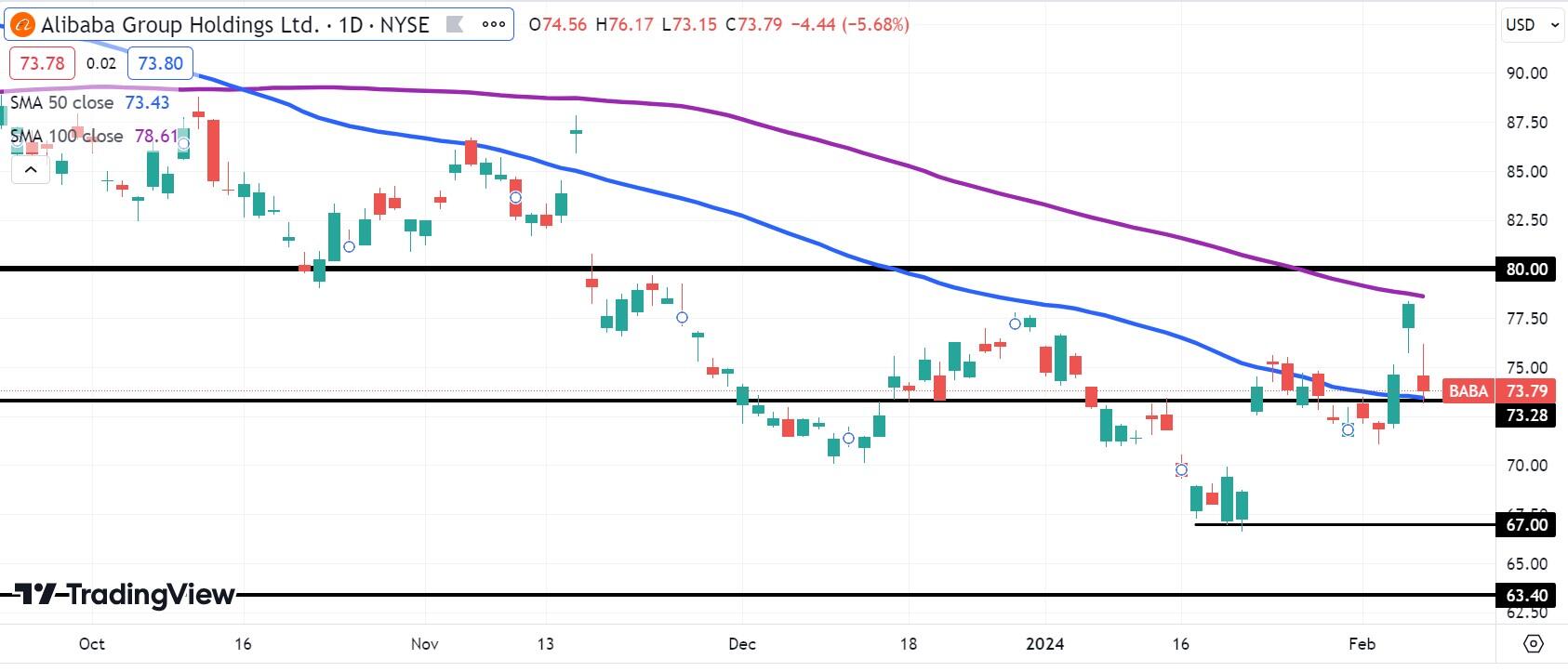
BABA daily stock chart
(This story was corrected on February 8 at 12:50 GMT to say that the S&P 500 rose 0.82% on Wednesday, while the NASDAQ gained 0.95%.)
Author

Clay Webster
FXStreet
Clay Webster grew up in the US outside Buffalo, New York and Lancaster, Pennsylvania. He began investing after college following the 2008 financial crisis.

















