AI stocks on the rise: How to invest in AI in 2024

You must have caught the frenzy that surrounds AI firms if you are an investor or if you feel like investing soon. The shares of those companies are on the rise. The AI market size is expected to show an annual growth rate of 28.46% and reach $826.70bn in 2030, so this is not a short-lasting trend.
However, where exactly are you supposed to start when it comes to investing in such a field? What kind of knowledge and skills should you possess in order to make money through AI stocks? Follow along as we explore these and other related issues in this article.

Before you start
First of all, there are several ways to earn money through AI stocks. You can either trade or invest in them. If you have no experience in these activities whatsoever, consider learning the basics of investment first. We recommend you try out this trading course for free — it was created by Andre Witzel, an experienced trader who knows all the peculiarities of financial markets.
If you already have some knowledge about the markets, there are a few things you should know about investing in AI:
- The artificial intelligence sector is not only about robotics. AI is much broader — it includes voice assistants and data analysis tools, among others. Do not confine your mind to just robots.
- It is quite unstable. Similarly to any other sector in technology, there can be enormous volatility in the AI market. Buckle up for a rough journey.
- There are many players in this field and everyone wants some share from it; thus there are numerous alternatives but also many firms that may fail.
Having understood this, we will now discuss ways to invest in this area.

Step 1: Educate yourself
Before you invest, you need to do your homework. Here's a quick to-do list:
- Read AI news daily. Follow websites or even social media pages that focus on tech news.
- Learn the industry’s lingo. Understand terms like machine learning, neural networks, and natural language processing.
- Study successful AI companies. Look at their business models, products, and growth strategies.
Step 2: Choose your investment method
There are several methods of investing in artificial intelligence. Choose the one that suits your risk tolerance and style:
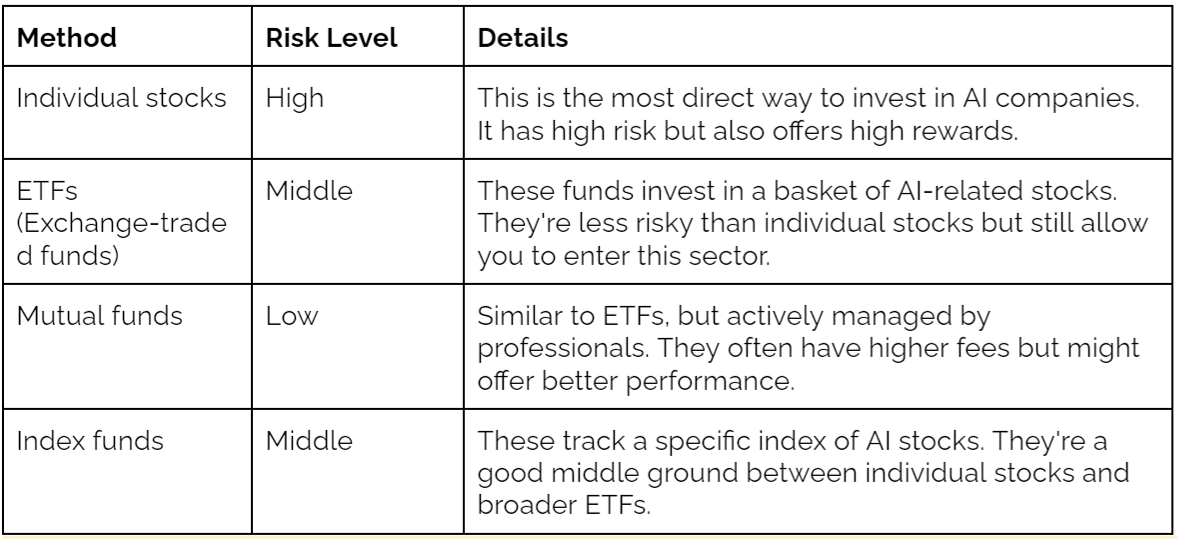

Step 3: Pick your stocks or funds
If you want to buy individual stocks, you can pick from both big tech and small, new companies. These top AI players have shown consistently high performance:
- NVIDIA (NVDA): They have taken the lead in the artificial intelligence chip, GPU, and software development.
- Microsoft (MSFT): The partnership with OpenAI, the creator of ChatGPT, has brought Microsoft to the forefront of this field.
- Amazon (AMZN): Amazon provides machine learning and AI services to businesses and employs artificial intelligence in Alexa.
- Taiwan Semiconductor Manufacturing (TSM): Since AI increases the demand for powerful processors, investing in such an established chipmaker may be less risky than other investments. A less flashy but crucial player.
For ETFs, check out options like:
- iShares Exponential Technologies ETF (XT)
- Defiance Machine Learning & Quantum Computing ETF (QTUM)
- ROBO Global Robotics & Automation Index ETF (ROBO)
Step 4: Determine your investment amount
You wouldn’t want to risk your entire portfolio when investing in this new market. Here are the main rules for choosing the right amount to invest:
- No more than 5-10% of your capital should be invested in one sector (which includes AI).
- No more than 5% should be put into one stock within the chosen sector.
Step 5: Monitor and adjust
How fantastic would it be to just invest and move on? Not with AI stocks — you’ll have to stay involved.
- Set up news alerts for your stocks or funds.
- Review your investments quarterly. Are they performing as expected?
- Be prepared to sell if a company's fundamentals change or if your investment thesis no longer holds.
Lastly, there is no guarantee in the stock market. Research and try out different risk management strategies and follow the news carefully to secure your finances.
Author

Percival Knight
BinaryOptions.com
Percival Knight began his journey into the financial markets in 2015 by trading binary options on a brokerage platform in London.