|

Why Binance Coin price could crash below $300

  • Binance Coin price inches closer to a major capitulation zone. 
  • Significant downside pressure to levels not seen since March 2021 is increasingly likely. 
  • Bulls have limited time to stave off a significant crash.

Binance Coin price, like the rest of the cryptocurrency market, is at risk of a major crash if it fails to hold onto its last levels of support. 

Binance Coin price action is on pace to fall another 40%

Binance Coin price has one primary support structure left on its weekly chart: the $340 to $360 value area where the bottom of the Ichimoku Cloud (Senkou Span B) and the 2021 Volume Point of Control exist. 

Nearly all the conditions for an Ideal Bearish Ichimoku Breakout of Binance Coin price are present:

  1. The current close is below the Tenkan-Sen and the Kijun-Sen. 
  2. The Tenkan-Sen below the Kijun-Sen. 
  3. Future Senkou Span A is below Senkou Span B. 
  4. Chikou Span is below the bodies of the candlesticks and in open space (a condition where the Chikou Span won’t intercept, horizontally, the body of any candlestick over the next five to ten periods). 
  5. The current close is below the Cloud. 

The only condition missing is number five. A close at or below $359 would confirm an Ideal Bearish Ichimoku Breakout. Additionally, a close at $359 would put BNB below the final major support from 2021’s high-volume node. From there, Binance Coin price could collapse towards the 100% Fibonacci expansion at $231. 
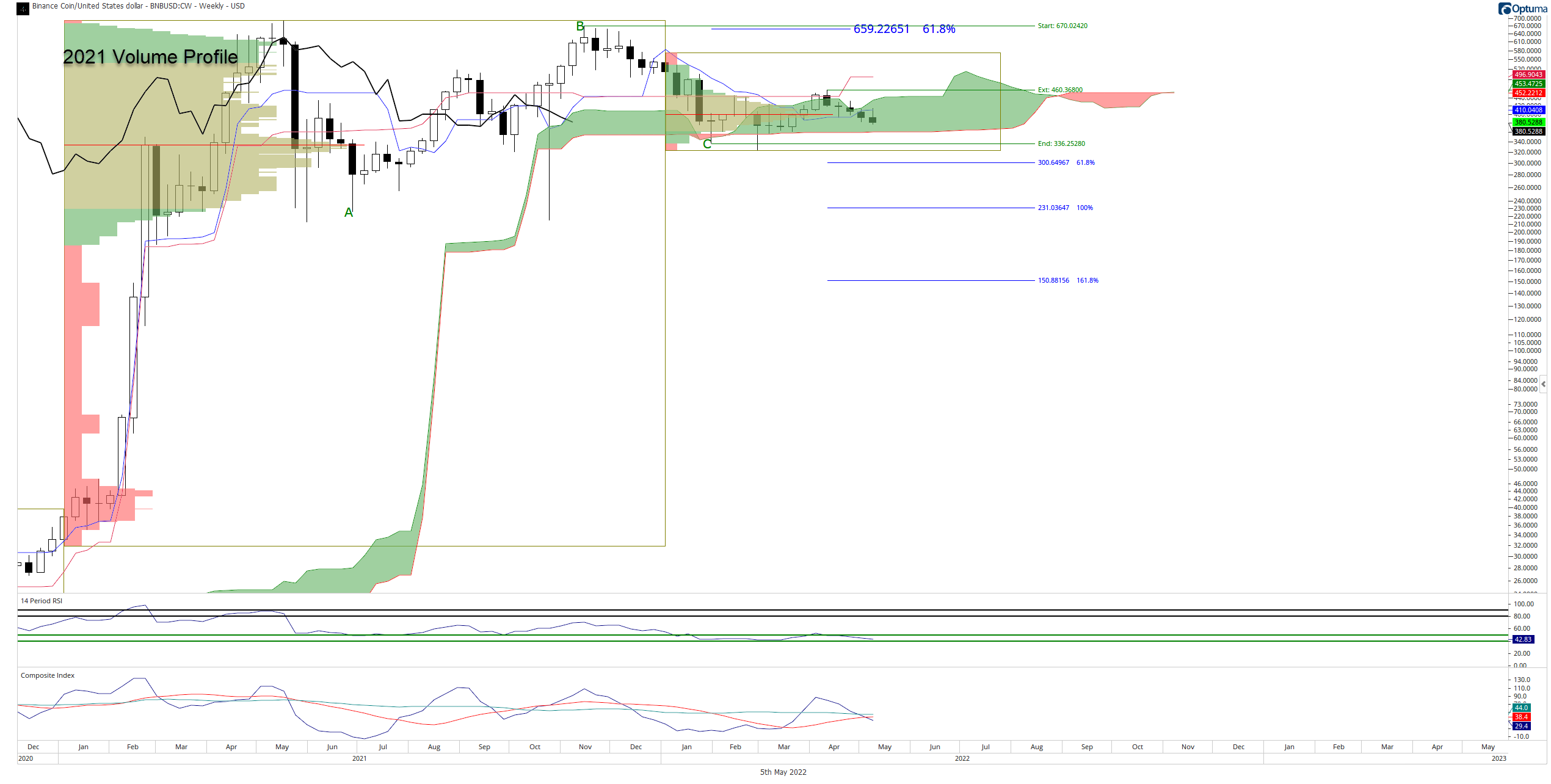
BNB/USDT Weekly Ichimoku Kinko Hyo Chart

If Binance Coin price bulls want to invalidate any near-term bearish outlook, they’ll need to pursue a weekly close above the Ichimoku Cloud at or above $444. If that occurs, the beginning of a new uptrend may not be far away.


Author

Jonathan Morgan

Jonathan Morgan

Independent Analyst

Jonathan has been working as an Independent future, forex, and cryptocurrency trader and analyst for 8 years. He also has been writing for the past 5 years.


More from Jonathan Morgan
Share:

Markets move fast. We move first.

Orange Juice Newsletter brings you expert driven insights - not headlines. Every day on your inbox.

By subscribing you agree to our Terms and conditions.

Editor's Picks

Avalanche struggles near $12 as Grayscale files updated form for ETF

Avalanche trades close to $12 by press time on Wednesday, extending the nearly 2% drop from the previous day. Grayscale filed an updated form to convert its Avalanche-focused Trust into an ETF with the US Securities and Exchange Commission.

Bitcoin slips below $87,000 as ETF outflows intensify, whale participation declines

Bitcoin price continues to trade around $86,770 on Wednesday, after failing to break above the $90,000 resistance. US-listed spot ETFs record an outflow of $188.64 million on Tuesday, marking the fourth consecutive day of withdrawals.

Michael Selig assumes role as new CFTC Chair, what does this mean for crypto?

Michael Selig has been sworn in to serve as the 16th Chairman of the Commodity Futures Trading Commission. Selig was confirmed by the US Senate to head the commission last week, following his October nomination by the US President Donald Trump.

Crypto.com hires sports trader for event prediction market-making

Crypto.com plans to recruit a quant trader for the sports market-making team to buy and sell financial contracts related to these events. Opponents argue that internal trading desks put operators or their affiliates on the opposite side of customer trades. 

Orange Juice Newsletter – Smart insights by real people. Every day.

A free newsletter highlighting key market trends to help traders stay a step ahead. Daily insights on the most relevant trading topics, compiled by our experts in an easy-to-read format so you never miss an important move.

Bitcoin: Fed delivers, yet fails to impress BTC traders

Bitcoin (BTC) continues de trade within the recent consolidation phase, hovering around $92,000 at the time of writing on Friday, as investors digest the Federal Reserve’s (Fed) cautious December rate cut and its implications for risk assets.