|

VeChain (VET/USD) Elliott Wave technical analysis [Video]

VET/USD Elliott Wave technical analysis

  • Function: Trend Following.

  • Mode: Motive.

  • Structure: Impulse.

  • Position: Wave II.

  • Direction of higher degree: Pending.

  • Wave invalid level: Not Specified.

VET/USD trading strategy – Daily chart

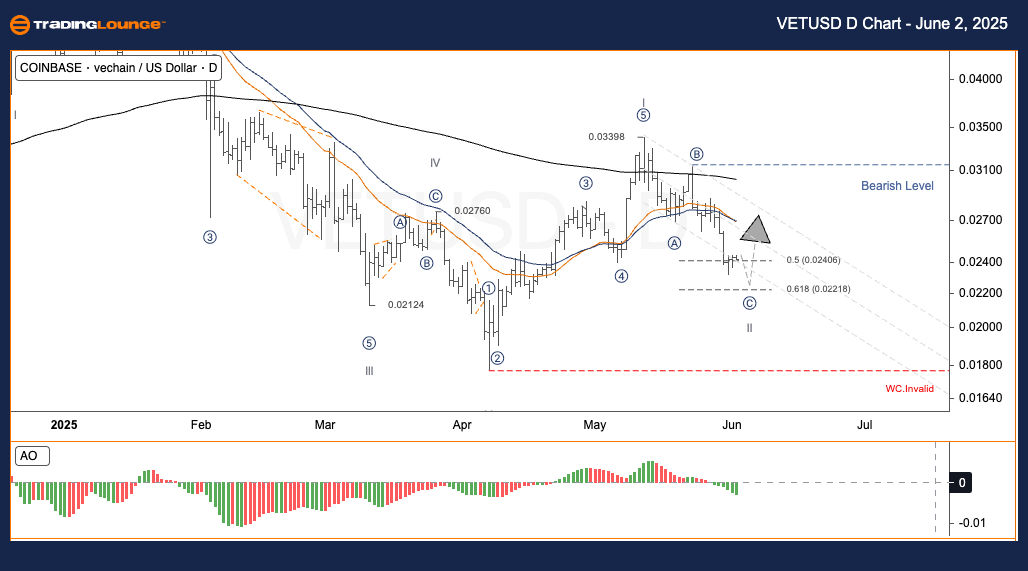
Following the major Wave V bottom at $0.0212, VETUSD advanced to $0.0315 during the sub-wave ⑤. This rise marks the beginning of a correction phase labeled A-B-C, signaling a pause in the larger bullish structure.

Currently, VETUSD is nearing the end of wave C. The price is testing a key Fibonacci support area between 0.5–0.618 retracement levels. Historically, this zone often acts as a launchpad for new upward movements after corrections.

Trading strategies

  • For swing traders
    • Look for a dip-buying chance between $0.022 and $0.024 if a reversal signal appears.
  • Risk management
    • Place a stop-loss order under $0.018 to control risk exposure.
Chart

VET/USD Elliott Wave technical analysis

  • Function: Trend Following
  • Mode: Motive
  • Structure: Impulse
  • Position: Wave II
  • Direction of Higher Degree: Pending
  • Wave Invalid Level: Not Specified

VET/USD trading strategy – Four-hour chart

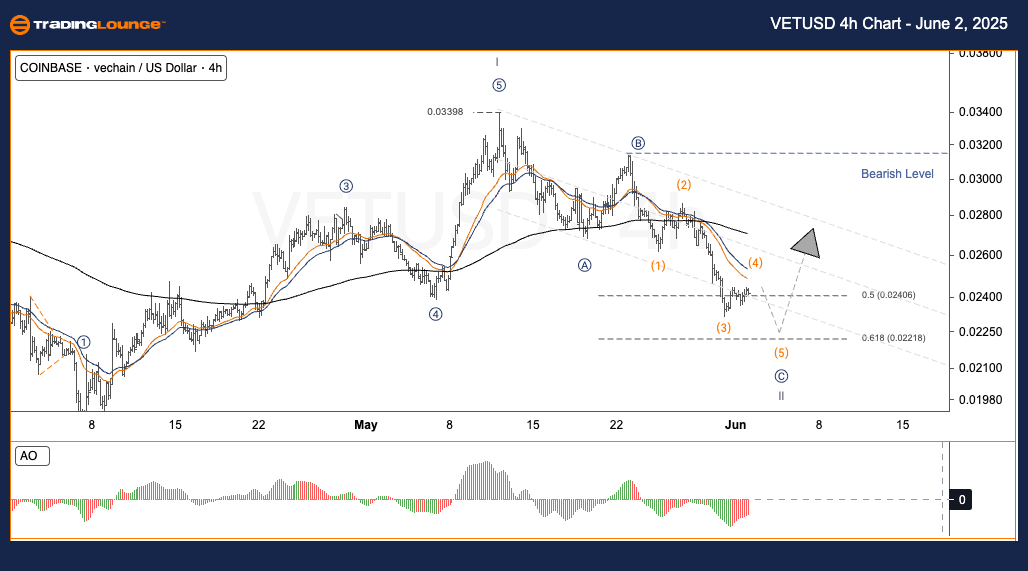
VETUSD rose from $0.0212 to $0.0315, ending sub-wave ⑤. Since then, it has entered a corrective A-B-C pattern, aligning with the broader bullish cycle.

As wave C approaches its end, the Fibonacci 0.5–0.618 support zone becomes critical. It is often where market reversals form post-correction.

Trading strategies

  • For swing traders
    • Watch for dip entries in the $0.022–$0.024 range, confirming a reversal pattern.
  • Risk management
    • A stop-loss below $0.018 is advised to manage potential downside.
Chart

VeChain (VET/USD) Elliott Wave technical analysis [Video]

Author

Peter Mathers

Peter Mathers

TradingLounge

Peter Mathers started actively trading in 1982. He began his career at Hoei and Shoin, a Japanese futures trading company.


More from Peter Mathers
Share:

Markets move fast. We move first.

Orange Juice Newsletter brings you expert driven insights - not headlines. Every day on your inbox.

By subscribing you agree to our Terms and conditions.

Editor's Picks

Avalanche struggles near $12 as Grayscale files updated form for ETF

Avalanche trades close to $12 by press time on Wednesday, extending the nearly 2% drop from the previous day. Grayscale filed an updated form to convert its Avalanche-focused Trust into an ETF with the US Securities and Exchange Commission.

Bitcoin slips below $87,000 as ETF outflows intensify, whale participation declines

Bitcoin price continues to trade around $86,770 on Wednesday, after failing to break above the $90,000 resistance. US-listed spot ETFs record an outflow of $188.64 million on Tuesday, marking the fourth consecutive day of withdrawals.

Michael Selig assumes role as new CFTC Chair, what does this mean for crypto?

Michael Selig has been sworn in to serve as the 16th Chairman of the Commodity Futures Trading Commission. Selig was confirmed by the US Senate to head the commission last week, following his October nomination by the US President Donald Trump.

Crypto.com hires sports trader for event prediction market-making

Crypto.com plans to recruit a quant trader for the sports market-making team to buy and sell financial contracts related to these events. Opponents argue that internal trading desks put operators or their affiliates on the opposite side of customer trades. 

Orange Juice Newsletter – Smart insights by real people. Every day.

A free newsletter highlighting key market trends to help traders stay a step ahead. Daily insights on the most relevant trading topics, compiled by our experts in an easy-to-read format so you never miss an important move.

Bitcoin: Fed delivers, yet fails to impress BTC traders

Bitcoin (BTC) continues de trade within the recent consolidation phase, hovering around $92,000 at the time of writing on Friday, as investors digest the Federal Reserve’s (Fed) cautious December rate cut and its implications for risk assets.