Uniswap’s UNI jumps 15% as governance vote to expand fee switch gains momentum

UNI climbed roughly 15% over the past 24 hours, outperforming bitcoin’s 4.7% gain and ether’s 8.5% rise, as investors reacted to a Uniswap governance vote aimed at broadening the protocol’s revenue capture across multiple layer-2 networks.
If approved, the proposal would expand the so-called fee switch to eight additional chains and replace the current pool-by-pool model with a tier-based v3 system that activates fees across all liquidity pools by default.
Fee switch is the mechanism that redirects a portion of the platform trading fees to the protocol treasury itself from liquidity providers. This captured fee revenue is then used for UNI token buybacks, burns and treasury growth, establishing a direct link between the platform's trading volume and UNI's market value.
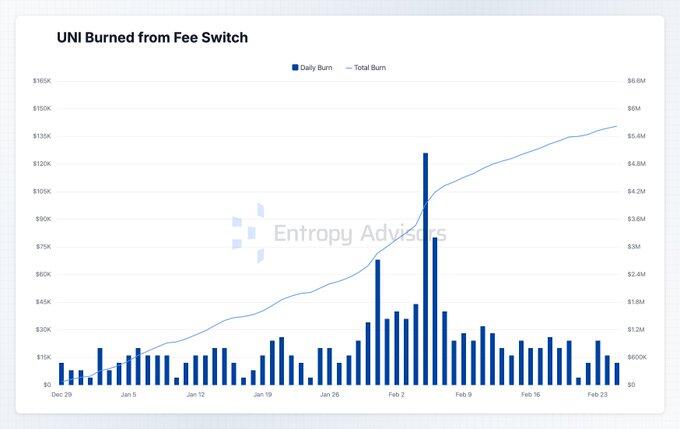
Some estimates suggest the change could add roughly $27 Million in annualized revenue on top of the approximately $34 Million already being generated and used to burn UNI, marking one of the most significant shifts in Uniswap’s token economics since fees were reintroduced late last year.
The governance proposal, split into two onchain votes due to transaction limits, would turn on protocol fees across multiple blockchains. It also introduces a new v3OpenFeeAdapter that applies protocol fees uniformly across liquidity pools based on their fee tier, rather than requiring governance to activate pools individually.
The change would make protocol fee capture automatic for all new v3 pools, reducing manual intervention and potentially broadening revenue collection across long-tail trading pairs.
Since the first phase of the fee switch rollout late last year, Uniswap has already burned more than $5.5 Million worth of UNI, implying an annualized pace of roughly $34 Million at current levels.
The rally comes as crypto markets broadly rebound, with bitcoin up around 4–5% and ether gaining roughly 8% over the same period.
Still, the long-term impact will hinge on whether higher protocol fee capture affects Uniswap’s competitiveness for liquidity on layer-2 networks, where fee-sensitive traders and market makers can migrate to alternative venues.
After years of generating trading volume without meaningful token-holder income, recent quarters show the protocol beginning to retain revenue.
In Q1 2026, Uniswap recorded roughly $3.12 million in gross profit, according to DeFi Llama data, compared with effectively zero in prior periods.
The change follows the gradual activation of the fee switch late last year, which redirected a portion of trading fees toward UNI burns.
If passed, the vote would cement Uniswap’s transition into a cross-chain revenue-generating protocol, with UNI burns increasingly tied to aggregate trading activity beyond Ethereum.
Author

CoinDesk Analysis Team
CoinDesk
CoinDesk is the media platform for the next generation of investors exploring how cryptocurrencies and digital assets are contributing to the evolution of the global financial system.