Uniswap token burn moves closer to reality as 99% voters favor ‘fee switch’ proposal
- Uniswap's proposal to introduce protocol fees has reached quorum, with significant support from UNI holders.
- The plan includes redirecting a portion of trading fees to burn UNI tokens, potentially reducing supply by $130 million annually.
- A one-time burn of 100 million UNI from the treasury is also proposed, aiming to align Uniswap's scale with its token economics.
Uniswap’s long-running debate over how, or whether, the protocol should return value to UNI holders is close to being resolved.
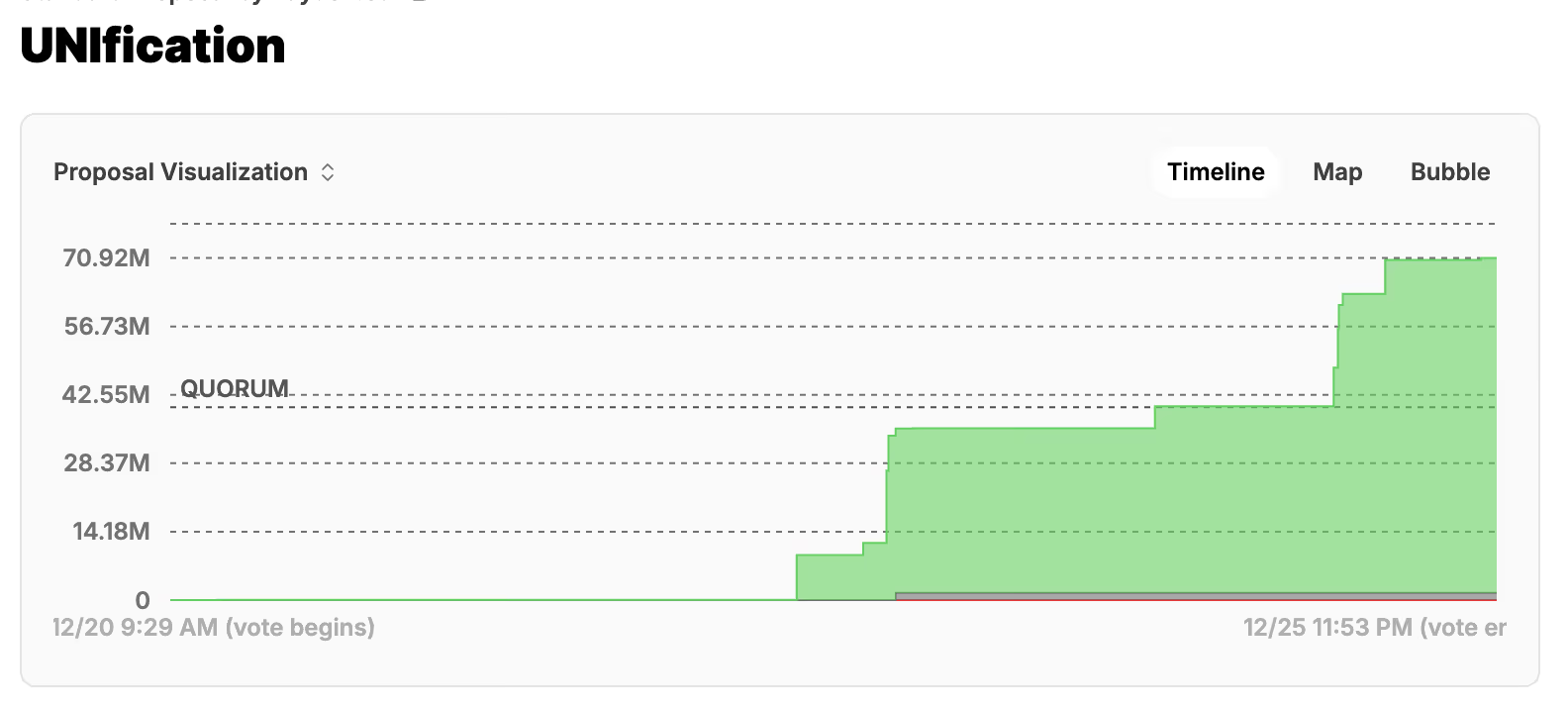
The protocol’s “UNIfication” proposal has already crossed quorum, with more than 69 million UNI tokens voting in favor and virtually no opposition as of Monday. Voting remains open until Dec. 25, but the margin suggests the outcome is largely decided.
At the center of the proposal is a change that UNI holders have waited years for: activating the protocol "fee switch."
The proposal would redirect a portion of trading fees — roughly one-sixth — into a protocol-controlled pool. Those fees would then be used to burn UNI tokens, reducing supply as trading activity grows. Despite being the largest decentralized exchange in crypto, Uniswap has so far routed all trading fees to liquidity providers, leaving UNI as a governance-only token with no direct economic link to the platform’s activity.
The proposal is effectively transforming UNI from a purely governance token into a value-accruing asset by directly linking the token's worth to exchange’s daily trading volume.
Based on current volumes, the fee switch could translate into roughly $130 million a year flowing into the burn mechanism, as CoinDesk analyzed in November.
Alongside the fee switch, the proposal includes a one-time burn of 100 million UNI from the treasury, worth roughly $940 million at current prices.
Uniswap processes close to $150 billion in trading volume every month across more than 30 blockchains, according to DefiLlama data.
Supporters argue that flipping the fee switch finally aligns Uniswap’s scale with its token economics, turning UNI into something closer to a cash-flow-linked governance asset rather than a purely speculative one.
The proposal also reshapes Uniswap’s internal structure. It consolidates Uniswap Labs and the Uniswap Foundation under a single operational and economic model, shifting away from a grant-heavy governance approach toward a more execution-driven setup focused on growth, distribution and protocol competitiveness.
Author

CoinDesk Analysis Team
CoinDesk
CoinDesk is the media platform for the next generation of investors exploring how cryptocurrencies and digital assets are contributing to the evolution of the global financial system.