Top Crypto Gainers: Zcash, Decred, Zora – Privacy coins rally on Winklevoss twins-backed investment
- Zcash reclaims $500 mark as Winklevoss twins-backed Cypherpunk reveals active buying to acquire 5% of total supply.
- Decred extends recovery above $30 as buying pressure resurfaces.
- Zora marks a trend reversal with a 28% rise on Thursday, targeting last week’s high.

Privacy coins, including Zcash (ZEC) and Decred (DCR), outpaced the broader cryptocurrency market over the last 24 hours, as Zora (ZORA) followed suit. Tyler Winklevoss revealed an investment of over $50 million to rebrand Nasdaq-listed Leap Therapeutics (LPTX) as a Zcash treasury company, refueling the rally for privacy coins on Wednesday. Technically, Zcash and Decred could extend gains if momentum holds, while Zora’s breakout rally hits a key resistance.
Zcash rebounds as Winklevoss twins set up ZEC treasury company
Tyler Winklevoss announced the rebranding of Leap Therapeutics as Cypherpunk Technologies (CYPH) with a holding of 203,775 ZEC, representing ~1.25% of the current ZEC supply. Cypherpunk aims to acquire at least 5% of the total ZEC supply.

Tyler further added, “If Bitcoin is digital gold, Zcash is an encrypted Bitcoin, or digital cash. One is your store of value, the other is how you privately move your value. We’ve been tracking this symbiosis for years and believe that now — as we enter the age of AI — is the right time to begin accumulating ZEC.”
The Winklevoss twins anticipate that the price of a single BTC will reach $1 million within the next five years.
At the time of writing, Zcash trades above $500 on Thursday, bouncing off a local support trendline formed by connecting the lows of October 17 and 23. The rebound in ZEC targets the $684 peak from Monday as it surfaces above the 50-period Exponential Moving Average (EMA).
The trend momentum on the 4-hour chart experiences a decline in selling pressure as Moving Average Convergence Divergence (MACD) reverts to the signal line, aiming for a crossover which would indicate a resurgence in buying pressure.
At the same time, the Relative Strength Index (RSI) rebounds to 49, a shift to sell-side dominance to neutral levels. If RSI extends above the midpoint line, it would signal an increase in buying pressure.
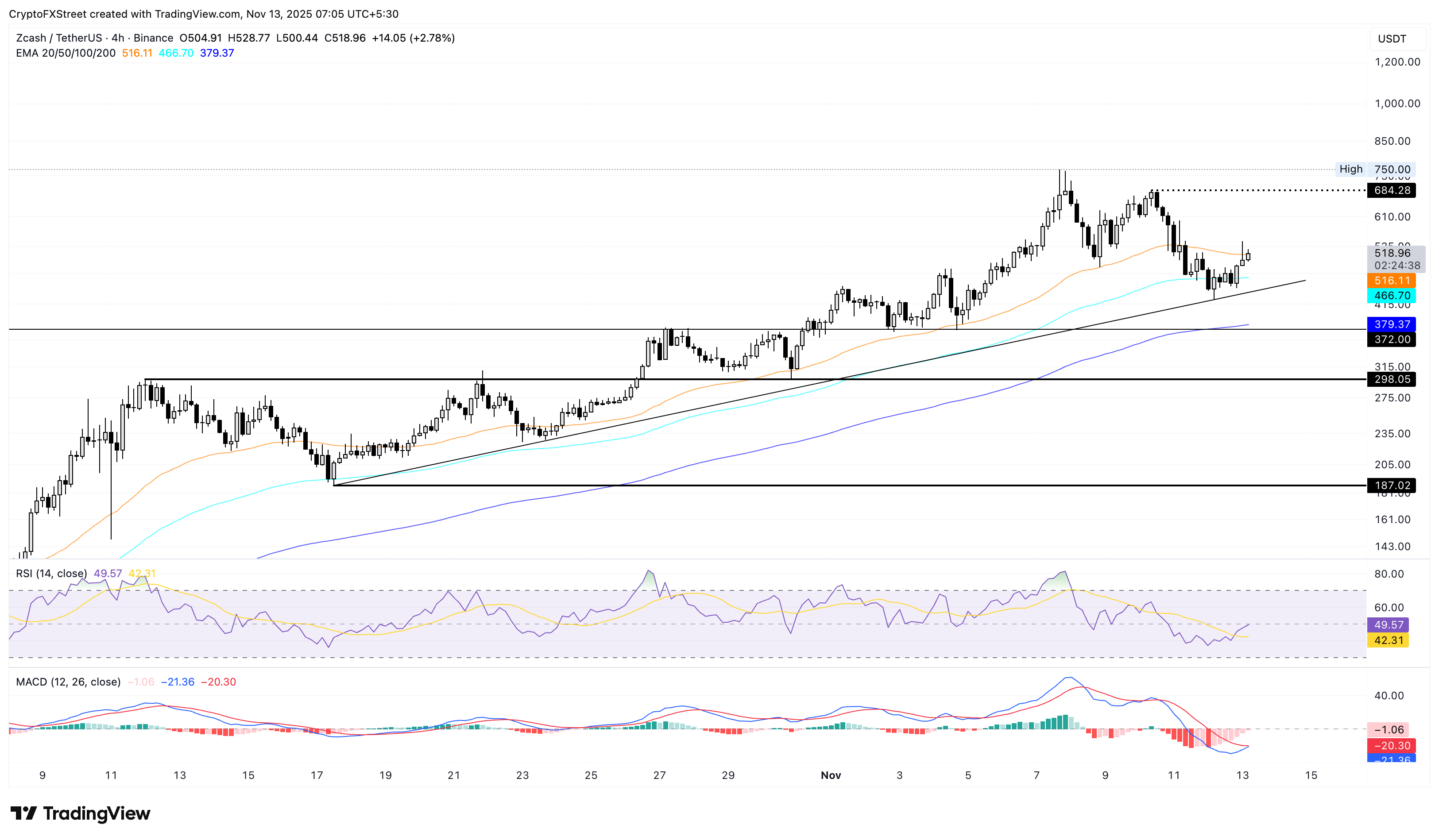
Looking down, ZEC could find support at the rising trendline near $450, followed by the 200-period EMA at $379.
Decred’s recovery gains traction, aiming for $40 breakout
Decred extends its gains by 5% at press time on Thursday, following a 16% surge the previous day. Following the early November rally, which peaked at $70, DCR struggles to reignite the uptrend.
Still, the short-term recovery in the privacy coin aims to reclaim the $40 mark to challenge Sunday’s peak at $45. If successful, Decred could target the $50 psychological mark followed by the $70 peak.
The momentum indicators on the 4-hour chart indicate a steady increase in buying pressure as the RSI at 58 extends into the upward direction with further room for growth before reaching the overbought zone.
Meanwhile, the MACD and signal line remain above the zero line, moving upward, indicating consistent bullish momentum.
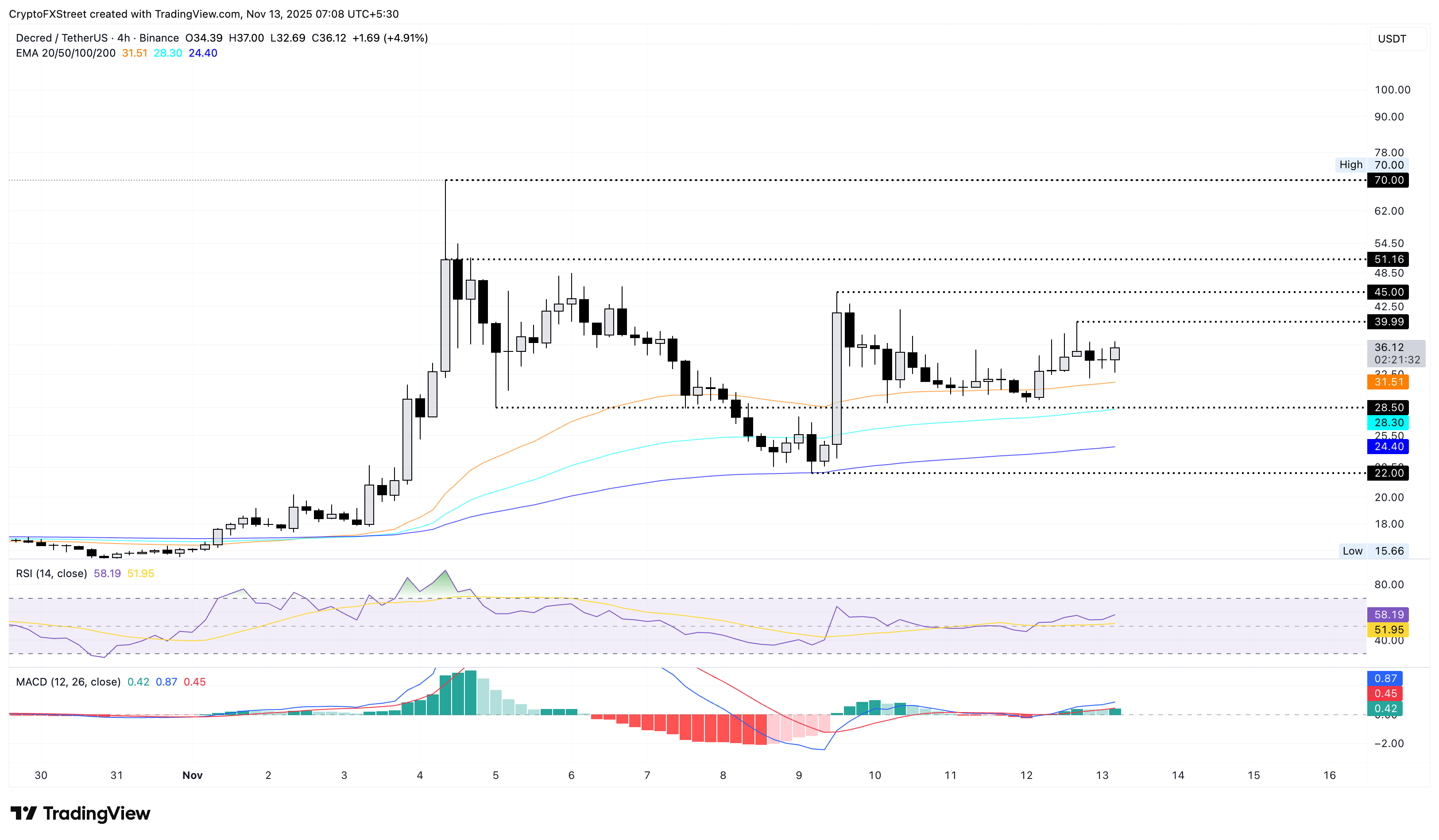
On the flip side, the $28 and $22 lows from November 5 and Sunday, respectively, could serve as support for Decred.
Zora’s breakout rally struggles at last week’s high
Zora, a layer-2 of the Base ecosystem, has experienced a 28% surge so far on Thursday, marking a breakout of the local resistance trendline and a revival of the bullish trend. ZORA faces resistance at the $0.07277 high from November 5, which serves as the immediate resistance.
A potential close above this level could confirm a breakout rally, targeting the $0.09150 high from October 28.
The intraday surge tilts the technical indicators bullish on the 4-hour chart, as the MACD crosses above the signal line, while the RSI is at 67, closer to the overbought zone.
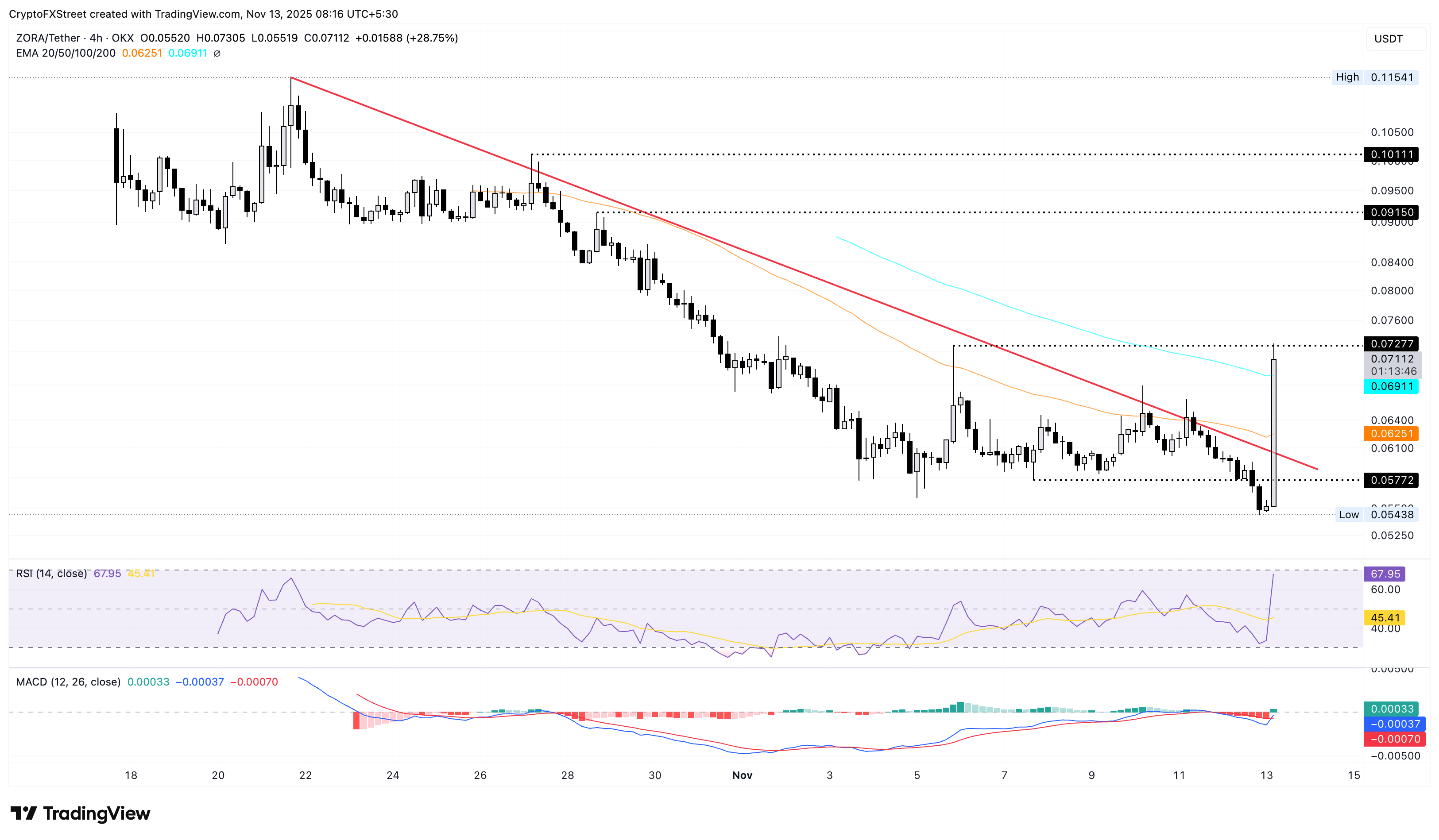
If ZORA fails to extend the breakout rally, a potential reversal could test the lows of Friday and Wednesday at $0.05772 or $0.05438, respectively.
Author

Vishal Dixit
FXStreet
Vishal Dixit holds a B.Sc. in Chemistry from Wilson College but found his true calling in the world of crypto.