Tariff uncertainty sends Bitcoin below $65,000 and wipes billion from crypto markets
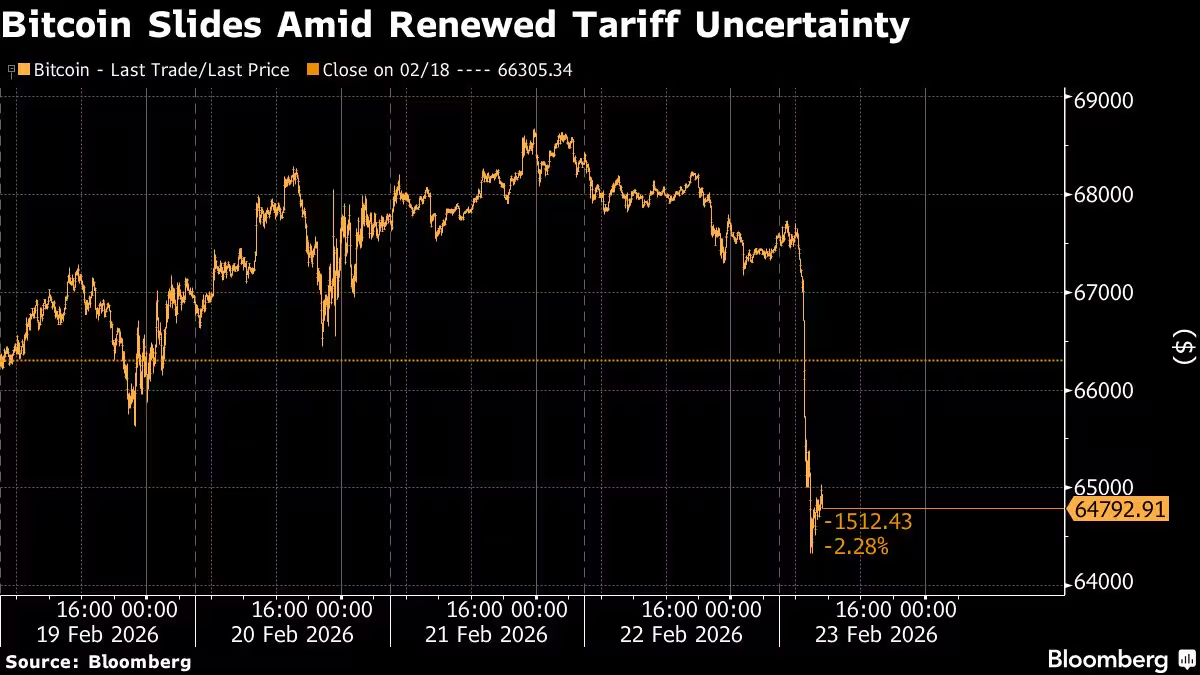
- Bitcoin dropped to $64,300 amid confusion over new US trade tariffs.
- Crypto market lost $100 billion in a day, liquidating 130,000 traders.
- Fear & Greed Index hit 5 as investors rotated into gold.

Bitcoin dropped to $64,300 on Monday, a price level last seen on February 6, as investors dumped risk assets in response to escalating confusion around US trade tariff policy. Ethereum fell below $1,870 in tandem. In under 24 hours, the total crypto market shed more than $100 billion, bringing cumulative losses tied to the current macro pressure past $2 trillion.
The Crypto Fear & Greed Index collapsed to a reading of 5-6, deep inside "Extreme Fear" territory. More than 130,000 traders faced liquidations totaling over $458 million, with altcoins absorbing some of the steepest cuts — Solana, XRP, and Avalanche each fell between 6% and 9%.
The immediate trigger came from Washington. After the US Supreme Court struck down President Trump's initial tariff proposal, the administration responded with a new plan for a flat 15% global tariff.
The crypto market continues to be fragile, with market participants counting on support at $60,000,” said Caroline Mauron, co-founder of Orbit Markets. “Macro uncertainty is now weighing on the market, from Iran geopolitical tensions to US tariffs whiplash, and may lead to another test of that level.
The back-and-forth produced exactly the kind of policy whiplash that pushes capital out of volatile assets. Gold climbed over 2% as investors rotated into traditional safe havens. Bitcoin ETFs recorded continued outflows, adding direct selling pressure on top of the macro-driven exit.
Analysts described the setup as textbook risk-off behavior: macro uncertainty prompts investors to prioritize cash and bonds, and crypto — still perceived by much of the institutional world as a high-beta growth asset — absorbs the first wave of redemptions.
Bitcoin's key price levels after the drop
Traders now watch a narrow set of price zones to determine whether the sell-off stabilizes or deepens.
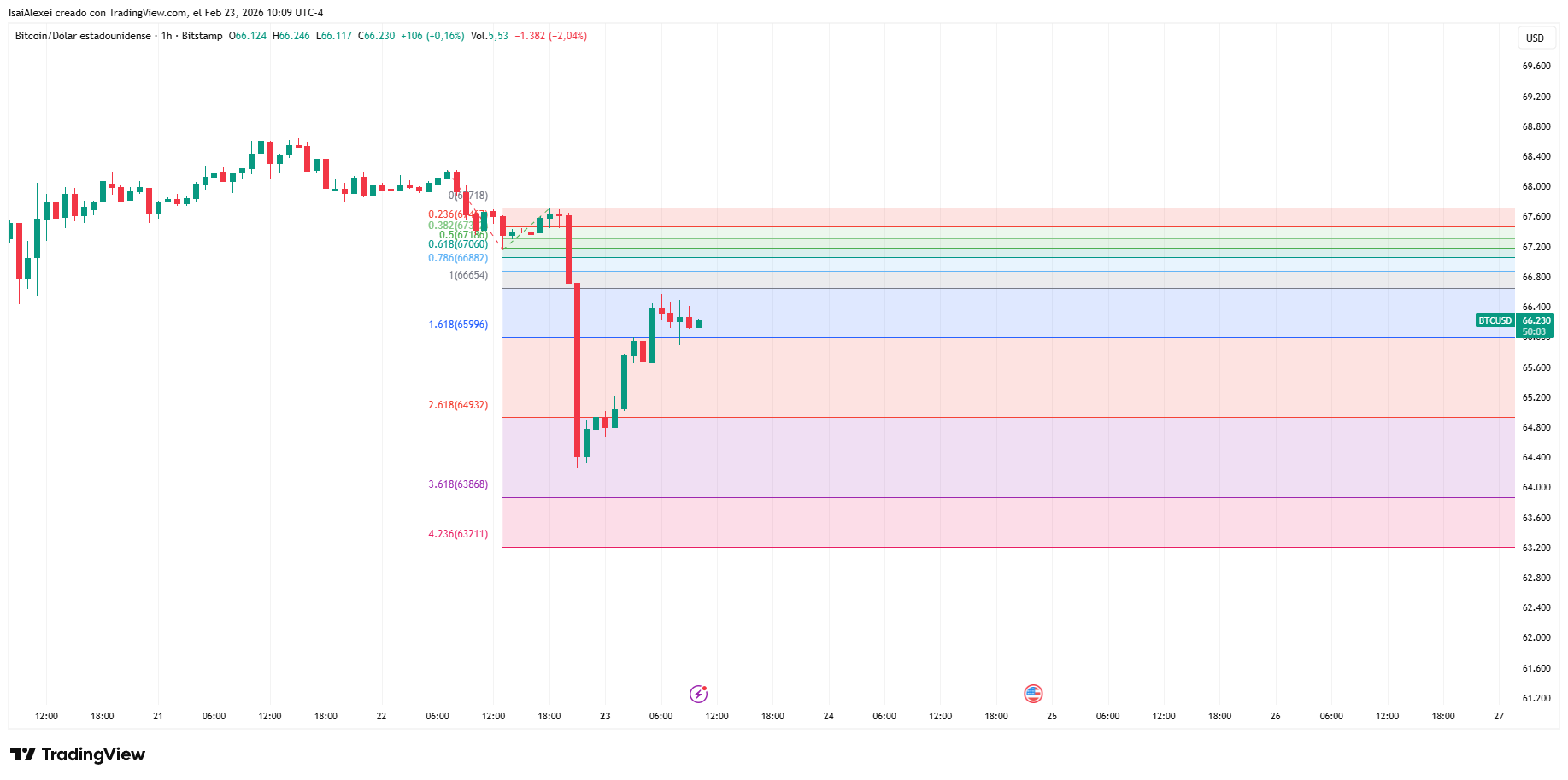
The $60,000–$62,000 range represents the first major technical and psychological floor below current prices. Many buyers treated prior corrections at similar levels as entry points, and analysts expect demand to return in that band if Bitcoin continues to slide. The 61.8% Fibonacci retracement, known among technical traders as the Golden Pocket, sits near $61,000 and historically attracts buying interest during corrections.
Below that, the $52,000–$55,000 zone functions as a secondary floor — a prior consolidation area where bulls would need to defend aggressively to prevent a deeper bearish structure from forming. A break there would put the entire 2025 rally in question.
Recovery, analysts say, depends less on crypto-specific factors and more on a macro shift. Three conditions dominate the discussion: a clear resolution or de-escalation on tariff policy, a reversal of ETF outflows back into net inflows, and Bitcoin reclaiming the $68,000–$70,000 range as support rather than resistance. Until at least one of those conditions materializes, the market lacks a credible floor, and capital continues to favor gold and short-duration bonds over crypto assets.
The broader read from analysts is consistent: as long as Washington produces policy confusion, crypto markets will price in the uncertainty before equities do.
Author

Isai Alexei
Independent Analyst
I am Isai Alexei. I work as a journalist and financial analyst covering cryptocurrency markets and traditional securities. I have spent ten years analyzing digital assets, trading activity, and market structure.