Hyperliquid and Near Protocol fall sharply as Arthur Hayes dumps HYPE and NEAR for Worldcoin
- Hyperliquid and Near Protocol are down 11% and 17% so far on Thursday, with Arthur Hayes offloading his HYPE and NEAR holdings.
- The exit of the “HYPE” man, citing potential market tops, shifts the retail sentiment bearish and risks influencing other large-wallet investors.
- Hayes shifts focus to Worldcoin, anticipating that the SpaceX IPO could renew capital flows into AI crypto assets.
- Fundamentals for Hyperliquid remain largely unchanged, with steady ETF demand and growing revenues.

Hyperliquid (HYPE) and Near Protocol (NEAR) prices have dropped 11% and 17%, respectively, at press time on Thursday, erasing gains as the well-known investor Arthur Hayes dumps HYPE and NEAR holdings. Hayes takes a sudden exit, citing a potential market top, in the same week after a $100,000 bet that HYPE would outperform the top crypto assets. The reactionary price move crushes retail demand, but fundamentals remain unchanged, which could stabilize the recovery in the long term.
Hayes’ exit leaves HYPE and NEAR hanging
Hyperliquid rallied over 80% in May, as an emerging “everything exchange” offering perpetuals of tokenized Real World Assets (RWAs). Similarly, NEAR’s roughly 80% recovery was linked to the AI buzz around NVIDIA’s first-quarter FY2027 profits of $58 billion.
HYPE and NEAR emerged as among the rising crypto assets, while Bitcoin’s (BTC) declining trend capped most altcoins.
However, recent news about Arthur Hayes, a well-known crypto founder and investor, shocked the crypto market when he dumped all his HYPE and NEAR holdings. On-chain data shows 247,334 HYPE were sold for over $18 million on Thursday, while the amount of NEAR tokens sold remains unknown.
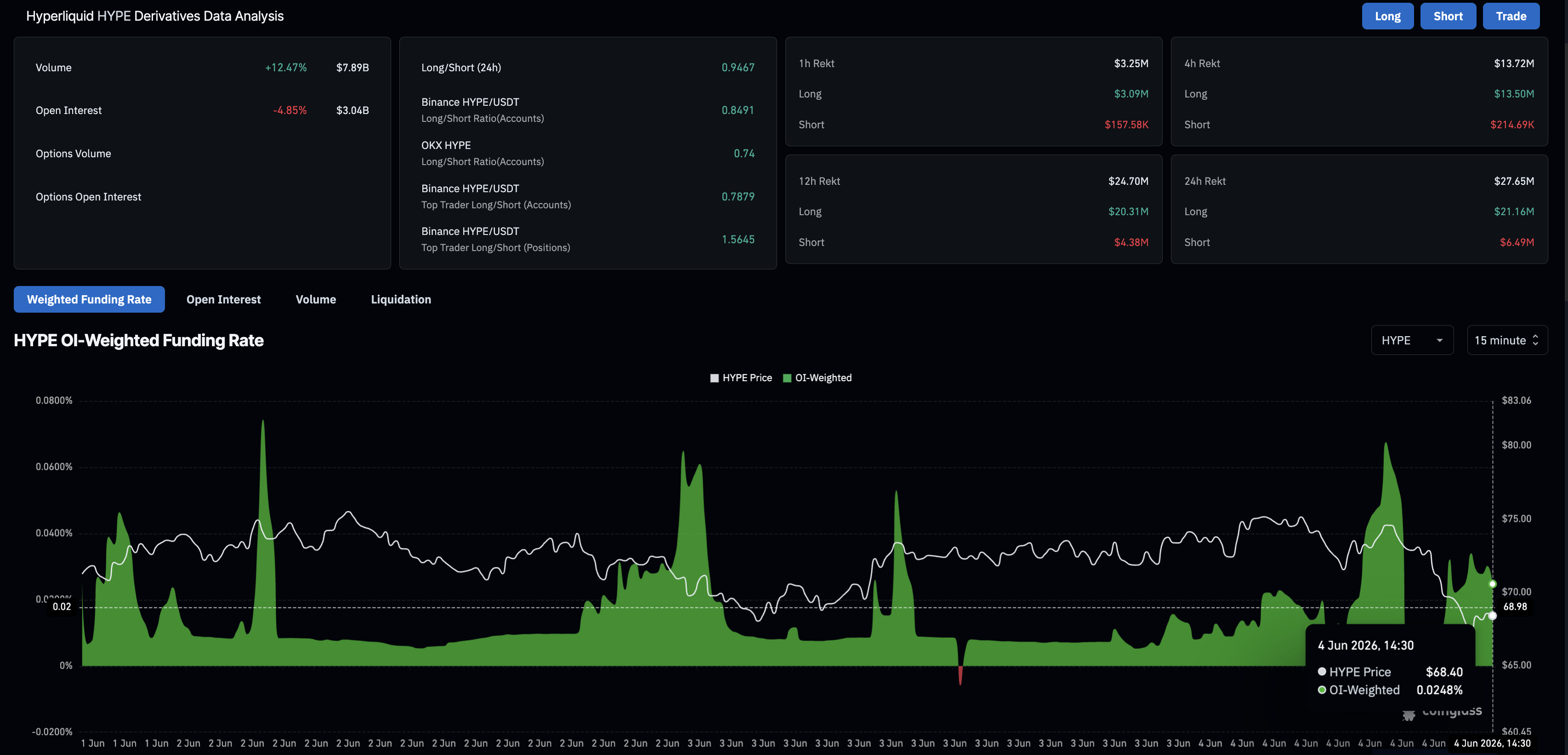
Triggering a market-wide cascade, HYPE is down 11% to $66, and NEAR is down 17% to $2.32, suggesting that Hayes’ exit likely influenced sharp selling. CoinGlass data shows the HYPE futures Open Interest (OI) is down roughly 5% in the last 24 hours to $3.04 billion, while the NEAR OI has dropped over 21% to $546.35 million, driven by $21 million and $10 million in long liquidations.
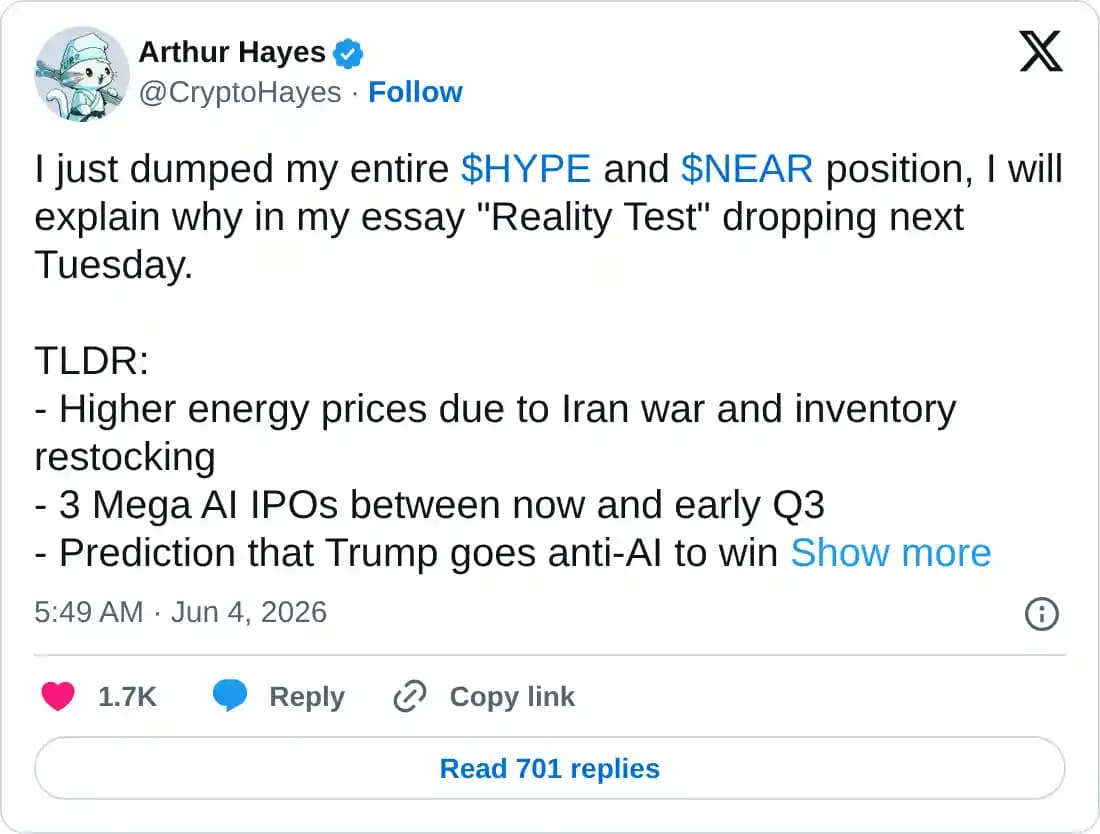
Hayes has announced that he will explain this sale in his “Reality Test” blog on Tuesday, while citing potential market high formations between June and September. Hayes also highlighted threats of higher energy costs and inventory restocking amid the US-Iran war, as well as Initial Public Offerings by SpaceX, Anthropic, and OpenAI, which could weigh on AI-linked assets.
In a subsequent tweet, Hayes positioned Worldcoin (WLD) for short-term gains ahead of SpaceX's IPO next week. Although the WLD token shows no direct link to SpaceX, Hayes likely expects a “Sympathy Rally” in Sam Altman’s crypto project.
“HYPE” man’s exit risks whales’ confidence
Arthur Hayes spotted Hyperliquid in his “$HYPE Man” essay in March, at a price of roughly $30, and anticipated an upside to $150 by August. Hayes held HYPE through three months of a bull run and even placed a $100,000 bet with Kyle Samani that HYPE would outperform top-10 crypto assets in 2026, boosting confidence among large-wallet investors (commonly referred to as whales) across the market.
LookOnChain data shows that multiple whale wallets bought roughly 1.5 million HYPE in total in June, while institutions like Galaxy Digital acquired 179,000 HYPE on Tuesday.
Hayes’ call to spot HYPE around $30 resulted in a 130% gain between March and May, culminating in an all-time high of $75 on June 4. This marked the halfway mark of Hayes’ upside target and led to his untimely dumping of HYPE.
Is this the end for HYPE and NEAR rally?
Hyperliquid’s “everything exchange” narrative remains strong with steady institutional inflows of roughly $140 million since May 12, and the launch of Grayscale’s HYPG ETF on Nasdaq, which includes staking rewards, could sustain the broader market demand. Hyperliquid remains one of the top revenue-generating protocols, second only to Tether’s USDT and Circle’s USDC stablecoins.
Meanwhile, NEAR Protocol’s innovation with Near Intents for cross-chain scalability and its privacy-focused features could sustain long-term growth. However, short-term risks remain for both tokens.
Author

Vishal Dixit
FXStreet
Vishal Dixit holds a B.Sc. in Chemistry from Wilson College but found his true calling in the world of crypto.