Separating Bitcoin from Blockchain, which one has economic value?

Bitcoin purists have stated Bitcoin and blockchain are inseparable. Let's take a look at reality.
Wall Street Built on Blockchain
Please consider As Crypto Slumps, Goldman Sachs Aims for a Wall Street Built on Blockchain
Wall Street’s biggest banks have largely avoided investing directly in cryptocurrencies. But many are quietly working to integrate blockchain, the technology behind crypto, into trading and other businesses.
Goldman Sachs is already trading some bonds and other debt securities for clients on blockchain-based networks such as Ethereum, and the bank is building its own blockchain-based trading platform. JPMorgan Chase already has a platform in place, called Onyx.
Outside of banking, Walmart Inc. has used blockchain for tracking its supply chains. In real estate, some title companies have used it for recording homeownership.
“Blockchain technology is going to rewire all financial services,” said Tom Farley, the former president of the New York Stock Exchange.
That said, Wall Street firms have been experimenting with blockchain projects for at least the past five years. Despite much hype, few have had a widespread impact on how financial transactions take place.
Others have thrown in the towel. A group of European insurance companies formed a consortium called B3i in 2016 to explore blockchain uses in their industry. In July, the consortium shut down after failing to raise new capital.
Blockchain Will Come
Bitcoin cannot be separated from blockchain, but it is already proven that blockchain neither needs nor requires Bitcoin.
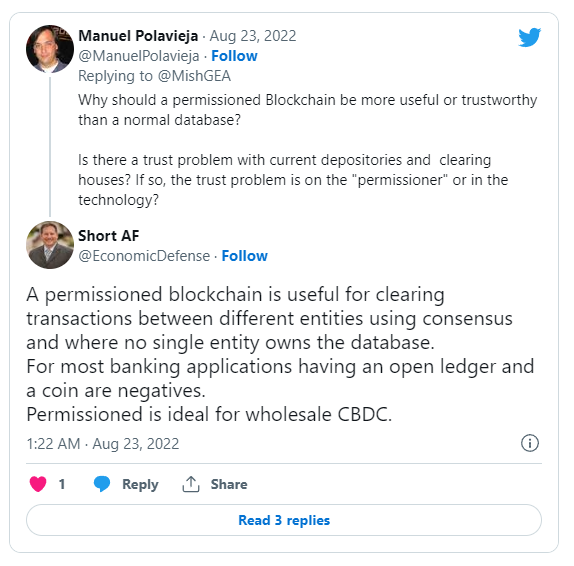
Importantly, Bitcoin is a public, distributed network that requires mining and massive amounts of electricity (proof of work) to function. In contrast, the blockchain systems used by Goldman and Walmart require a permissioned authority.
The alleged advantage of Bitcoin's permissionless, distributed network melts under increasing energy costs to run it, massive ledgers, and conversion costs from Bitcoin to dollars, euros, etc., to function as money.
Permissioned blockchain will eventually be a big winner. And it will be a winner without Bitcoin. Bitcoin is too unstable, too costly for transactional use, and too dependent on energy.
Fun Facts
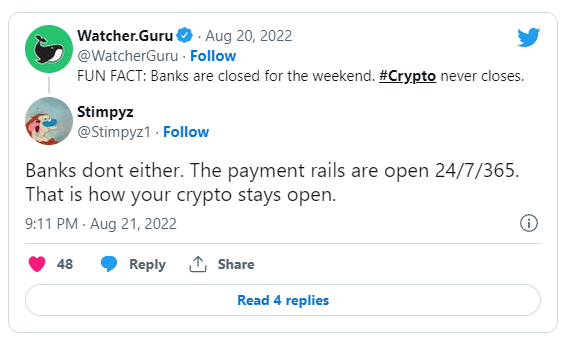
Spare me the sap of being able to send Bitcoin anywhere instantly cheaply. One still has to convert Bitcoin to dollars, euros, yen or whatever to spend it.
Coming soon, central bank digital currencies will truly be 24x7 and costless, albeit with well known flaws including risk of confiscation.
That's an aside. The blockchain technology will succeed, standalone.
Finally, it is beyond idiotic to believe governments will embrace Bitcoin en masse or that it will succeed as money if they don't.
Bitcoin has been amazingly successful as a medium for speculation. But unlike blockchain, Bitcoin will never advance beyond that.
Ironically, the more Bitcoin succeeds as a tool for speculation, the less use it has as money, its original stated purpose.
Why Use Blockchain?
Perceived Value of Bitcoin
Much of the perceived value of Bitcoin is no more that speculative hype. The word "bezzle" is a good description.
Bezzle is a temporary gap between perceived wealth and long term-economic value.
For discussion, please see The Stock Market, Bitcoin, and Housing Fake Wealth Bezzle Will Be Wiped Out.
Author

Mike “Mish” Shedlock's
Sitka Pacific Capital Management,Llc
Mike “Mish” Shedlock is a registered investment advisor for SitkaPacific Capital Management.