SEC files opposition to Coinbase motion for lawsuit dismissal, response due on October 24
- The US SEC has asked the judge to deny a motion by Coinbase Global to dismiss the regulator's lawsuit.
- According to the SEC, Coinbase’s reliance on the recent court ruling on Ripple and Terraform Labs is wrong.
- The regulator stated that the case is about whether Coinbase intermediated transactions involving securities than performing brokerage functions.

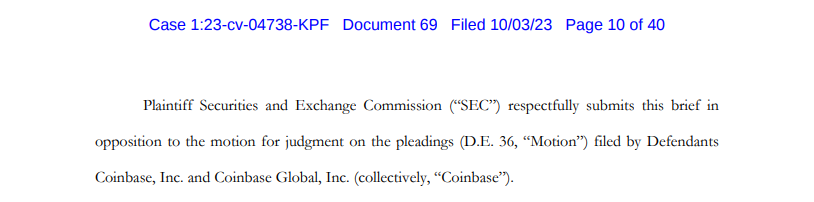
The US Securities and Exchange Commission (SEC) has filed an opposition asking the court to deny Coinbase Exchange’s motion to dismiss the regulator’s lawsuit. The financial watchdog had levied charges against the largest cryptocurrency exchange in the US, pursuing it for failing to register with the agency while it operated unlawfully as a national securities exchange, broker and clearing agency.
Also Read: Coinbase finds acceptance in Spain; continues to struggle in the US at the hands of the SEC
SEC asks judge to deny Coinbase motion to dismiss its lawsuit
The SEC has asked a federal judge at the US Southern District of New York court to deny Coinbase’s motion to dismiss its lawsuit against the US-based crypto exchange.
SEC files opposition against Coinbase
According to the SEC, Coinbase is relying on recent rulings in the Ripple Labs case. To recap, on July 14, Judge Analisa Torres determined that XRP is not a security when sold to the general public unless when sold to institutional investors. The ruling marked a partial win for the SEC and a clear win for Ripple holders.
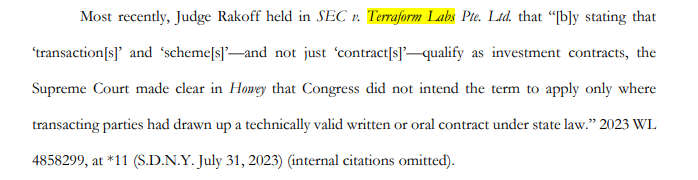
Nevertheless, the SEC believes Coinbase relying on this determination as the foundation for its motion to dismiss is wrong. To solidify its stance, the commission draws reference to the Terraform Labs case, whose ruling rejected the court’s reasoning in the Ripple Labs case.
SEC files opposition against Coinbase
Coinbase CLO Paul Grewal challenges SEC’s claims
In response to the commission’s opposition, Coinbase Chief Legal Officer Paul Grewal has accused the SEC of countlessly making sweeping claims of what the law is or must be without any legal citation.
A preliminary note: over and over again the SEC makes sweeping claims of what the law is/must be without any legal citation. See, e.g., p 8,17-18,21. 2/7
— paulgrewal.eth (@iampaulgrewal) October 3, 2023
Further, Grewal defends that the assets listed on Coinbase “are not securities and are not within the SEC’s jurisdiction. Court decisions over the past several months have made that plain.” In his opinion, the commission’s regulation by enforcement approach overlooks the voice of the 52-million strong crypto constituency in the US calling for rules and regulations for the industry.
Last week, founders from 40+ crypto companies around the country joined @standwithcrypto in DC to tell their representatives to pass legislation that protects consumers, enables innovation, and creates jobs and opportunities in the US. 6/7
— paulgrewal.eth (@iampaulgrewal) October 3, 2023
With this, Grewal asserts that Coinbase will be filing its reply by October 24.
Cryptocurrency metrics FAQs
What is circulating supply?
The developer or creator of each cryptocurrency decides on the total number of tokens that can be minted or issued. Only a certain number of these assets can be minted by mining, staking or other mechanisms. This is defined by the algorithm of the underlying blockchain technology. Since its inception, a total of 19,445,656 BTCs have been mined, which is the circulating supply of Bitcoin. On the other hand, circulating supply can also be decreased via actions such as burning tokens, or mistakenly sending assets to addresses of other incompatible blockchains.
What is market capitalization?
Market capitalization is the result of multiplying the circulating supply of a certain asset by the asset’s current market value. For Bitcoin, the market capitalization at the beginning of August 2023 is above $570 billion, which is the result of the more than 19 million BTC in circulation multiplied by the Bitcoin price around $29,600.
What is trading volume?
Trading volume refers to the total number of tokens for a specific asset that has been transacted or exchanged between buyers and sellers within set trading hours, for example, 24 hours. It is used to gauge market sentiment, this metric combines all volumes on centralized exchanges and decentralized exchanges. Increasing trading volume often denotes the demand for a certain asset as more people are buying and selling the cryptocurrency.
What is funding rate?
Funding rates are a concept designed to encourage traders to take positions and ensure perpetual contract prices match spot markets. It defines a mechanism by exchanges to ensure that future prices and index prices periodic payments regularly converge. When the funding rate is positive, the price of the perpetual contract is higher than the mark price. This means traders who are bullish and have opened long positions pay traders who are in short positions. On the other hand, a negative funding rate means perpetual prices are below the mark price, and hence traders with short positions pay traders who have opened long positions.
Author

Lockridge Okoth
FXStreet
Lockridge is a believer in the transformative power of crypto and the blockchain industry.