Ripple’s RLUSD gets major boost as Amina bank becomes first Global bank supporter
- Amina Bank becomes the first bank globally to support Ripple’s stablecoin directly.
- Ripple applies for a US national banking license and a Federal Reserve-supervised master account.
- On-chain data shows RLUSD supply surging to $469 million, reflecting rising adoption and utility.

Ripple’s stablecoin (RLUSD) is accelerating its entry into traditional finance as demand for stablecoins surges globally. AMINA Bank AG (AMINA Bank) has become the first bank in the world to support Ripple’s RLUSD, signaling growing institutional confidence in crypto-backed assets. This move comes as Ripple has applied for a national bank charter from the US Office of the Comptroller of the Currency (OCC) to custody of its reserves.
AMINA bank becomes the first bank to support Ripple’s stablecoin
AMINA Bank, a Swiss Financial Market Supervisory Authority (FINMA)-regulated crypto bank, became the first bank globally to directly support Ripple’s stablecoin (RLUSD), a stablecoin pegged one-to-one to the US Dollar (USD), on Thursday.
The bank will support RLUSD, offering custody and trading services to institutional investors. This milestone marks a major step toward real-world adoption of RLUSD.
“At launch, custody and trading services will be available to AMINA clients holding RLUSD, laying the groundwork for expanded services in the coming months,” said AMINA bank in a press release.
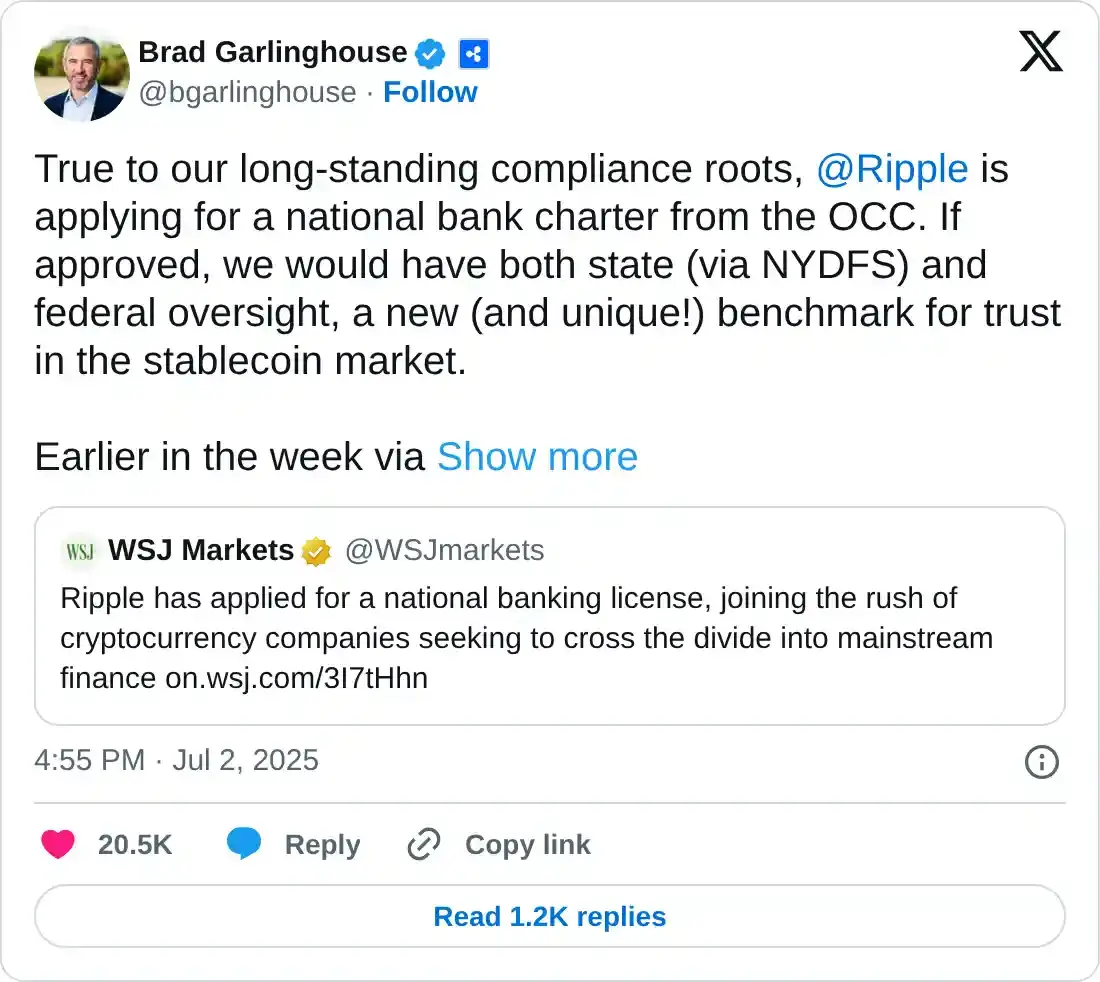
Earlier on Wednesday, Ripple’s CEO, Brad Garlinghouse, announced that the blockchain payments company had applied for a national bank charter from the US OCC.
“If approved, we would have both state (via NYDFS) and federal oversight, a new (and unique!) benchmark for trust in the stablecoin market,” Brad Garlinghouse said on his Xpost.
Garlinghouse continued that Ripple had applied for a Fed Master Account earlier in the week through its subsidiary Standard Custody. If approved, the company will be allowed to hold its RLUSD reserves directly with the Federal Reserve (Fed), ensuring an additional layer of security and fostering trust in RLUSD.
Growth of RLUSD stablecoin supply has surged to $469.3 million, as shown in the graph below.
-1751610983500.jpeg)
RLUSD stablecoin total supply chart. Source: Artemis
What next?
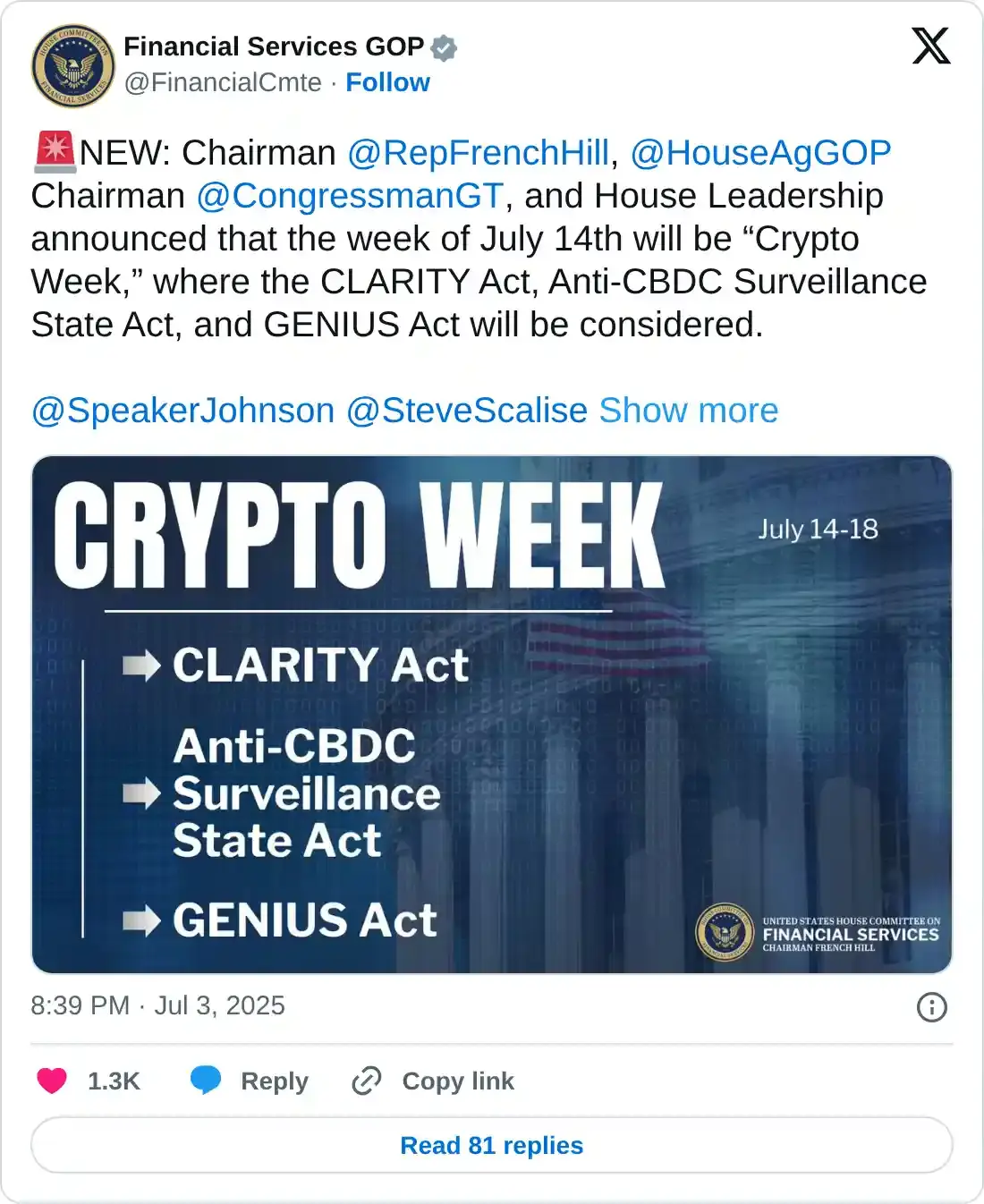
US Republican House leaders announced on Thursday that the week of July 14 will be “Crypto Week.”
House Finance Committee Chair French Hill, House Agriculture Committee Chair Glenn Thompson and Speaker Mike Johnson would review the CLARITY Act, the Anti-CBDC Surveillance State Act, and the Senate’s GENIUS Act from July 14 to July 18.
“After years of dedicated work in Congress on digital assets, we are advancing landmark legislation to establish a clear regulatory framework for digital assets that safeguards consumers and investors, provides rules for the issuance and operation of dollar-backed payment stablecoins, and permanently blocks the creation of a Central Bank Digital Currency (CBDC) to safeguard Americans’ financial privacy,” said Chairman Hill.
This “Crypto Week” could provide more regulatory clarity on the future of stablecoins and the overall crypto market. Clear and more crypto-friendly regulations in the US could boost not only the stablecoin sector, but also the overall cryptocurrency industry.
Ripple FAQs
Ripple is a payments company that specializes in cross-border remittance. The company does this by leveraging blockchain technology. RippleNet is a network used for payments transfer created by Ripple Labs Inc. and is open to financial institutions worldwide. The company also leverages the XRP token.
XRP is the native token of the decentralized blockchain XRPLedger. The token is used by Ripple Labs to facilitate transactions on the XRPLedger, helping financial institutions transfer value in a borderless manner. XRP therefore facilitates trustless and instant payments on the XRPLedger chain, helping financial firms save on the cost of transacting worldwide.
XRPLedger is based on a distributed ledger technology and the blockchain using XRP to power transactions. The ledger is different from other blockchains as it has a built-in inflammatory protocol that helps fight spam and distributed denial-of-service (DDOS) attacks. The XRPL is maintained by a peer-to-peer network known as the global XRP Ledger community.
XRP uses the interledger standard. This is a blockchain protocol that aids payments across different networks. For instance, XRP’s blockchain can connect the ledgers of two or more banks. This effectively removes intermediaries and the need for centralization in the system. XRP acts as the native token of the XRPLedger blockchain engineered by Jed McCaleb, Arthur Britto and David Schwartz.
Author

Manish Chhetri
FXStreet
Manish Chhetri is a crypto specialist with over four years of experience in the cryptocurrency industry.