Crypto market sell-off: Bitcoin cracks below $60,000 as bears seize the upper hand
- Bitcoin price slips below $60,000 on Friday, falling nearly 20% so far this week.
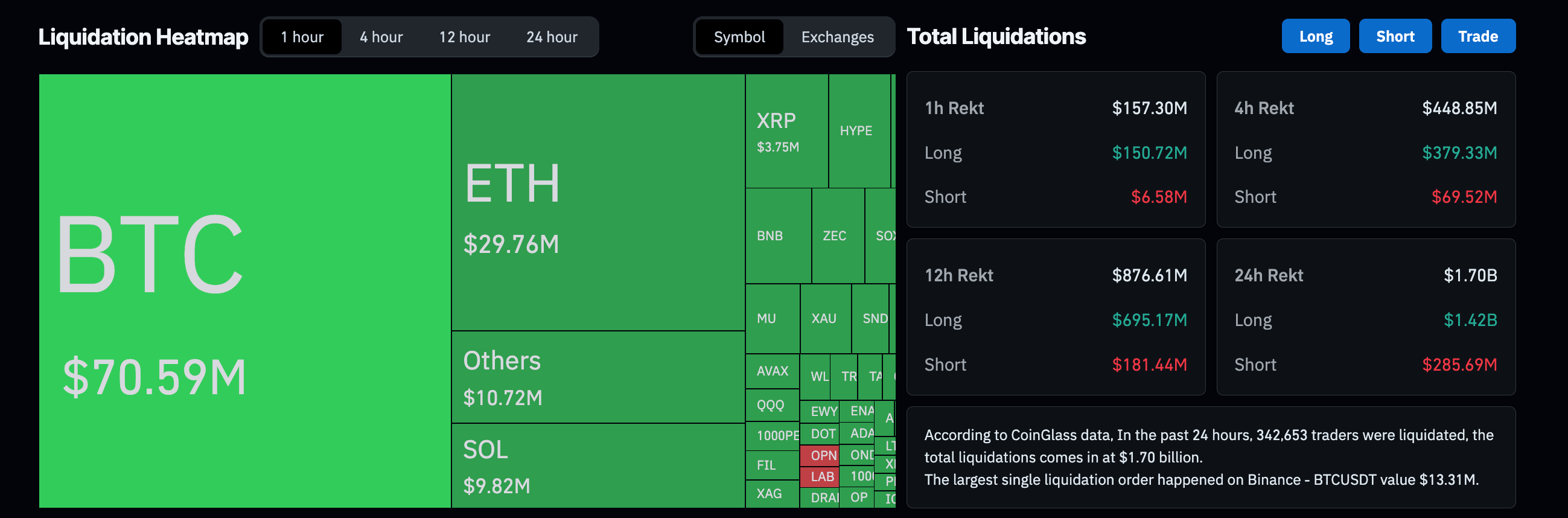
- Data shows $1.70 billion in liquidation in 24 hours as panic spreads market-wide.
- Technical levels suggest BTC could test the $53,485 support zone if selling pressure continues.

Bitcoin (BTC) price has breached below $60,000 at press time on Friday, recording a 20% crash so far this week. Institutional selling and weak derivatives weigh on Bitcoin’s pullback, deepening downside risks as buyers lose the critical $60,000 support band. Market momentum is extremely bearish, with the path of least resistance targeting the next key support at $53,485.
Crypto market bleeds over $1.70 billion
Bitcoin's slip below $60,000 has wiped out $1.70 billion in total liquidation over the last 24 hours, led by $1.42 billion in long liquidations, pointing to a clear sell-side market-wide dominance. Weak signals like the downward spiral in Bitcoin futures Open Interest (OI), as previously reported by FXStreet, which is now down to $45.28 billion, suggest further downside risk for potential dip buyers.
Bitcoin’s broken $60,000 level signals a bearish structural shift
Bitcoin's price has slipped below the February 6 low of $60,000 at press time on Friday, trading at levels last seen in October 2024 following Donald Trump’s pro-crypto Presidential win. From a technical perspective, Bitcoin’s freefall reflects a falling-knife scenario, putting dip buyers at risk of becoming bagholders while the downside remains exposed.
That said, the daily chart shows strong bearish dominance, with the Relative Strength Index (RSI) at 14, indicating oversold conditions. Yet, the Moving Average Convergence Divergence (MACD) shows the average lines extending their decline below zero as the bearish profile expands, suggesting intense selling pressure.
Looking down, the $55,000 round figure could serve as psychological support, while price action highlights the July 5, 2024, low at $53,485 as a key technical demand zone where buyers could regain strength.
Crypto ETF FAQs
An Exchange-Traded Fund (ETF) is an investment vehicle or an index that tracks the price of an underlying asset. ETFs can not only track a single asset, but a group of assets and sectors. For example, a Bitcoin ETF tracks Bitcoin’s price. ETF is a tool used by investors to gain exposure to a certain asset.
Yes. The first Bitcoin futures ETF in the US was approved by the US Securities & Exchange Commission in October 2021. A total of seven Bitcoin futures ETFs have been approved, with more than 20 still waiting for the regulator’s permission. The SEC says that the cryptocurrency industry is new and subject to manipulation, which is why it has been delaying crypto-related futures ETFs for the last few years.
Yes. The SEC approved in January 2024 the listing and trading of several Bitcoin spot Exchange-Traded Funds, opening the door to institutional capital and mainstream investors to trade the main crypto currency. The decision was hailed by the industry as a game changer.
The main advantage of crypto ETFs is the possibility of gaining exposure to a cryptocurrency without ownership, reducing the risk and cost of holding the asset. Other pros are a lower learning curve and higher security for investors since ETFs take charge of securing the underlying asset holdings. As for the main drawbacks, the main one is that as an investor you can’t have direct ownership of the asset, or, as they say in crypto, “not your keys, not your coins.” Other disadvantages are higher costs associated with holding crypto since ETFs charge fees for active management. Finally, even though investing in ETFs reduces the risk of holding an asset, price swings in the underlying cryptocurrency are likely to be reflected in the investment vehicle too.
Author

Vishal Dixit
FXStreet
Vishal Dixit holds a B.Sc. in Chemistry from Wilson College but found his true calling in the world of crypto.