XRP nears key support as derivatives sell-off outweighs modest ETF inflows
- XRP trades under dense headwinds, targeting lows around $1.00 on Friday.
- XRP derivatives market extends drawdown, with futures Open Interest falling to $2.51 billion.
- XRP’s mild inflows into spot ETFs fail to lift sentiment as bears tighten their grip.

Ripple (XRP) extends its downtrend, trading around $1.09 at the time of writing on Friday, its lowest level since November 2024. The cross-border remittance token’s free fall since the week began aligns with a broader crypto market sell-off, with Bitcoin (BTC) closing in on the critical $60,000 level and Ethereum (ETH) approaching support at $1,600. Capital outflows continue to weigh on the overall outlook, increasing the odds of an extended sell-off.
XRP retail demand fades as declines deepen
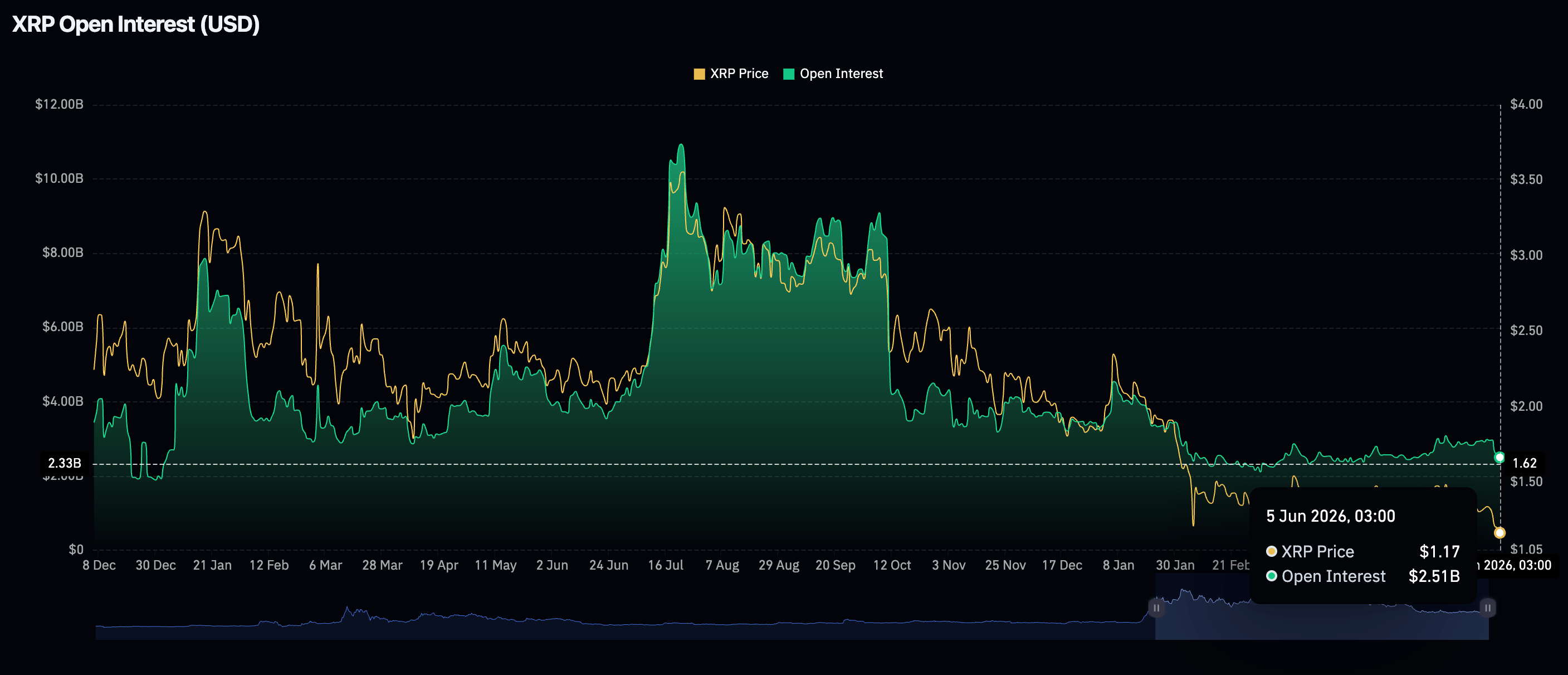
XRP remains under duress as risk-averse sentiment persists in the derivatives market. According to CoinGlass data, Open Interest (OI) in perpetual futures narrowed to $2.51 billion on Friday, down from $2.59 billion the day before and $2.96 billion on Monday.
A sustained drop in OI suggests that traders lack conviction in XRP’s ability to sustain an uptrend and are therefore unwilling to open new positions.
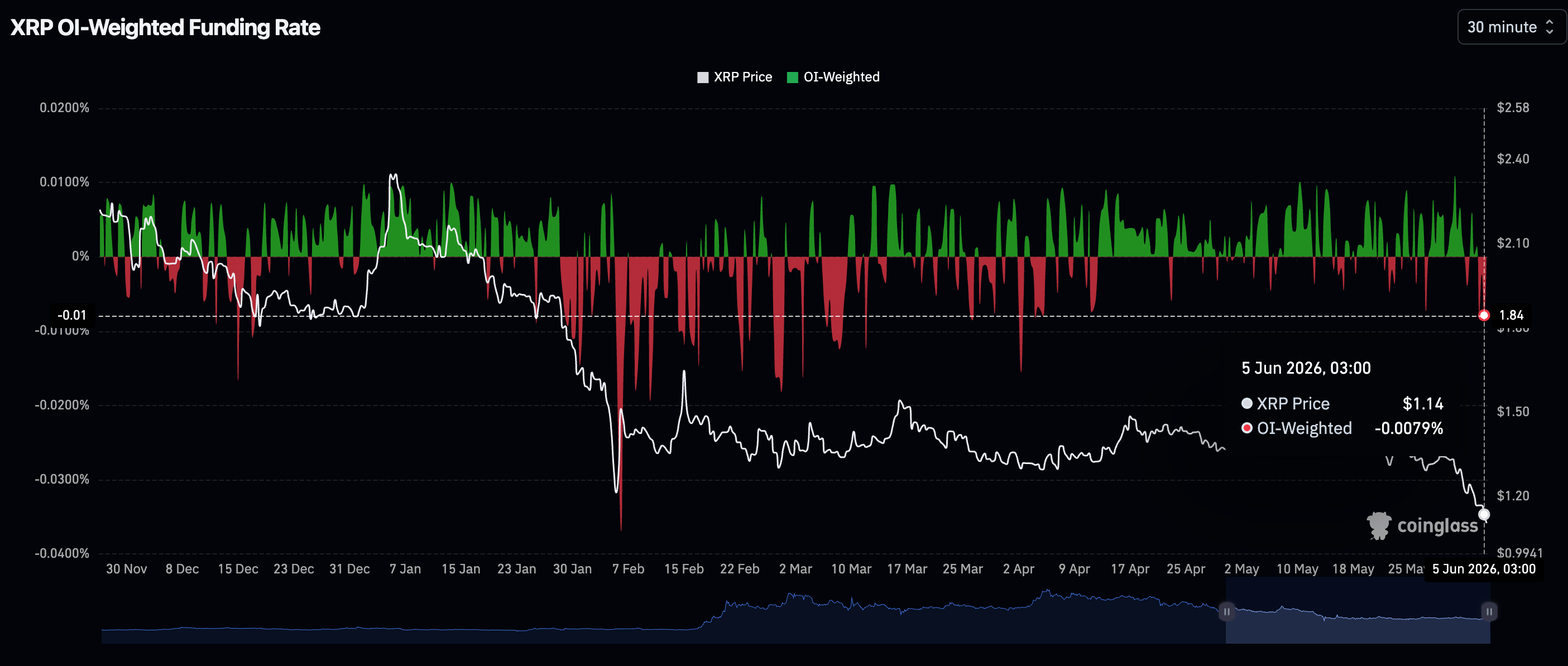
Retail participants remain primarily bearish, as evidenced by the OI-Weighted Funding Rate in negative territory at -0.0079% on Friday. This indicates that sellers are willing to pay a premium in fees to keep their short positions open, convinced that the decline will persist.
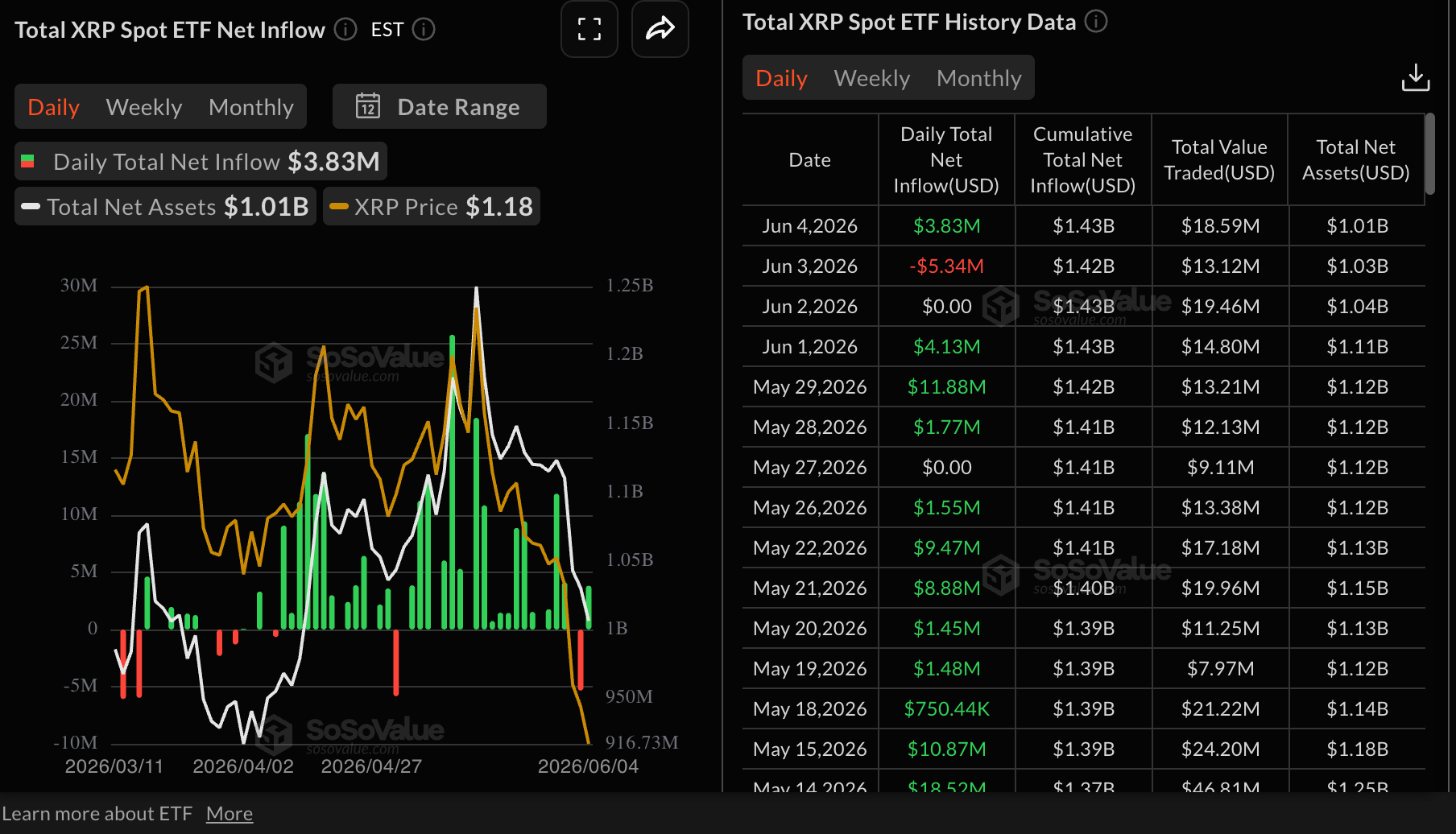
Despite a modest $3.83 million inflow into XRP spot ETFs from institutional investors on Thursday, XRP’s price continued its downward trajectory, edging closer to the pivotal $1.00 support. According to SoSoValue, cumulative inflows stand at $1.43 billion while net assets under management average $1.01 billion.
Price analysis: XRP bulls rely on $1.00 lifeline support
XRP trades at $1.12, extending a dominant bearish bias as price holds well beneath the 50-day, 100-day and 200-day Exponential Moving Averages (EMAs). The stacked bearish alignment of the short-, medium- and long-term EMAs above spot reinforces a downside-skewed structure, while the Relative Strength Index (RSI) near 20 highlights oversold conditions that could slow the decline.
The Moving Average Convergence Divergence (MACD) histogram remains in negative territory on the daily chart, suggesting persistent selling pressure despite the stretched momentum backdrop. Moreover, a heavily oversold Relative Strength Index (RSI) at 19 on the same chart suggests that the downtrend is overstretched and XRP may be due for a rebound.
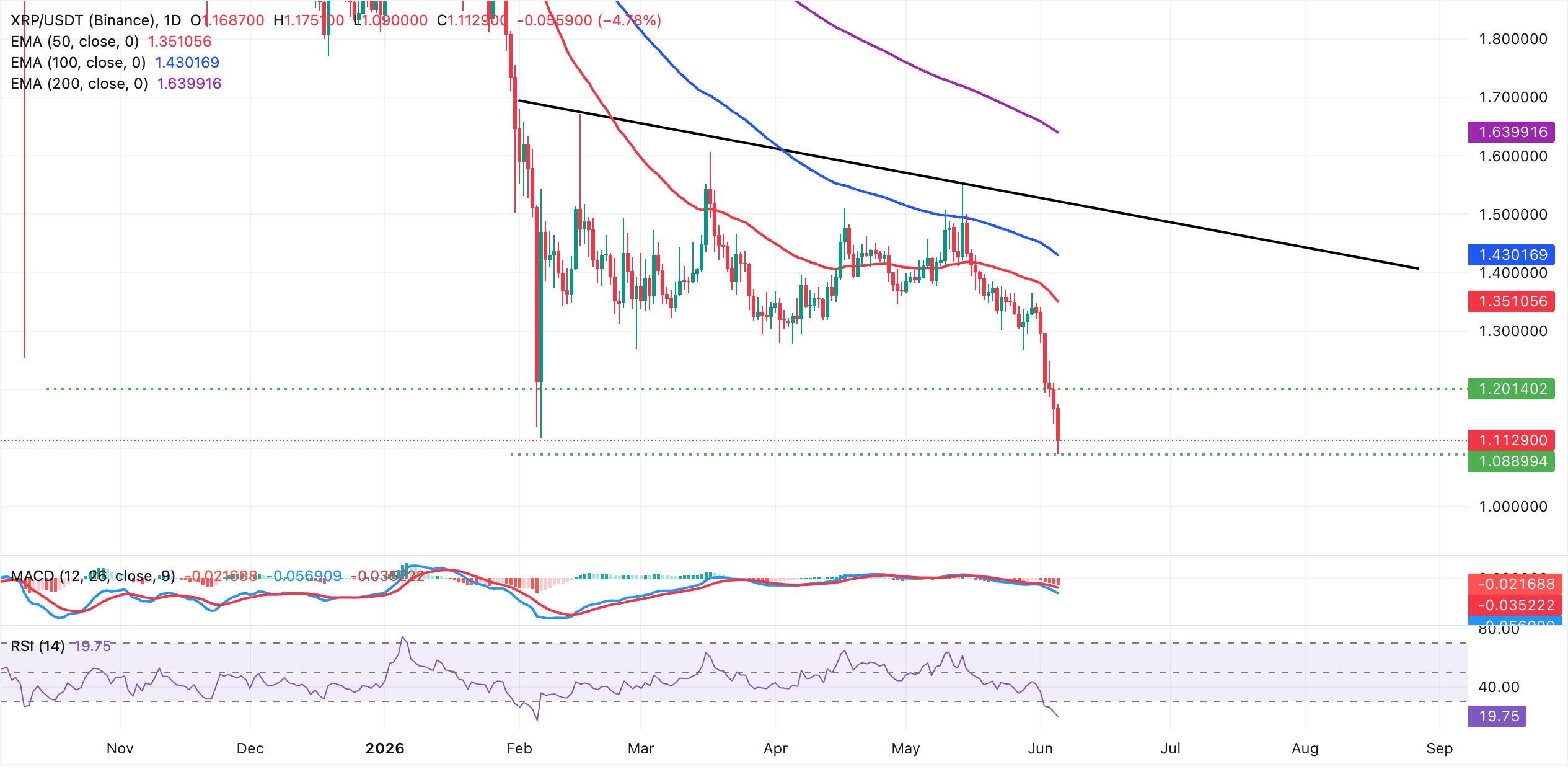
On the topside, initial resistance emerges at the 50-day EMA around $1.35, ahead of the 100-day EMA near 1$.43. Above these, the bearish downward resistance trendline, with a key break level around $1.52, is expected to cap recovery attempts before the more distant 200-day EMA near $1.64 comes into play.
A sustained sell-off could push XRP into the demand at $1.10, followed by a deeper correction to the critical $1.00 level, where interested buyers could seek re-engagement.
(The technical analysis of this story was written with the help of an AI tool.)
Ripple FAQs
Ripple is a payments company that specializes in cross-border remittance. The company does this by leveraging blockchain technology. RippleNet is a network used for payments transfer created by Ripple Labs Inc. and is open to financial institutions worldwide. The company also leverages the XRP token.
XRP is the native token of the decentralized blockchain XRPLedger. The token is used by Ripple Labs to facilitate transactions on the XRPLedger, helping financial institutions transfer value in a borderless manner. XRP therefore facilitates trustless and instant payments on the XRPLedger chain, helping financial firms save on the cost of transacting worldwide.
XRPLedger is based on a distributed ledger technology and the blockchain using XRP to power transactions. The ledger is different from other blockchains as it has a built-in inflammatory protocol that helps fight spam and distributed denial-of-service (DDOS) attacks. The XRPL is maintained by a peer-to-peer network known as the global XRP Ledger community.
XRP uses the interledger standard. This is a blockchain protocol that aids payments across different networks. For instance, XRP’s blockchain can connect the ledgers of two or more banks. This effectively removes intermediaries and the need for centralization in the system. XRP acts as the native token of the XRPLedger blockchain engineered by Jed McCaleb, Arthur Britto and David Schwartz.
Author

John Isige
FXStreet
John Isige is a seasoned cryptocurrency journalist and markets analyst committed to delivering high-quality, actionable insights tailored to traders, investors, and crypto enthusiasts. He enjoys deep dives into emerging Web3 tren