Is Yearn.Finance decentralized enough to survive without Andre Cronje?
- Yearn Finance contributors publish a decentralization manifesto.
- The personality of the creator affects the project anyway.
- YFI is hovering around major support.


Yearn Finance is a DeFi protocol created by Andre Cronje, a DeFi developer behind quite a number of cryptocurrency projects, including smart contract ecosystem Fantom and iEarn project.
The platform with its native token (YFI) went live in July 2020, and in less than two months, the token price increased by over 5000% to trade at $40,000, twice as much as Bitcoin's All-Time High. Currently, there are only 30,000 YFI in circulation, while the token is changing hands at $13,400, down over 60% since the peak.
Yearn.Finance position itself as a portal to various DeFi products, a place to start with for those who want to join the growing industry. The project claims to be fully decentralized and governed by the community.
Unlike the creators of many other DeFi protocols, Andre Cronje has never owned any YFI tokens. They were distributed between the participants who had deposits in certain key liquidity pools.
To promote the idea of decentralization, the contributors to the Yearn Finance published a manifesto explaining how Yearn is different from the traditional frameworks of ownership and control.
In this article, we will dive into the topic to see if the project is really as decentralized as it is depicted by its supporters.
"How we think about Yearn"
Contributors to Yearn Finance outlined a unique nature of the DeFi protocol in a manifesto called "How we think about Yearn." The post describes the ideas behind the project and explained what it is and what it isn't
The key takeaway from the manifesto is that Yearn Finance is not a company governed by a single person or a centralized body. On the contrary, it is driven by contributors that come together and work on the project voluntarily.
There's no legal entity; there's no foundation, no copyright, no patent, no central authority to stamp announcements with official seals from some great leader.
The authors also emphasize that Yearn has no investors or representatives, while Andre Cronje, the person behind the whole project, has no control over its future or the development trajectory. These are the tasks solved collectively by governance tokens holders. They come together and vote on issues like software development or partnerships with other projects and applications.
Yearn is governed by YFI, but YFI does not govern Yearn's contributors. Holding YFI entitles you to signal for real, practical change that improves Yearn. It doesn't give you the right to tell other contributors what to do. You want something done? Do it.
The post is published on the Yearn governance coordination page by Daniel Lehnberg and supported by numerous of Yearn contributors, who left their comments below the manifesto.
Is there a life without Cronje?
It looks like Andre Cronje is not involved in creating the document; at least, he has neither endorsed it nor commented upon it. This fact supports the idea that the project truly belongs to the contributors.
This is all fine, but will the project survive if Cronje drops out, stops supporting it, or disappears? The answer may be yes, but his personality doubtlessly affects the price of YFI and the credibility of the project itself.
The latest example is the case with Cronje's disappearance after a flurry of death threats from furious investors in Eminence protocol. People poured money in unfinished and non-audited smart contracts developed by Cronje and lost all their money to a hacker.
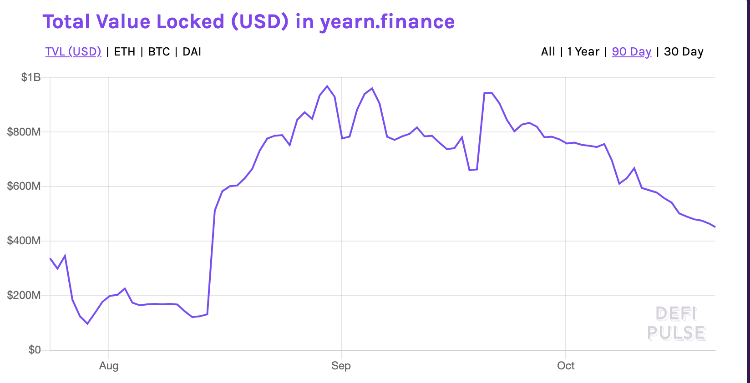
The incident drove Cronje away from social media and caused YFI sell-off to $12,250. The token lost 50% of its value in less than two weeks. The project's total value locked (TVL) also crashing by 50% from over $900 million to $450 million by the time of writing.
Yearn.Finance: total value locked
Source: DefiPulse
YFI/USDT: the technical picture
From the technical point of view, the price came close to the critical support area of $13,000, created by 76.8% Fib for the upside move from $4,600 to the historic high of $44,000. The price has tested this barrier on numerous occasions since the beginning of October, but it backstopped the sell-offs.
Once it is broken, the downside momentum will gain traction with the next focus on $11,500 that served as a consolidation zone and a jumping-off ground at the end of August. Below is the abyss.
YFI/USDT daily chart
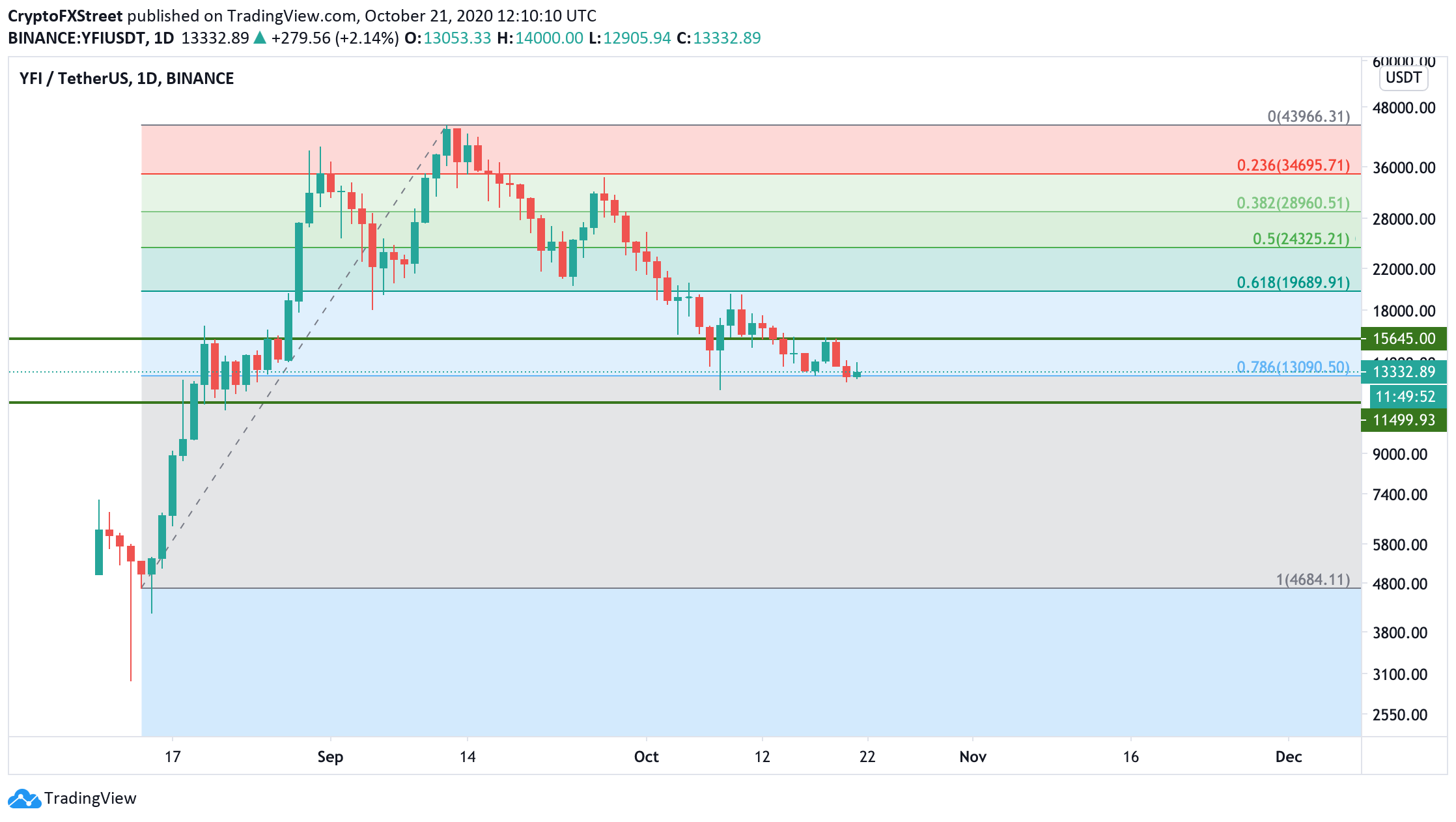
On the upside, the recovery is limited by $15,500; this area flipped from support to resistance during the previous week. Now it may slow down the recovery. If it is broken, YFI is likely to move to $19,600. This barrier stopped the upside at the beginning of October. Also, it coincides with the 61.8% Fib. Once above, the recovery will gain traction and take the price to $24,300.
Author
Tanya Abrosimova
Independent Analyst