Here are the three things to watch as Bitcoin's rally toward $120K gathers speed


Bitcoin (BTC) continues to gain ground, consistent with the inverse head-and-shoulders breakout from early this week, which opened the door for a rally to $120,000.
Prices have crossed above the 50-day simple moving average (SMA), a widely-tracked momentum indicator. Additionally, the guppy multiple moving average (GMMA) indicator is teasing a renewed bull cross. Taken together, these two developments may draw momentum chasers to the market, accelerating the price rise.
That said, there are at least three reasons to continue being cautious. Let's take a look at those individually.
BTC nearing bull fatigue zone
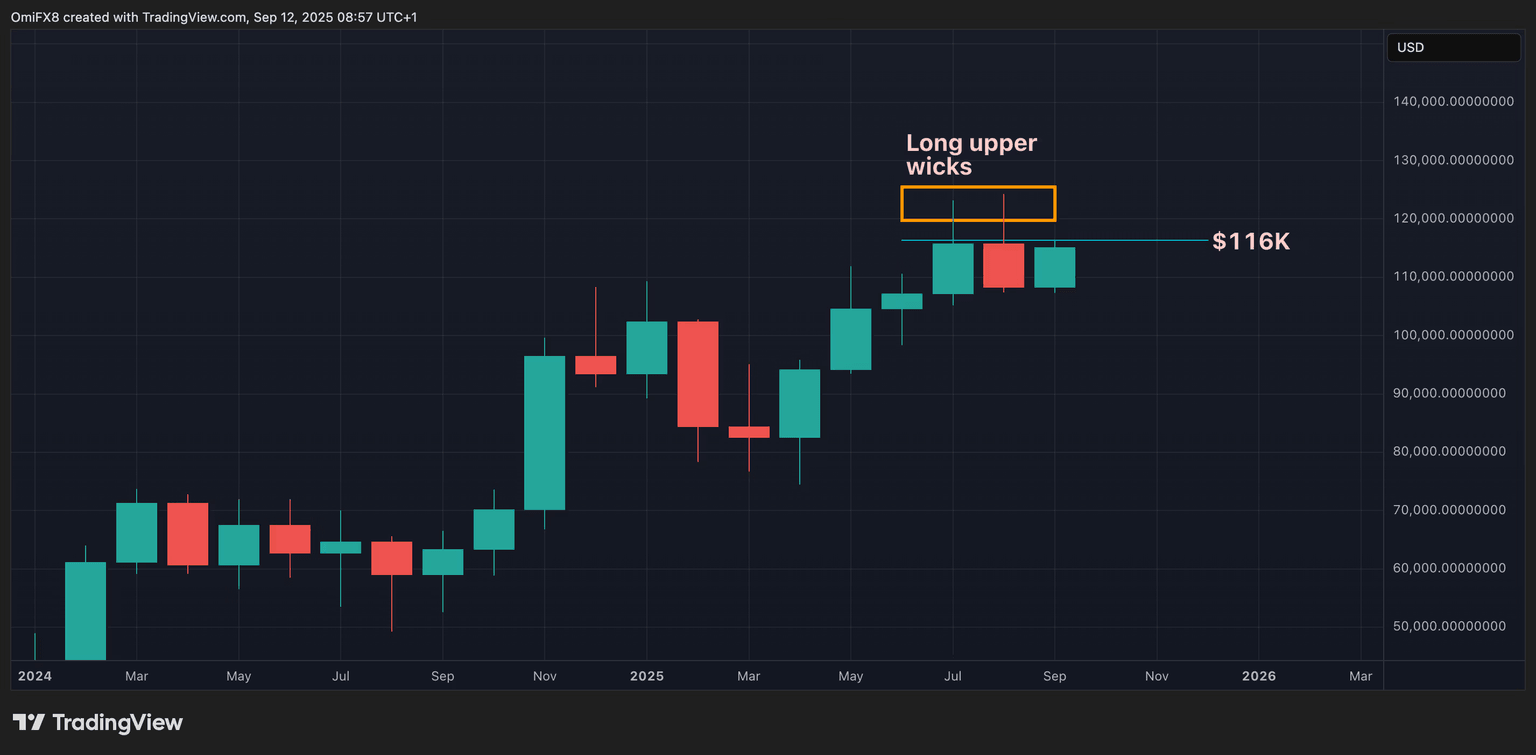
BTC is closing on the bull fatigue zone above $115,000.
While past patterns do not guarantee future results, it is notable that since July, bitcoin’s bull momentum has consistently weakened above the $115,000 level, as reflected by the long upper wicks on the last two monthly candles.
These long wicks indicate that although bulls pushed prices to new record highs above $124,000, strong selling pressure forced the price back below $115,000, signaling a key resistance level and potential hesitation among buyers.
Has the Dollar Index priced Fed rate cuts?
With the U.S. labor market weakening at a rapid pace, futures traders have priced in 70 basis points (bps) of rate cuts by Dec. 31. That's almost three 25-basis-point rate cuts, starting from Sept. 17. Further, traders have priced in a total of 125 bps of easing by July 2026, which would take the benchmark interest rate down to 3% to 3.25% range from the present 4.25-4.50 range.
Market participants appear confident that the central bank will look past the sticky inflation, as highlighted by Thursday's consumer price index, and cut rates to support the labour market and economic growth. These dovish expectations starkly contrast with those of the Fed's peers, such as the European Central Bank (ECB), which appear to have moved on from rate cuts. In other words, the rate differential favors USD weakness.
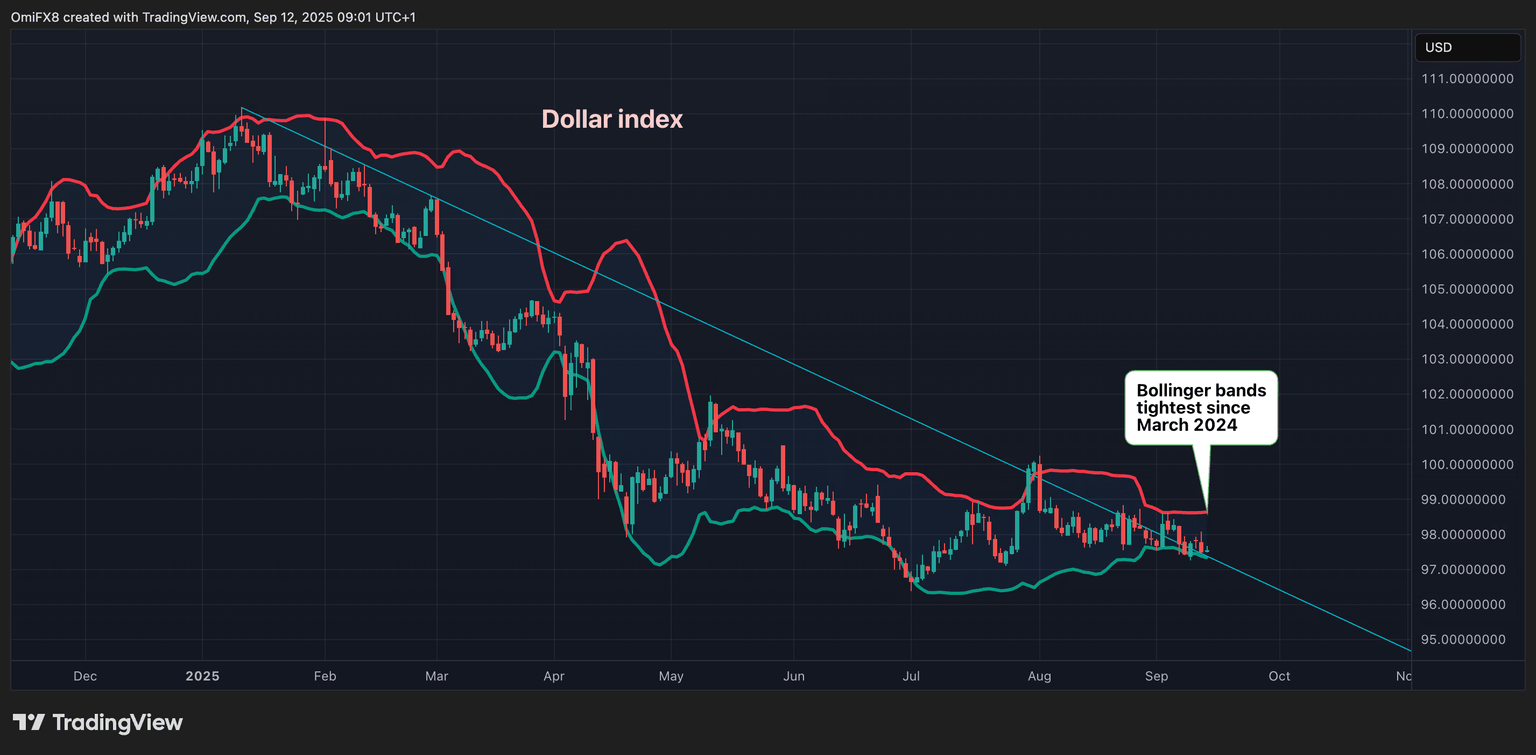
Yet, the dollar index, which gauges the greenback's value against major fiat currencies, continues to hover in the recent range of 97.00 to 98.00. The index has dropped just 0.20% to 97.55 this week despite the sharp rise in the Fed rate cut pricing.
This raises the question: Has the dollar already priced in the Fed rate cuts? If so, it could recover from here, capping gains in the dollar-denominated assets like BTC and gold.
The chart shows that the dollar sell-off has run out of steam since the index hit a low of 96.37 on July 1.
As of writing, the Bollinger bands, or volatility bands placed two standard deviations above and below the index's 20-day SMA, were at their tightest since March 2024. The so-called squeeze means a big move in either direction could happen soon. A bullish one may not bode well for BTC.
Generational bullish shift in 10-year yield
Expectations of rapid Fed rate cuts have fueled anticipation of a sharp decline in the benchmark 10-year Treasury yield, which influences borrowing costs for consumers, businesses, and governments alike. Hence, a slide in the 10-year yield would likely lead to greater risk-taking across both the economy and financial markets.
However, longer-term monthly charts indicate a generational bullish shift in momentum for yields, suggesting that the downside could be limited. So, the anticipated flood of money into riskier assets driven by expectations of ultra-low rates may not materialize. In other words, ultra-low interest rates are unlikely to return anytime soon, which should keep fixed-income instruments attractive to investors.
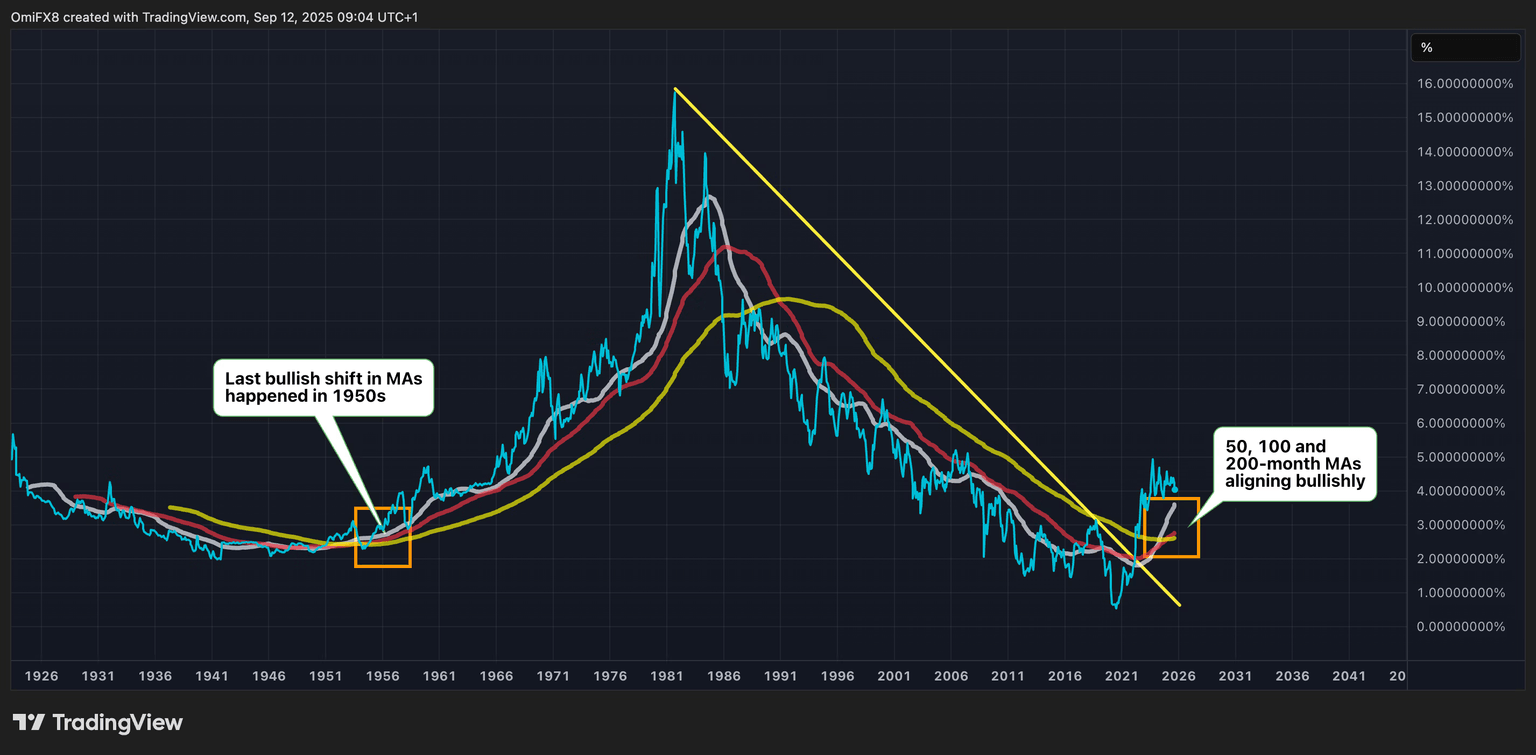
The 10-year yield has surged in the aftermath of the coronavirus pandemic, ending a four-decade-long downtrend that began in 1981.
Furthermore, the 50, 100-, and 200-month MAs have realigned bullishly one above the other. Such a bullish configuration last occurred in the 1950s, marking the onset of a three-decade rally in the benchmark yield.
The same thing can be said for the two-year yield, which tends to be more sensitive to interest rate expectations.
Author
CoinCodex Team
CoinCodex
CoinCodex is a cryptocurrency and ICO/STO listing website, gathering data from more than 130 exchanges to bring users real-time prices and historical charts for over 3,000 coins. The website was launched in September 2017.