Fed, ECB and others take coordinated steps to boost Dollar liquidity, Bitcoin tops $28K

The U.S. Federal Reserve (Fed) on Sunday announced it had joined hands with other major central banks to ensure a steady flow of the U.S. dollar, a dominant reserve currency, in the global financial system.
The Fed said it would increase the frequency of the dollar swap lines with the European Central Bank, the Bank of Japan, the Bank of England, the Bank of Canada and the Swiss National Bank from weekly to daily, starting Monday. The dollar swap lines allow foreign central banks to borrow U.S. dollars while protecting the Fed from downside risks. In a swap, a Foreign central bank swaps its own currency for an equivalent amount of U.S. dollars from the Fed at the market exchange rate. After a pre-determined time, the bank returns the dollars it borrowed, with interest, to the Fed.
The move is aimed at calming exchange rate volatility and avoiding strains in the supply of credit to households and businesses worldwide. It comes on the heels of blowups of three banks in the U.S. and the takeover of troubled Swiss-lender credit Suisse by UBS and Swiss National Bank.
It shows heightened financial stability concerns among policymakers and questions the Fed's ability to continue hiking rates. The central bank has lifted the borrowing cost by 450 basis points since March 2022, roiling asset markets, including cryptocurrencies, last year.
More importantly, the Fed's backstopping of the global dollar liquidity reduces the risk of a worldwide dash-for-cash – investors selling everything, including bitcoin and other cryptocurrencies, and moving to cash, predominantly the U.S. dollar. During turmoil, investors typically sell risk assets and park money in cash, preferably the dollar. That drives up the cost of acquiring U.S. dollars, leading to stress in the financial system.
In other words, the increased frequency of swap lines has cleared the way for an unabated rise in risk assets, including bitcoin. The leading cryptocurrency by market value is largely seen as a hedge against the banking system and hit a nine-month high above $28,000 late Sunday, taking the cumulative month-to-date gains to nearly 25%, CoinDesk data show.
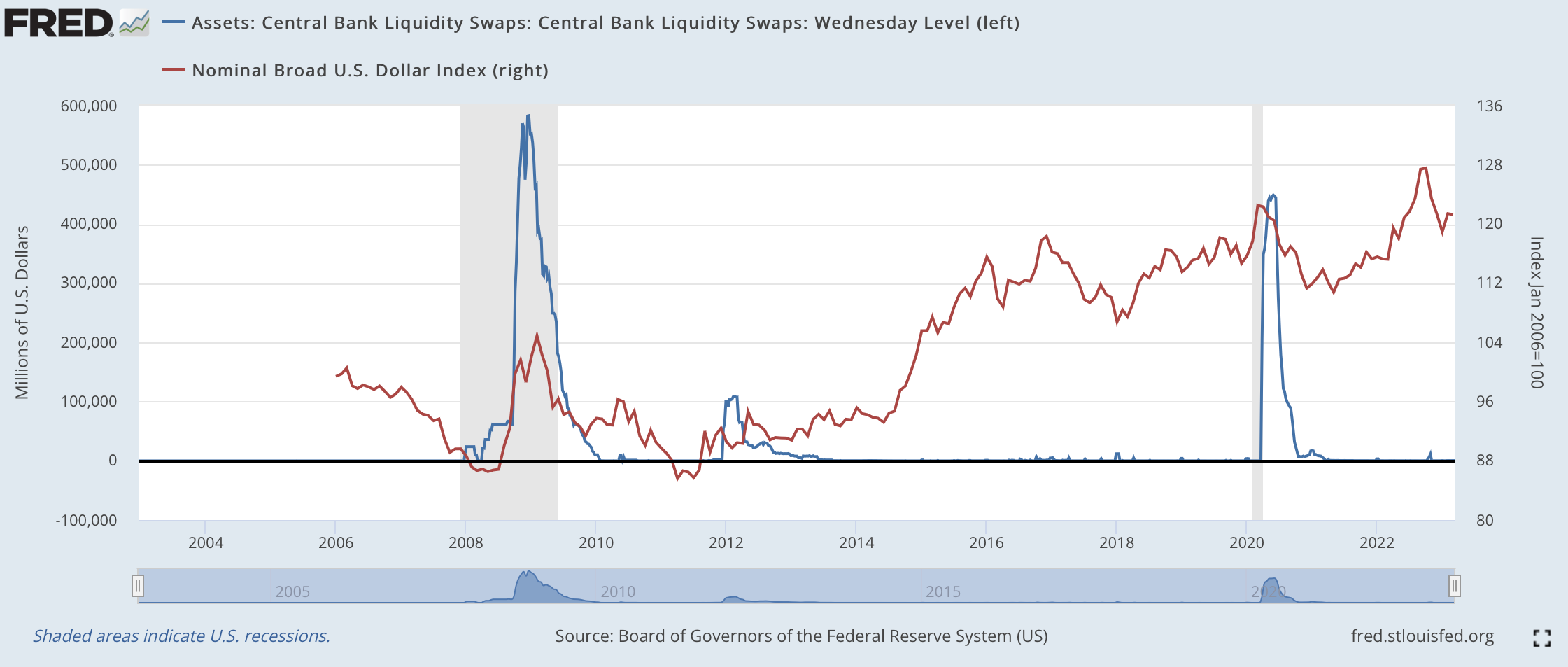
The dollar peaked after the Fed opened swap lines in March 2020. (Fred.stlouis.org) (Fred.stlouis.org)
The dollar swap lines have been bearish for the dollar in the past. Bitcoin and risk assets, in general, tend to move in the opposite direction of the greenback.
The last global dash for cash observed during the coronavirus-led crash of March 2020 saw the dollar index surge above 100 and bitcoin nosedive by over 50%.
Author

CoinDesk Analysis Team
CoinDesk
CoinDesk is the media platform for the next generation of investors exploring how cryptocurrencies and digital assets are contributing to the evolution of the global financial system.