Expected Fed rate cuts support bull case in Bitcoin, but there is a catch
-
The Fed minutes released Wednesday show policymakers could cut rates this year.
-
Past data show an economic recession tends to follow as the Fed begins cutting rates.
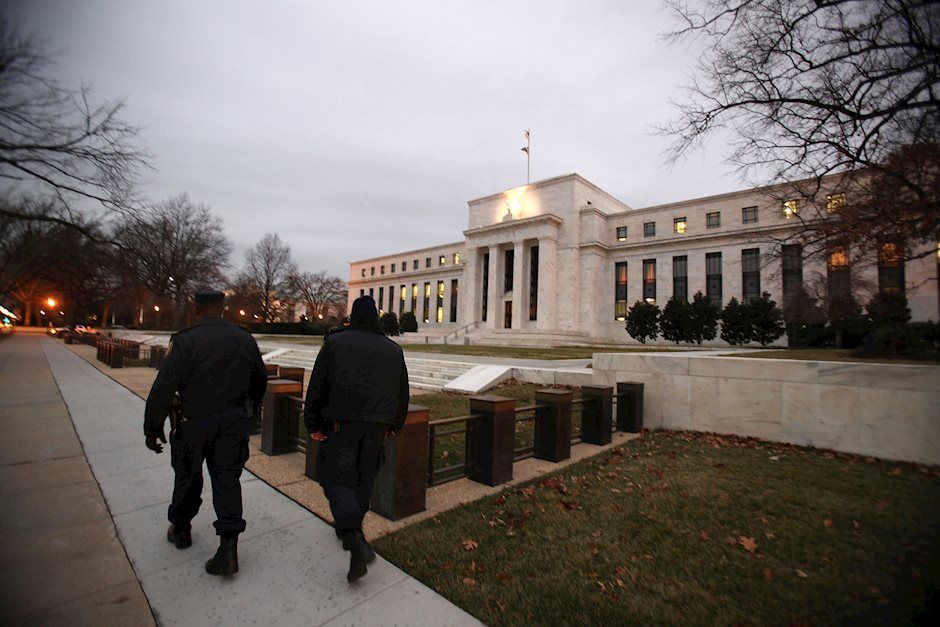

The minutes of the Federal Reserve's (Fed) December meeting released Wednesday showed interest rate cuts are likely in 2024.
The long-awaited liquidity easing has been widely touted as a critical bullish tailwind for Bitcoin (BTC) alongside the impending spot ETF launch and Bitcoin blockchain's quadrennial mining reward halving.
There is a catch. Past data sourced from MacroMicro shows that the early stages of the supposedly stimulatory Fed rate cut cycle are often characterized by the economy on the brink of a recession and brief but notable rally in the U.S. dollar, a global reserve currency backed by the world's largest and most liquid government bond market.
In other words, if history is a guide, bitcoin may see a brief and intense bout of risk aversion later this year after the Fed begins cutting the benchmark Federal Funds rate.
A recession is a prolonged period of declining economic output and a rise in unemployment. Left to market forces, a recession can lead to sharp decline in investors' risk taking ability and asset price deflation. Thus, central banks often combat the same with monetary stimulus.
The dollar is a global reserve currency, with an outsized role in global trade, international debt, and non-bank borrowing. When the greenback rallies, those with dollar borrowings face higher debt servicing costs. That leads to tighter financial conditions, leading to investors reducing exposure to risk assets like Bitcoin.
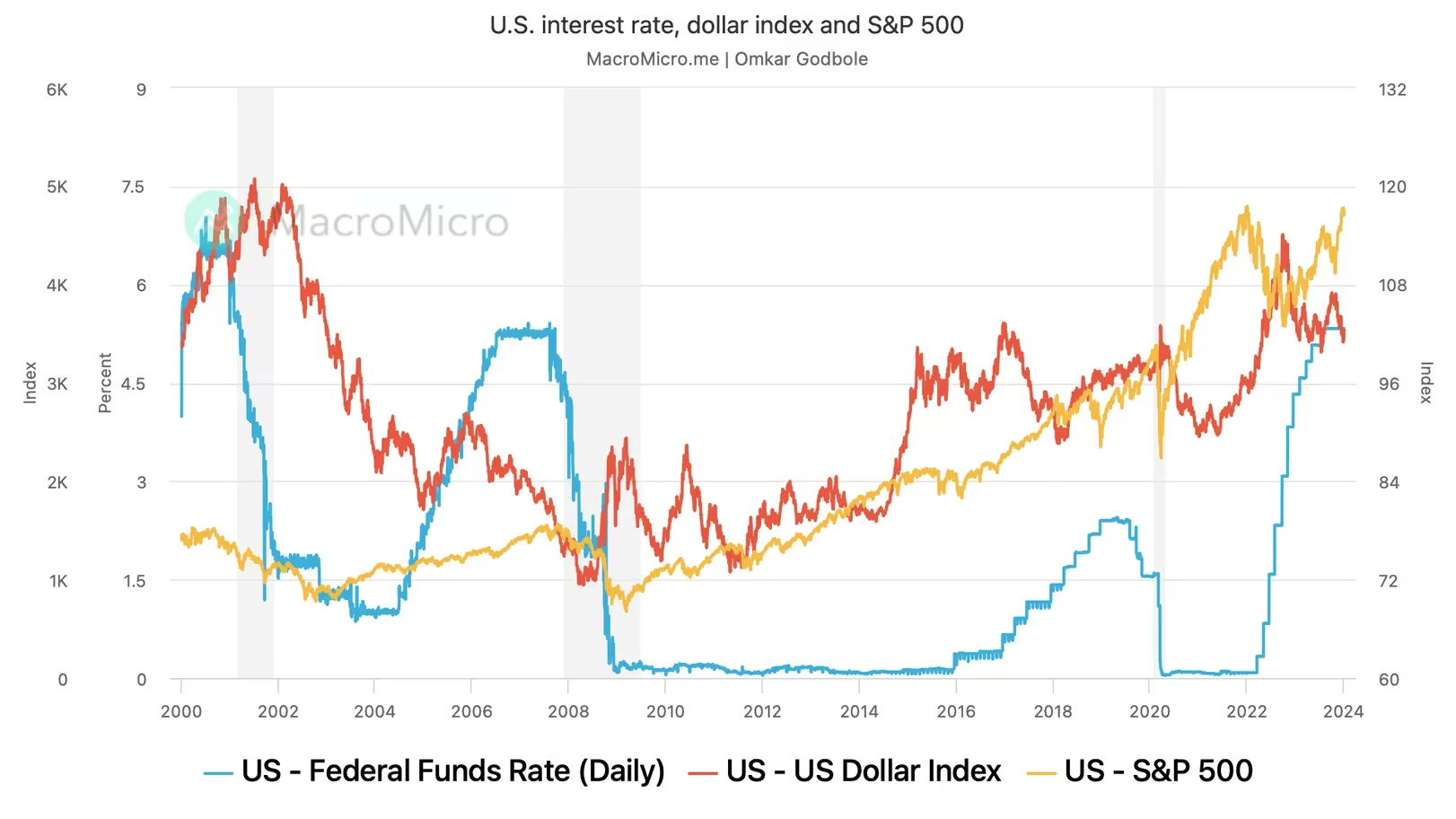
US interest rate, Dollar Index, S&P 500. (MacroMicro) (MarcroMicro)
The dollar index, which gauges the USD's exchange rate against major fiat currencies, initially strengthened after the Fed kicked off the rate-cut cycle in mid-2000, September 2007, and August 2019. The S&P 500, a proxy for worldwide investor risk appetite, saw bouts of risk aversion during the early stages of the rate-cut cycle.
The shaded area shows recessions followed the Fed pivot to rate cuts.
Recession follows rate cuts?
Historically, the Fed has resorted to rate cuts only with recession at the doorstep. That has led to forward-looking markets treating rate cuts as a harbinger of bad news and seeking safety in the U.S. dollar.
Recessions have consistently followed the onset of easing cycles over the past 60 years, according to data tracked by investment banking firm Piper Sandler.
"This sequence often occurs because the Fed tends to overshoot by raising and maintaining high-interest rates for longer than necessary, inadvertently stifling economic growth. Rate cuts usually come into play only when the economy is visibly declining and unemployment is on the rise. By that point, a recession is typically inevitable," Piper Sandler said in a note to clients on Jan. 2.
"This time around, it's likely that the same pattern will repeat, with the Fed maintaining a hawkish stance longer than required," Piper Sandler added.
Per some observers, markets are currently overestimating the U.S. economy's ability to avoid a recession in the wake of the steep Fed rate hike cycle that saw borrowing costs surge 525 basis points to 5.25% in 16 months to July 2022. That leaves the door open for negative market reaction on potential recession.
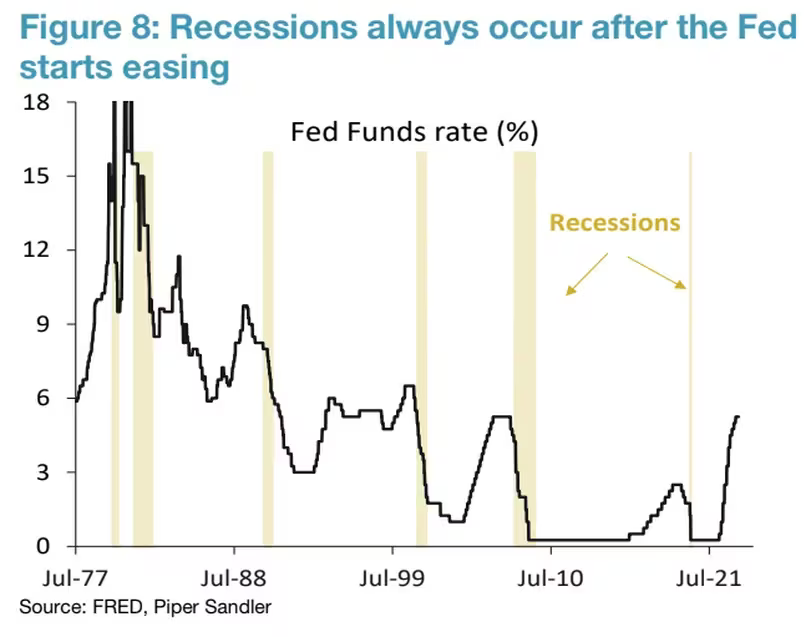
U.S. recessions always occur after the Fed starts easing. (FRED, Piper Sandler) (FRED, Piper Sandler)
Author
CoinDesk Analysis Team
CoinDesk
CoinDesk is the media platform for the next generation of investors exploring how cryptocurrencies and digital assets are contributing to the evolution of the global financial system.