Ether’s growth as independent asset fuels ETH-BTC flippening narrative

The narrative surrounding Ether (ETH) of it fast transforming into an independent asset has been around for some time now. However, the last few months have seen this notion gain an increasing amount of mainstream traction, as is best highlighted by the fact that, since Oct. 1, ETH has showcased substantial northbound movement against Bitcoin (BTC).
To put things into perspective, toward the beginning of November, the one-month realized correlation between the BTC/ETH pair dipped as low as 60%, its lowest ever in the currency’s decade-old history. Furthermore, since the start of the year, while Bitcoin registered gains of 105%, Ether went up by a whopping 505%, thus outperforming the flagship crypto by nearly five times.
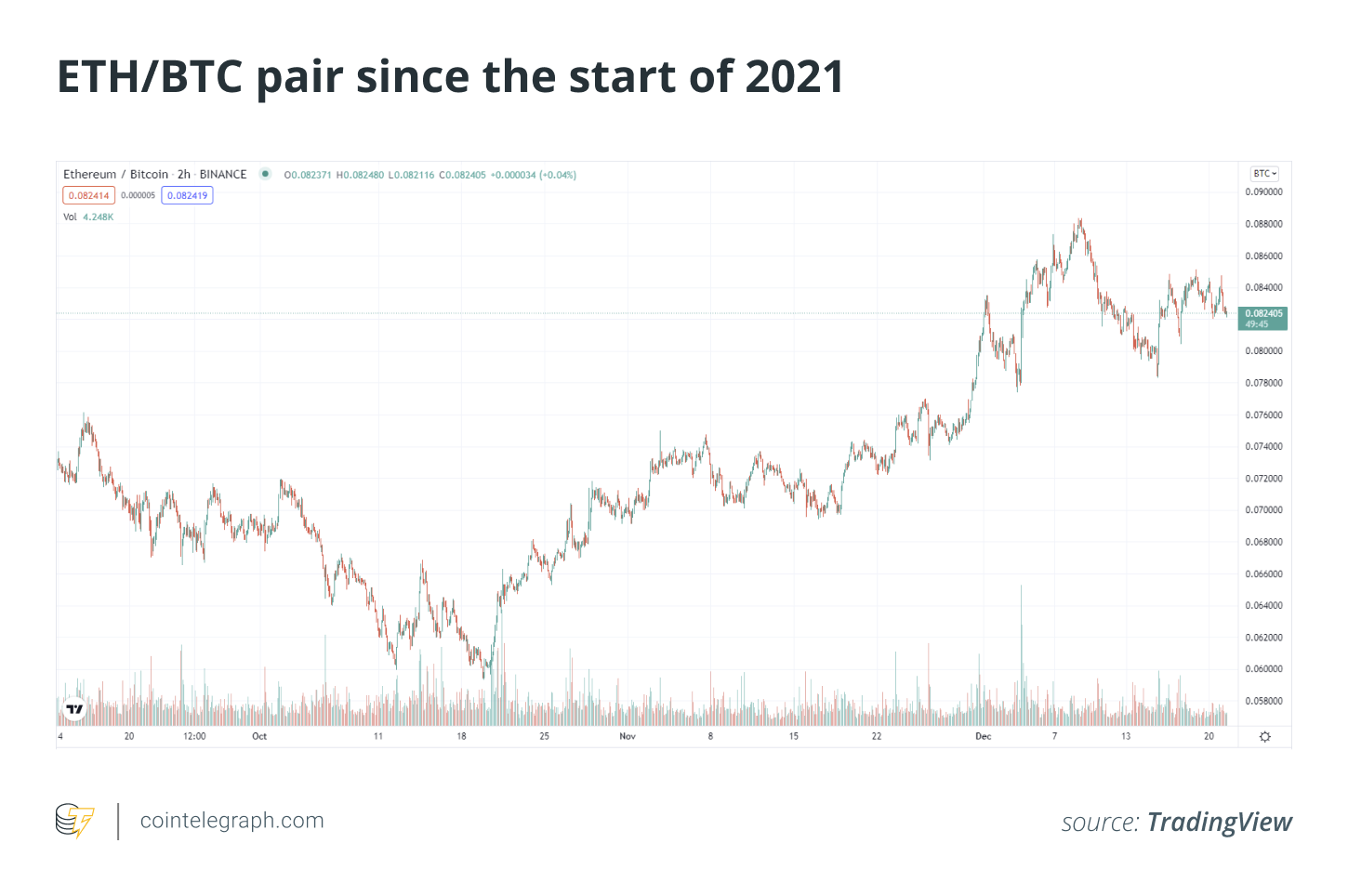
Ether gaining an upper hand is perhaps best reflected in that, over the course of the last couple of months, the ETH/BTC pair has continued to trend north, despite there being a major market dip across the board since the start of December. In this regard, even when the value of BTC fell back below $50K, the ETH/BTC pair price continued to accrue value, quickly rising by around 13%, thus hitting a three-year high.
The 'flippening' narrative
Speaking with Binance's research wing, a spokesperson for the cryptocurrency exchange told Cointelegraph that the above stated activity — wherein ETH has been able to muster a lot of independent market support against Bitcoin — has been quite unusual considering that the ETH/BTC pair tends to only rally during bull runs, adding: “This is not to say that ETH has already decoupled from BTC, but it provides a clear-cut glimpse that not all alts are correlated to BTC movements.” The spokesperson further elaborated:
“It’s important to acknowledge that ETH may no longer be considered as an alt, but it’s a token with its unique characteristics. The key drivers for the recent rise can be attributed to the growing Metaverse, GameFi, and NFT narratives, which are all largely built on the ETH network.”
Although ETH is still far from being fully decoupled, the spokesperson highlighted that such a vision can no longer be considered just a pipedream, as the overall narrative is already beginning to shift thanks to Ethereum’s new emerging use cases and adoption.
Not only that, the analyst also opined that a similar scenario could very well play out for a number of other prominent altcoins as well: “Just like in traditional equities, there will be no distinction between ‘BTC and alts,’ but rather with prices of all tokens being independently driven by both systematic and unsystematic risks.”
Igneus Terrenus, head of communications for cryptocurrency exchange Bybit, told Cointelegraph that, at the end of the day, the value of a digital asset is determined by its supporters and investors, and with more than six years of development and a plethora of smart contract applications built atop Ethereum — including those related to fledgling spaces like DeFi and NFTs — the premium altcoin has now developed an identity and ecosystem of communities that exist independently from that of BTC, particularly over the past year. “Overlaps will still remain, but there is now sufficient difference to sustain a divergence in price movement,” Terrenus said, adding:
“As the demographics of BTC and ETH camps continue to diverge, we shall also expect to see their respective price actions gradually disentangling even further.”
ETH is uniquely positioned in the market
Netta Korin, co-founder of Orbs, a public blockchain infrastructure, highlighted to Cointelegraph that ETH’s straight-up northbound movement since Oct. 1 continues to add fuel to the narrative that Ether truly could flip Bitcoin sometime in the near future. Even though a vast majority of other cryptocurrencies continue to exhibit a high degree of correlation with BTC, she said that Ether has clearly proven to be “oil for DApps.”
Korin added that Ethereum has long passed Bitcoin as the most used blockchain and, even when it comes to recovery after periods of market cooldowns, it has demonstrated significantly better performance than BTC. She further stated that the upcoming Eth2 upgrade will “enhance the demand perspective,” adding:
“New supply and demand mechanics of Ethereum and its position as the leading financial infrastructure and a crucial backbone for some of the most popular projects, like MakerDAO and Uniswap make ETH decoupling a potential reality.”
Korin also pointed out that Ethereum is a key player in DeFi and a central platform for the NFT space, which seeks to build financial applications for lending and trading on the blockchain — of which more than 3,600 DApps are currently running atop the Ethereum ecosystem. Not only that, Ether could also be an inflation hedge due to its links to DeFi and the market for NFTs, two areas that will grow exponentially in 2021, in her view. “Ether is on pace to overtake Bitcoin as the top cryptocurrency by market capitalization,” she concluded.
Could ETH’s continued independence help spur BTC?
If ETH’s decoupling is an imminent reality, will this impact a potential BTC bullish move if the ETH/BTC pair starts to grow? On the subject, a member of Binance’s research wing pointed out to Cointelegraph that, if the price spread between the ETH/BTC pair continues to grow at its current trajectory, it would still not be correct to say that the development could lead to an overall growth spurt for BTC, noting:
“Large investors will continue to buy BTC regardless of how bearish it looks on the charts or how other tokens are performing. They do so because BTC remains [...] the pioneer in the space and market driver. This is further fuelled by the narrative of BTC being a digital store of value and hedge against inflation.”
That being said, the Binance analyst did concede that, when considering the other end of the spectrum, they still expect to see a feeding frenzy amongst both retail and institutional investors as they rush in to increase their exposure in ETH.
Ether’s increasing market clout has not gone unnoticed by major financial institutions around the globe, with U.S. banking giant JPMorgan Chase claiming in a recent report that ETH could be a better bet for investors than BTC, especially as the digital asset market continues to mature and evolve. According to the company’s research analysts, ETH’s fivefold rise in comparison to BTC over the last year has resulted in the altcoin accruing a market cap that is nearly half of that of Bitcoin’s.
Another aspect of ETH that has many investors starry-eyed is the network’s potential to gain a major foothold in the burgeoning Web 3.0 ecosystem, which is extremely popular at the moment even though its real-world implementation is still years away. While nobody can for sure ascertain how this space will continue to evolve, there is a good chance that ETH will capture much of the value associated with the decentralized Web 3.0 in the future.
Last but not least, it is worth noting that the Ethereum network’s recently implemented London upgrade — which went live during August 2021 — altered the way in which the currency’s gas fee rates are calculated, effectively burning a portion of all ETH-based fees and reducing the altcoin’s total supply pool. Numbers-wise, this has resulted in Ether’s annual inflation rate dipping from ~4% to ~3%.
Not only that, Ether’s ever-evolving monetary policies are also designed to help convert the asset into a deflationary one, making it attractive to long-term owners as well as institutional funds. Therefore, it stands to reason that Ether’s perception as an independent asset will only continue to garner more support.
Author

Cointelegraph Team
Cointelegraph
We are privileged enough to work with the best and brightest in Bitcoin.