Ethereum’s metaverse boost

Facebook’s announcement to rebrand to Meta led to a ripple effect throughout crypto markets. As the tech giant emphasizes its metaverse ambitions, people are waking up to its potential. This has benefitted several tokens building game economies or metaverses of their own, primarily on top of the Ethereum blockchain.
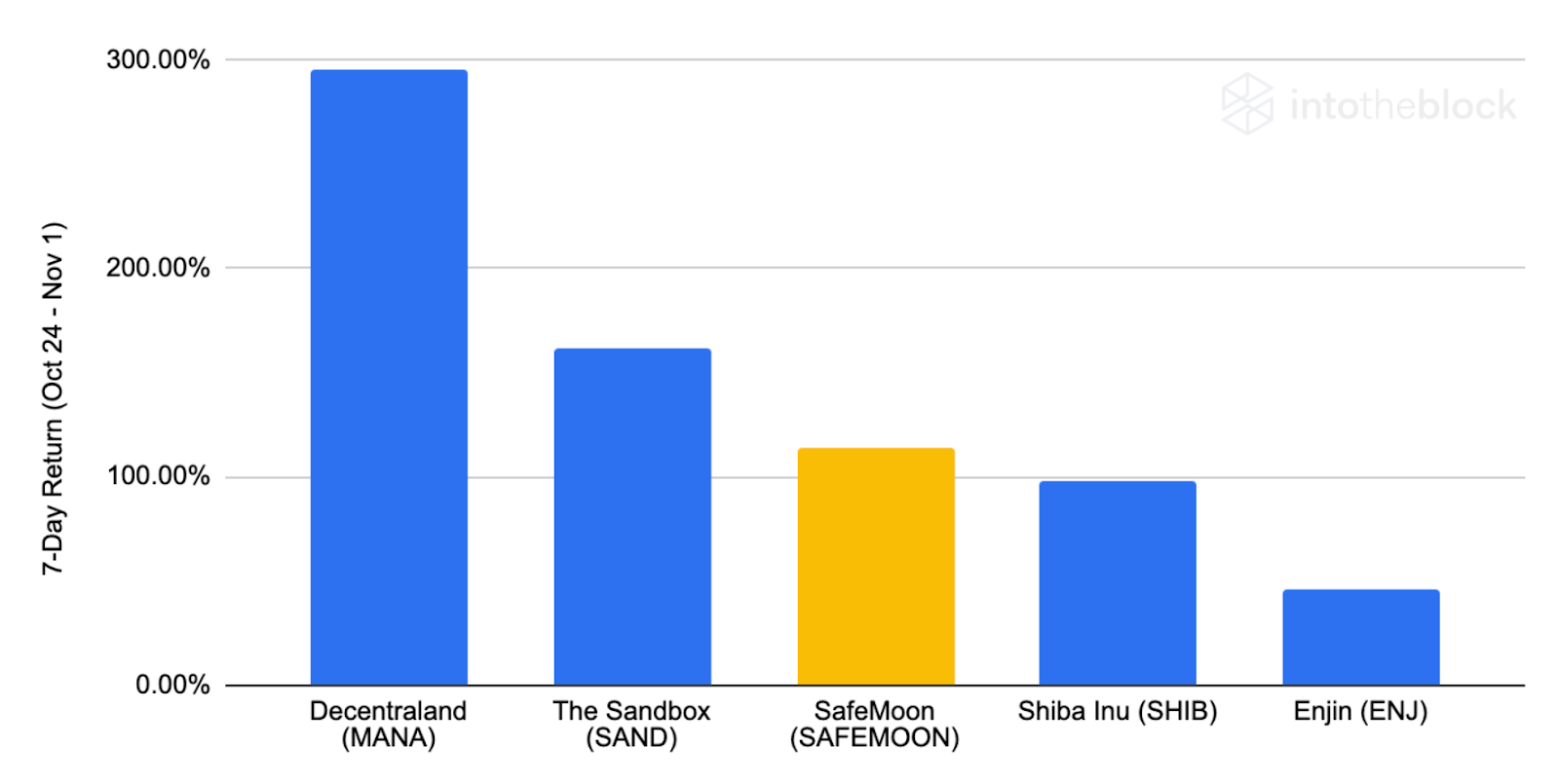
Within just a week, Decentraland’s MANA token and The Sandbox’ SAND managed to appreciate 295% and 162% respectively. Retail traders’ favorites SafeMoon and Shiba Inu followed as the third and fourth highest performers with increases of 114% and 98%. Finally, Enjin (ENJ), the gaming and NFTs platform, rose a significant 46%. Four out of five of the best performers in the top 100 are built on top of Ethereum as indicated in blue in the chart below.
Ether itself also benefited from investors’ shift towards the metaverse, hitting new all-time highs over $4,400 the day after Facebook’s Meta’s keynote. Meta’s plans appears to have been a catalyst for Ethereum as Mark Zuckerberg announced its metaverse will support NFTs and be interoperable with open platforms. Since then Ethereum has gained $20 billion in market cap.
The increased activity surrounding metaverse tokens, as well as the continued interest in Shiba Inu, have led to higher fees on Ethereum. Ethereum recorded its second highest weekly fees, with over $457 million being paid to use its blockchain.
-637714417997891203.png)
As of November 1, 2021 through IntoTheBlock’s Ethereum network indicators
Higher fees act as a double-edged sword. For one, these can price out average users who are unable to afford over $100 for simple Uniswap trades. On the other hand, high fees are representative of the vast demand to use Ethereum, where over $450 million are spent in a week to use its blockchain. For reference, Bitcoin processed $5 million in fees during the same period.
Moreover, following the implementation of EIP-1559, high fees benefit ETH holders. This is the case as EIP-1559 introduced the basefee, which is a portion of the transaction fee that is burnt, or removed from circulation. Through the basefee, Ether holders get to benefit from the growing activity in metaverse-related and meme tokens.
Over the past 7 days, the basefee made up over 85% of all Ether used to pay for fees, leading to 100,000 ETH being burnt. For the first time, the amount of ETH burnt on a weekly basis surpassed the total issued, meaning that Ether had its first deflationary week.
-637714418554210193.png)
As of November 1, 2021 through IntoTheBlock’s Ethereum supply indicators
As can be seen above, Ether’s net issuance rate — which calculates Ether’s effective annual inflation rate by subtracting ETH burnt from the amount issued — had its first negative week. Net issuance has been decreasing since the implementation of EIP-1559, leading to Ether to become scarcer.
The recent frenzy surrounding metaverse tokens might be just a glimpse of what is coming. Platforms like Decentraland show promising signs for a decentralized metaverse, but is still in its early stages with less than 1,000 monthly active users as per Dapp Radar. As more use-cases pop up within these metaverses, it is likely that more people will play and even work in them as has been the case with Axie Infinity.
Overall, Ethereum stands to benefit as the base layer on top of which much of these applications are building. As economic activity in the metaverse grows, Ether’s issuance is likely to further drop as more and more ETH gets burned. Ultimately, this creates the opportunity for both Ethereum users and Ether holders to benefit from the rise of a decentralized metaverse.
Author
IntoTheBlock Team
IntoTheBlock
IntoTheBlock Team consists of a tribe of data scientists, crypto experts and AI geeks.