Dogecoin price stuck in daily demand zone amid numb volatility
- Dogecoin price is muddled in the demand zone at $0.0618, trying to push north but there is no driving volatility.
- DOGE must break and close above the 100-day EMA at $0.0666 to activate a recovery rally, possibly triggering 10% climb.
- A break below the $0.0604 level would put out the optimism, potentially kickstarting a downtrend.

Dogecoin (DOGE) price is trying to muster momentum to recover after a 25% fall that began on July 26. The price is currently confined within a demand zone, an area populated by buyers. Accordingly, you would expect aggressive buying to drive DOGE up, but the absence of volatility seems to be limiting the upside potential for the king of meme coins.
Also Read: Dogecoin likely in the accumulation phase with 20% DOGE wallets sitting on unrealized profits
Dogecoin price needs chaos to move
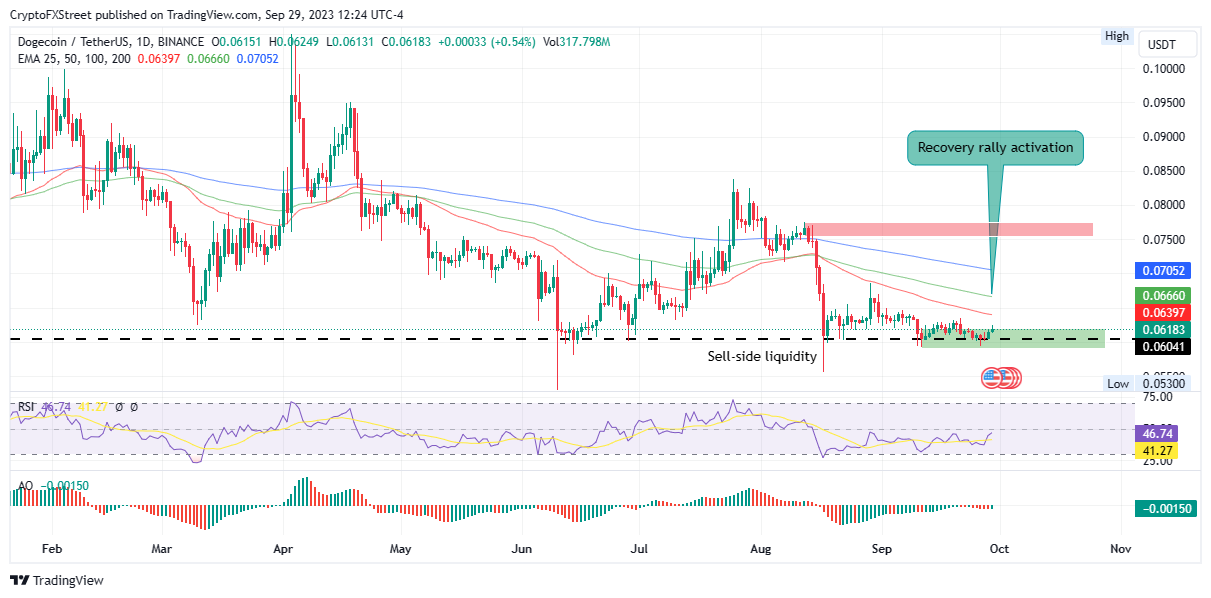
Dogecoin (DOGE) price is up almost 0.5% in the last 24 hours, which is more than what many in the crypto top ten can say. The token is trying to bud a recovery rally after a multi-week consolidation around the floor price of $0.0604. Technical indicators support the potential for more gains, but the absence of volatility leaves DOGE in paralysis.
At press time, Dogecoin price is stuck within a demand zone, a key area where most of the price action is expected. It is where you would expect to find the big buyers with large order clusters executed simultaneously therefore driving the price.
Increased bullish momentum could see Dogecoin price escape the demand zone, to confront the 50-day Exponential moving Average at $0.0639. Further north, the climb could see DOGE shatter the 100-day EMA at $0.0666, where it was rejected during the August 28 attempt that later proved premature. As such, conservative longs could mark this area as their take profit.
A break and close above the 100-day EMA would activate the recovery rally, with the potential for extending to the 200-day EMA at $0.0705, or in highly bullish cases, target the supply zone at $0.0750. A break above the midline of this supply zone order block, otherwise termed mean threshold, would confirm an uptrend.
The Relative Strength Index (RSI) supports this outlook, heading north as momentum rises. The Awesome Oscillator is also bullish as well, flashing green to show bulls are gaining ground.
DOGE/USDT 1-day chart
On the flip side, seller momentum could send Dogecoin price below the immediate support provided by the mean threshold of the demand zone order block at $0.0604, likely sending DOGE to collect sell-side liquidity resting underneath.
Bitcoin, altcoins, stablecoins FAQs
What is Bitcoin?
Bitcoin is the largest cryptocurrency by market capitalization, a virtual currency designed to serve as money. This form of payment cannot be controlled by any one person, group, or entity, which eliminates the need for third-party participation during financial transactions.
What are altcoins?
Altcoins are any cryptocurrency apart from Bitcoin, but some also regard Ethereum as a non-altcoin because it is from these two cryptocurrencies that forking happens. If this is true, then Litecoin is the first altcoin, forked from the Bitcoin protocol and, therefore, an “improved” version of it.
What are stablecoins?
Stablecoins are cryptocurrencies designed to have a stable price, with their value backed by a reserve of the asset it represents. To achieve this, the value of any one stablecoin is pegged to a commodity or financial instrument, such as the US Dollar (USD), with its supply regulated by an algorithm or demand. The main goal of stablecoins is to provide an on/off-ramp for investors willing to trade and invest in cryptocurrencies. Stablecoins also allow investors to store value since cryptocurrencies, in general, are subject to volatility.
What is Bitcoin Dominance?
Bitcoin dominance is the ratio of Bitcoin's market capitalization to the total market capitalization of all cryptocurrencies combined. It provides a clear picture of Bitcoin’s interest among investors. A high BTC dominance typically happens before and during a bull run, in which investors resort to investing in relatively stable and high market capitalization cryptocurrency like Bitcoin. A drop in BTC dominance usually means that investors are moving their capital and/or profits to altcoins in a quest for higher returns, which usually triggers an explosion of altcoin rallies.
Author

Lockridge Okoth
FXStreet
Lockridge is a believer in the transformative power of crypto and the blockchain industry.