Curve Finance’s Michael Egorov proposes transaction fee of core crvUSD pools be doubled for higher CRV income
- Curve Finance CEO, Michael Egorov, initiated a governance proposal suggesting transaction fee rate of crvUSD pools be doubled from 0.01% to 0.02%.
- If transaction volume remains same, Curve is likely to generate higher income, while protecting it from price oracle manipulation.
- CRV price is in a consistent decline, yielding 10.35% losses for holders over the past week.

Curve Finance, a decentralized exchange platform, suffered an exploit on July 31. Hackers took off with over $50 million in crypto assets and this negatively influenced CRV token price. The asset’s price has been in a consistent decline since the event.
Michael Egorov, the founder and CEO of the project, recommended that the transaction fee of core liquidity pools (crvUSD) be doubled from 0.01% to 0.02%. Egorov initiated a governance proposal for the same.
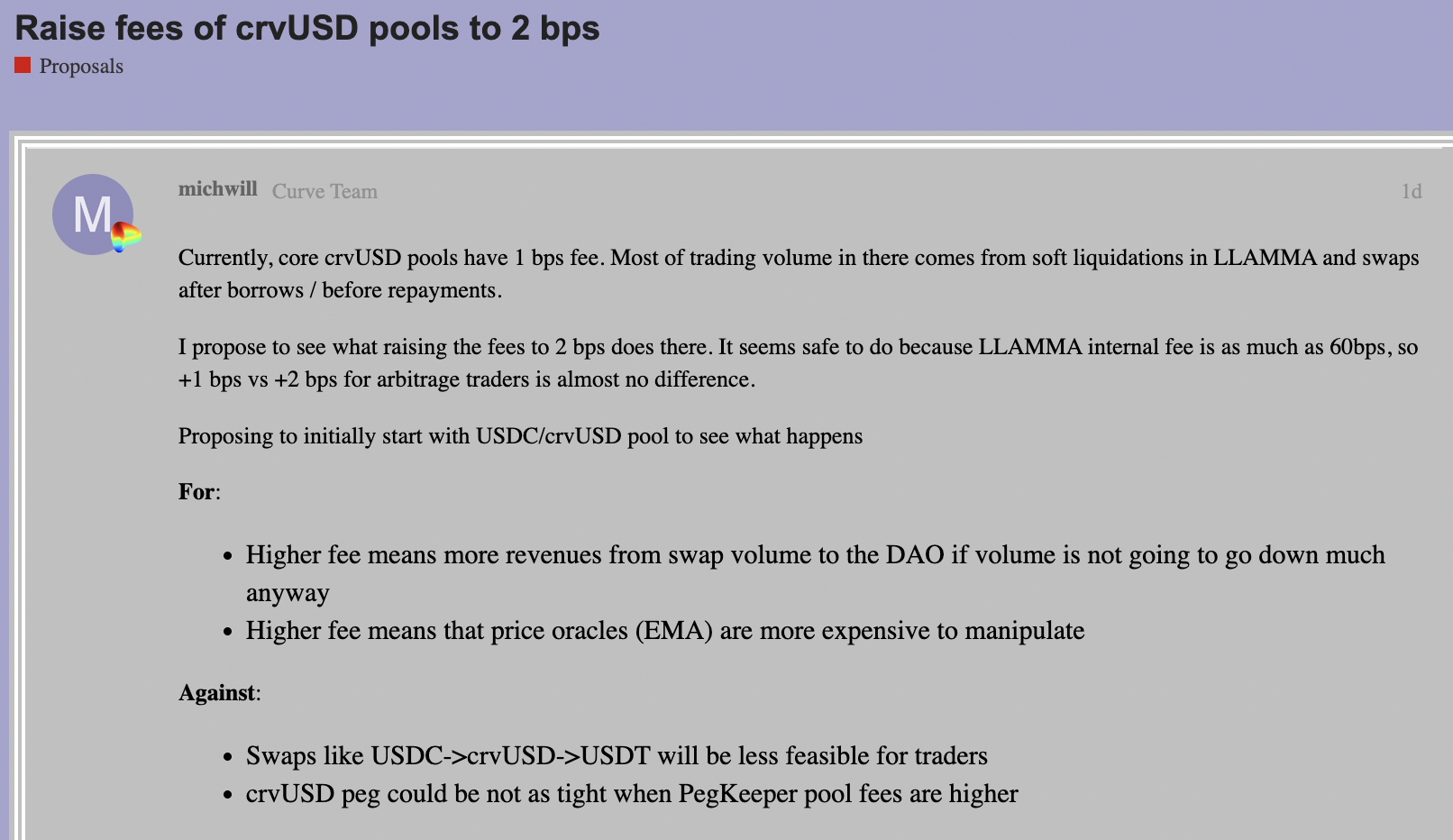
Governance proposal by Michael Egorov
The proposal serves two purposes:
- First, it increases Curve’s income if transaction volume remains the same
- Second, it makes it expensive and difficult for exploiters to engage in price oracle manipulation
Reasons why doubling transaction fees of crvUSD pools
Higher revenue generation is likely to benefit Curve and its community of holders. This could act as a bullish catalyst and push CRV price towards its recovery, after months of decline. Moreover, price oracle manipulation recently resulted in a $6.4 million exploit on Magnet Finance, a project based on Coinbase’s newly launched BASE chain.
Protecting the project from price oracle manipulation is therefore beneficial to CRV token holders in the long term.
At the time of writing, CRV price is $0.4515, after yielding 10.29% losses for holders over the past week and 38.24% in the past month.
Bitcoin, altcoins, stablecoins FAQs
What is Bitcoin?
Bitcoin is the largest cryptocurrency by market capitalization, a virtual currency designed to serve as money. This form of payment cannot be controlled by any one person, group, or entity, which eliminates the need for third-party participation during financial transactions.
What are altcoins?
Altcoins are any cryptocurrency apart from Bitcoin, but some also regard Ethereum as a non-altcoin because it is from these two cryptocurrencies that forking happens. If this is true, then Litecoin is the first altcoin, forked from the Bitcoin protocol and, therefore, an “improved” version of it.
What are stablecoins?
Stablecoins are cryptocurrencies designed to have a stable price, with their value backed by a reserve of the asset it represents. To achieve this, the value of any one stablecoin is pegged to a commodity or financial instrument, such as the US Dollar (USD), with its supply regulated by an algorithm or demand. The main goal of stablecoins is to provide an on/off-ramp for investors willing to trade and invest in cryptocurrencies. Stablecoins also allow investors to store value since cryptocurrencies, in general, are subject to volatility.
What is Bitcoin Dominance?
Bitcoin dominance is the ratio of Bitcoin's market capitalization to the total market capitalization of all cryptocurrencies combined. It provides a clear picture of Bitcoin’s interest among investors. A high BTC dominance typically happens before and during a bull run, in which investors resort to investing in relatively stable and high market capitalization cryptocurrency like Bitcoin. A drop in BTC dominance usually means that investors are moving their capital and/or profits to altcoins in a quest for higher returns, which usually triggers an explosion of altcoin rallies.
Like this article? Help us with some feedback by answering this survey:
Author

Ekta Mourya
FXStreet
Ekta Mourya has extensive experience in fundamental and on-chain analysis, particularly focused on impact of macroeconomics and central bank policies on cryptocurrencies.