Bitcoin ETF approval kicks off fee wars, expert say BlackRock, Fidelity, Grayscale will stay long term
- The Bitcoin Spot ETF approval by the US financial regulator on Wednesday ignites fee wars between issuers.
- Crypto expert Vijay Boyapati said that BlackRock, Fidelity, and Grayscale are likely to emerge as survivors in the long term.
- Bitcoin price is up nearly 9% on the week, with gains capped below $48,000.

The Bitcoin spot Exchange-Traded Fund (ETF) was approved by the US Securities and Exchange Commission (SEC) on Wednesday, marking January 10 as a historic moment for BTC holders after years of anticipation. The approval has triggered fee wars among the 11 issuers, and experts weigh in on who is likely to survive in the long term by offering near-zero fees to market participants.
Bitcoin price increased slightly after the announcement, but these gains were quickly erased.
Also read: Bitcoin ETF finally approved by SEC
Daily digest market movers: Bitcoin ETFs receive SEC greenlight
- The Bitcoin ETF approval marked the end of an era of anticipation among market participants. The next catalyst for BTC price is the upcoming halving event, which is scheduled for April.
- The approval ushered in competition among issuers to offer the lowest fee and capture the largest market share.
- Vijay Boyapati, a crypto expert and author, shared his views on issuers that are likely to survive in the long term, and offer near-zero fees on Bitcoin Spot ETFs. Boyapati named BlackRock, Fidelity and Grayscale’s Bitcoin ETF products as the most likely to gain market share.
- According to the expert, asset management giant Blackrock is big enough to handle almost-zero margin indefinitely, Fidelity has a large enough client base, and Grayscale is likely to differentiate itself with the largest volume of Assets Under Management (AUM).
The #Bitcoin ETF fee war has begun in earnest, driving margins toward zero. My view is that only three survive long term:
— Vijay Boyapati (@real_vijay) January 11, 2024
- Blackrock: big enough to handle zero margin indefinitely
- Fidelity: large enough client base
- Grayscale: Largest AUM pic.twitter.com/SngMYWT4uR
- Approved Bitcoin ETFs and their reported fees are as follows:
Grayscale (GBTC): 1.5%
Hashdex (DEFI): 0.9%
Valkyrie (BRRR): 0.49%
Invesco (BTCO): 0.39%
Wisdom Tree (BTCW): 0.3%
Franklin (EZBC): 0.29%
Blackrock (IBIT): 0.25%
Fidelity (FBTC): 0.25%
Vaneck (HODL): 0.25%
Ark 21 (ARKB): 0.21%
Bitwise (BITB): 0.2%
- The upcoming Bitcoin halving event could act as a catalyst for BTC price. The halving is less than 100 days away, and historically BTC price has rallied after the halving.
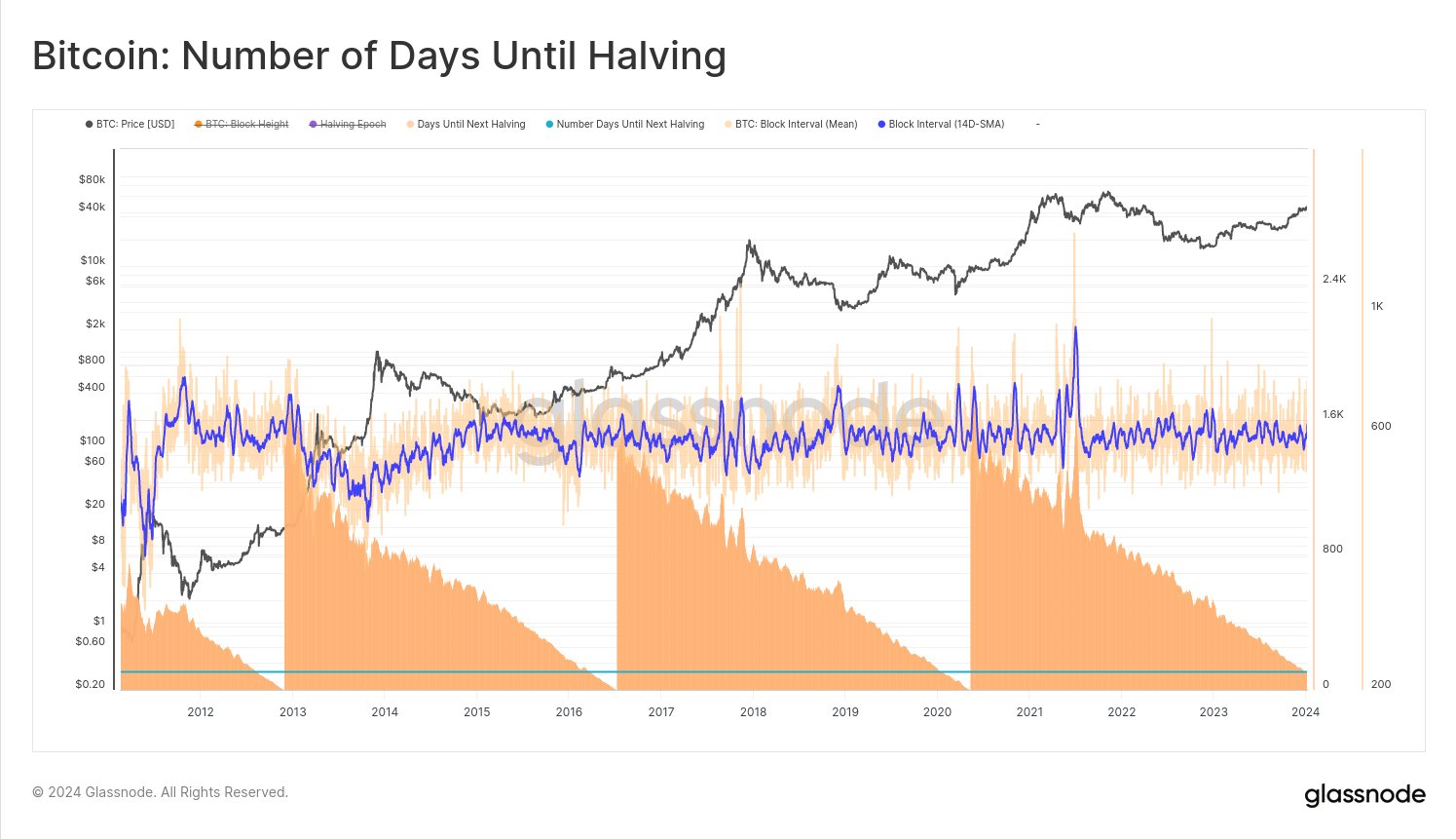
Bitcoin Number of Days until Halving. Source: Glassnode
Technical Analysis: Bitcoin price finds strong support at $45,000,
Bitcoin price rallied in response to the optimism from the BTC Spot ETF approval by the US financial regulator. There are two key catalysts: Spot ETF approval, and the halving, that were expected to drive gains in BTC. Whether BTC price rallies once Spot ETFs start trading remains to be seen.
The announcement showed that Bitcoin’s upside is capped below $48,000. Bitcoin price increased slightly to $47,690 after the SEC’s approval, but fell later to around $46,000 on Thursday.
Analysts at Skew @52kskew said that as long as Bitcoin price holds above $44,700, BTC is in an uptrend. The asset faces resistance between $47,000 and $48,000 on a high time frame.
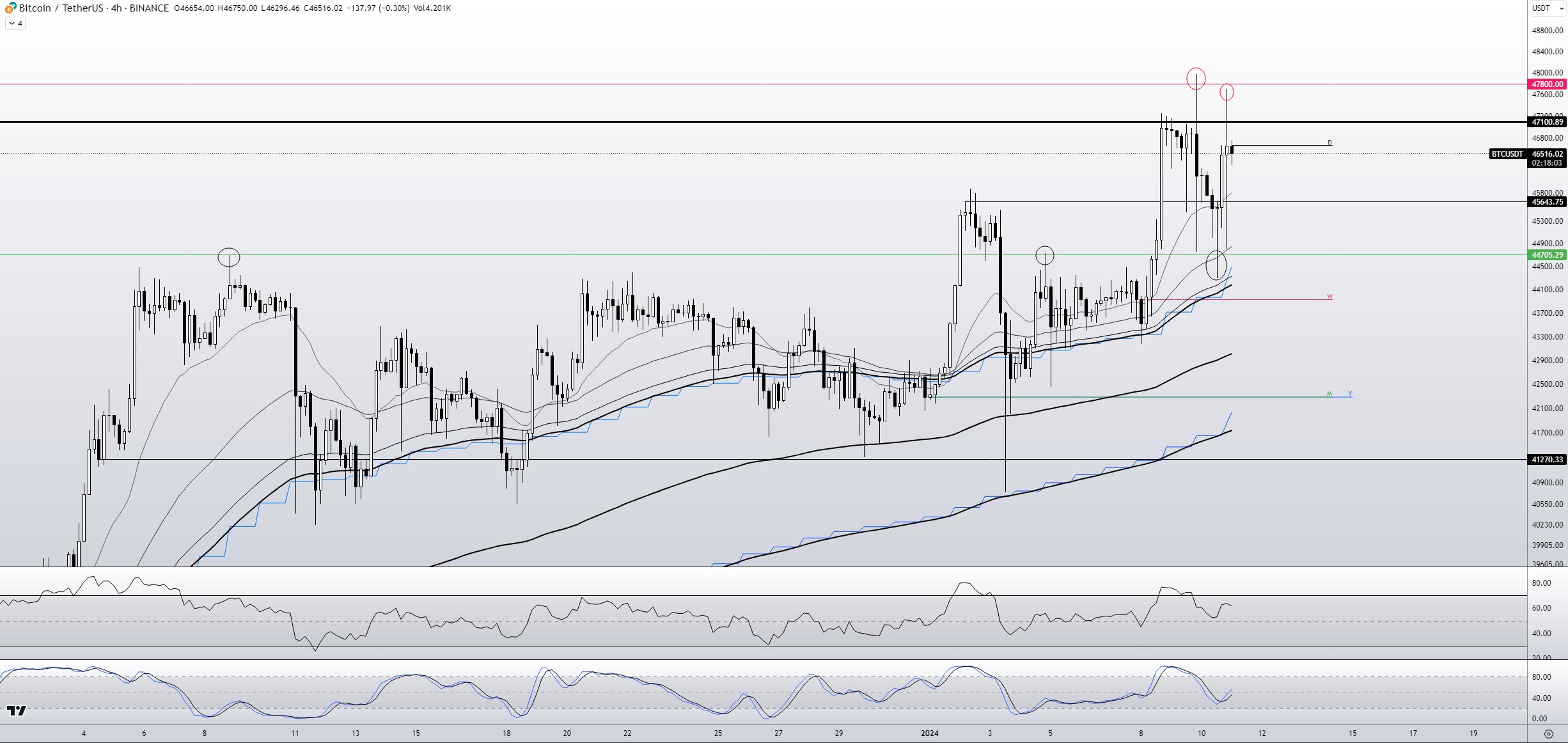
BTC/USDT 4-hour chart Source:Skew tweet on X
Cryptocurrency prices FAQs
How do new token launches or listings affect cryptocurrency prices?
Token launches like Arbitrum’s ARB airdrop and Optimism OP influence demand and adoption among market participants. Listings on crypto exchanges deepen the liquidity for an asset and add new participants to an asset’s network. This is typically bullish for a digital asset.
How do hacks affect cryptocurrency prices?
A hack is an event in which an attacker captures a large volume of the asset from a DeFi bridge or hot wallet of an exchange or any other crypto platform via exploits, bugs or other methods. The exploiter then transfers these tokens out of the exchange platforms to ultimately sell or swap the assets for other cryptocurrencies or stablecoins. Such events often involve an en masse panic triggering a sell-off in the affected assets.
How do macroeconomic releases and events affect cryptocurrency prices?
Macroeconomic events like the US Federal Reserve’s decision on interest rates influence risk assets like Bitcoin, mainly through the direct impact they have on the US Dollar. An increase in interest rate typically negatively influences Bitcoin and altcoin prices, and vice versa. If the US Dollar index declines, risk assets and associated leverage for trading gets cheaper, in turn driving crypto prices higher.
How do major crypto upgrades like halvings, hard forks affect cryptocurrency prices?
Halvings are typically considered bullish events as they slash the block reward in half for miners, constricting the supply of the asset. At consistent demand if the supply reduces, the asset’s price climbs. This has been observed in Bitcoin and Litecoin.
Author

Ekta Mourya
FXStreet
Ekta Mourya has extensive experience in fundamental and on-chain analysis, particularly focused on impact of macroeconomics and central bank policies on cryptocurrencies.