Bitcoin price gains might be sustainable with declining stablecoin dominance
- Bitcoin price rally is likely to continue with declining stablecoin dominance, investors are moving capital into BTC and altcoins.
- BTC mining difficulty hit a record high on November 26, securing the Bitcoin network further.
- MicroStrategy outperformed most other stocks since its adoption of Bitcoin strategy, fueling bullish outlook among institutions.

Bitcoin price rallied to its local peak of $38,400 on November 24, before pulling back to $37,300, early on Monday. The asset’s late October to early November rally was driven by rising stablecoin reserves on exchanges, according to Santiment data. A similar outcome is expected from the declining stablecoin dominance.
Also read: Cosmos Hub founder plans fork, ATOM holders may receive token airdrop
Daily Digest Market Movers: Bitcoin mining difficulty hits new all-time high, stablecoin dominance declines
- Bitcoin mining difficulty noted a difficulty adjustment at block height 818496. The mining difficulty was raised by 5.07%, and climbed to 67.96 Trillion, a record high. The current average hashrate of the entire network is 493.22 EH/s, according to data from explorer.btc.com.
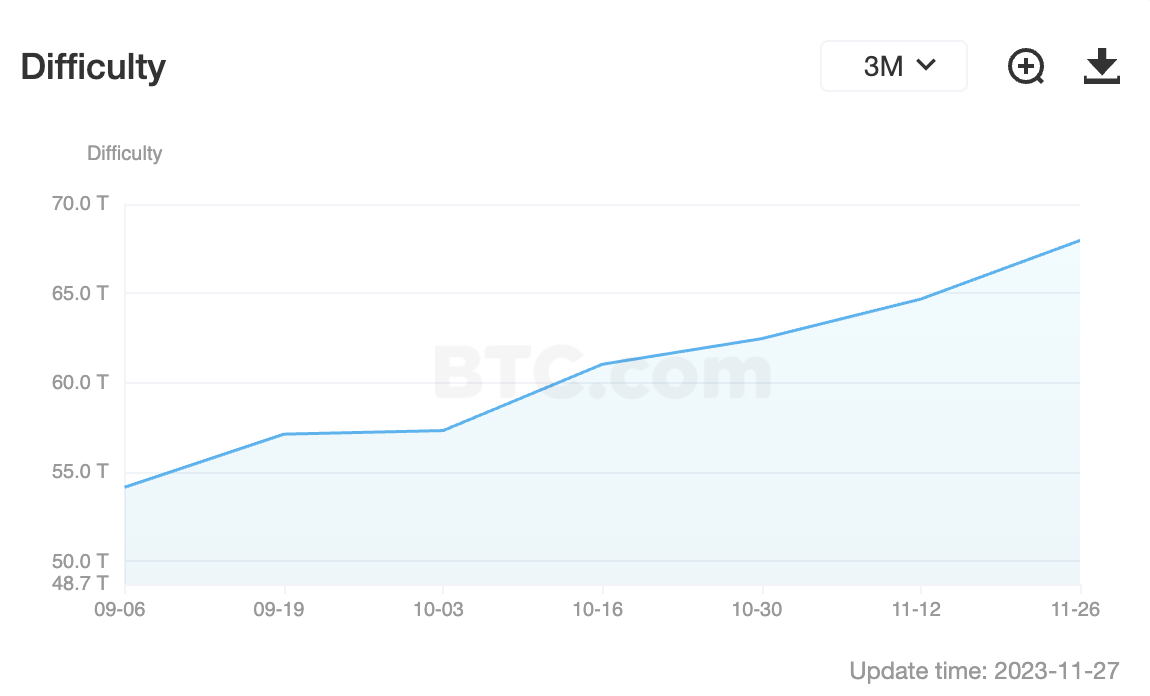
Bitcoin mining difficulty
- Increase in mining difficulty makes the network secure as it becomes more difficult to execute an attack on the Bitcoin network. The difficulty adjustment, alongside the halving events ensures a slow down of new BTC entering the market, over time.
- The recent spike in mining difficulty is therefore a milestone for the Bitcoin network.
- BTC price rally to $35,000 was likely catalyzed by the rising Tether and USDC reserves across exchange platforms. Based on Santiment data, between August 19 and October 16, 3.54% of USDT’s entire supply and 0.72% of USDC supply moved to crypto exchange platforms. These moves were followed by a massive spike in BTC price.
- Santiment analysts believe a return of USDT and USDC to exchanges, following the ongoing cooldown period, will drive the second leg of the BTC price rally in 2023.

Bitcoin price rally driven by stablecoins
- The crypto analyst behind the X handle: @rektcapital noted a decline in USD Tether (USDT) dominance. The analyst notes that investors have become more risk-seeking and are moving away from stablecoins into BTC and altcoins. The risk tolerance is increasing and capital rotation has become clearer.
USDT Dominance is declining
— Rekt Capital (@rektcapital) November 26, 2023
Investors are becoming more risk-seeking, eager to move away from stable coins into #BTC and Altcoins
Tolerance to risk is growing, rotational behaviour clear
Lose blue as support and this psychological trend will continue$BTC #Crypto #Bitcoin pic.twitter.com/11TiZb5GsI
- Institutional investors are likely to continue BTC accumulation, in light of MicroStrategy stock’s performance, since Bitcoin adoption. Michael Saylor, co-founder and former CEO of MicroStrategy shared the performance of MSTR, the firm’s stock, since BTC adoption. MSTR’s outperformance is expected to catalyze BTC adoption among firms, as the asset continues its uptrend.
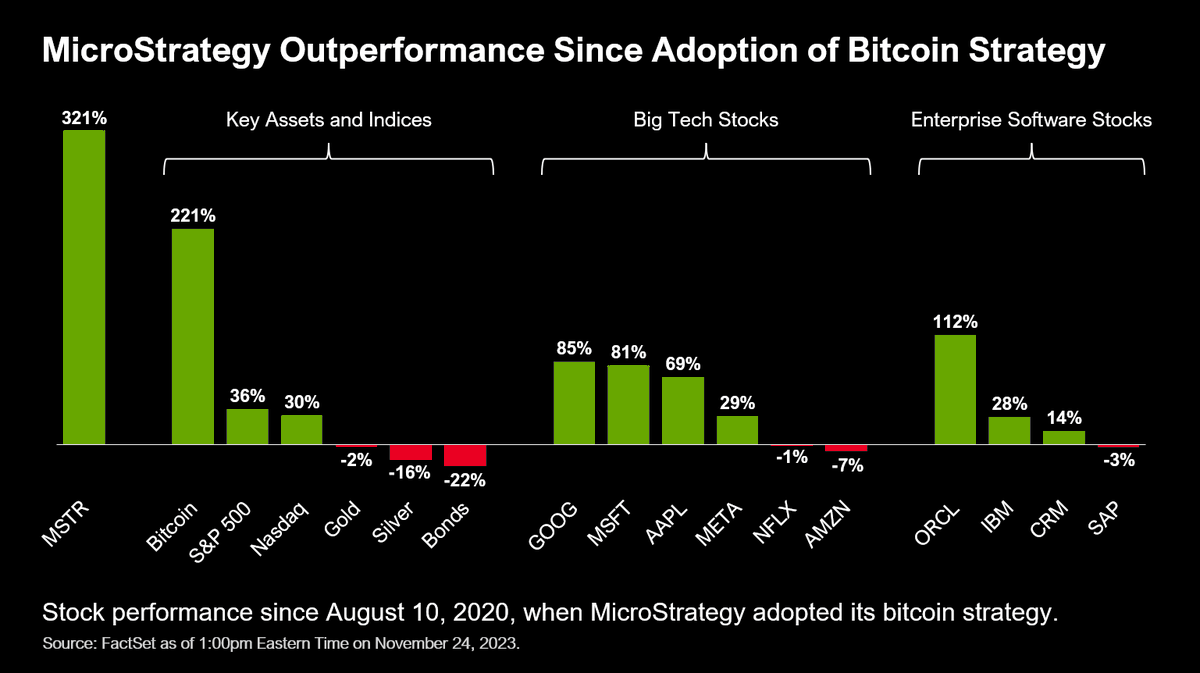
MSTR performance since adoption of BTC strategy
- Tempo, an online transfer provider, told FXStreet in a press release that:
the number of EU financial institutions implementing blockchain in their systems may grow by up to 30% in the next year. As Euro-backed stablecoins should play a significant role in the blockchain portions of settlements made, their deficit may become critical in the second quarter already. This will drastically stimulate companies to meet the demand by putting new coins into circulation.
Technical analysis: Bitcoin price rally likely to continue
Analysts behind the quantitative intraday trading firm 52kskew noted a clean Bitcoin uptrend and resistance between $38,000 and $40,000 levels. Analysts noted that demand is likely between $35,000 to $31,000 and this offers a dip-buying opportunity for traders, on the 4-hour price chart.

BTC/USDT 4-hour chart
Technical analysts have noted a loss of momentum from buyers, despite the ongoing uptrend and believe bulls will need to reclaim the $37,500 level and the 21-day Exponential Moving Average (EMA) on the 4-hour chart to sustain recent gains.
$BTC 4H
— Skew Δ (@52kskew) November 27, 2023
Still clean uptrend till the trendline & structure is broken
for now clear resistance is $38K - $40K
Demand is likely $35K - $31K ~ dip buying opportunity with closes above $30K
4H / 1D Systematic trend
Price still respecting the trend, however clear loss of… pic.twitter.com/u1EbqO0wkm
Bitcoin price expansion outside $38,414 and $35,632 on either side could induce volatility in BTC, according to 52kskew.
Cryptocurrency prices FAQs
How do new token launches or listings affect cryptocurrency prices?
Token launches like Arbitrum’s ARB airdrop and Optimism OP influence demand and adoption among market participants. Listings on crypto exchanges deepen the liquidity for an asset and add new participants to an asset’s network. This is typically bullish for a digital asset.
How do hacks affect cryptocurrency prices?
A hack is an event in which an attacker captures a large volume of the asset from a DeFi bridge or hot wallet of an exchange or any other crypto platform via exploits, bugs or other methods. The exploiter then transfers these tokens out of the exchange platforms to ultimately sell or swap the assets for other cryptocurrencies or stablecoins. Such events often involve an en masse panic triggering a sell-off in the affected assets.
How do macroeconomic releases and events affect cryptocurrency prices?
Macroeconomic events like the US Federal Reserve’s decision on interest rates influence risk assets like Bitcoin, mainly through the direct impact they have on the US Dollar. An increase in interest rate typically negatively influences Bitcoin and altcoin prices, and vice versa. If the US Dollar index declines, risk assets and associated leverage for trading gets cheaper, in turn driving crypto prices higher.
How do major crypto upgrades like halvings, hard forks affect cryptocurrency prices?
Halvings are typically considered bullish events as they slash the block reward in half for miners, constricting the supply of the asset. At consistent demand if the supply reduces, the asset’s price climbs. This has been observed in Bitcoin and Litecoin.
Author

Ekta Mourya
FXStreet
Ekta Mourya has extensive experience in fundamental and on-chain analysis, particularly focused on impact of macroeconomics and central bank policies on cryptocurrencies.