Bitcoin exchange reserves down $5B in 2020 hints at whale accumulation

Bitcoin exchange reserves dropped by $5 billion in the past year, showing signs of accumulation.
The Bitcoin (BTC) reserves of exchanges are continuing to drop, which suggests retail investors and whales might be accumulating.
According to data from CryptoQuant, all exchanges’ reserves dropped to 2.4 million BTC, which is equivalent to $25 billion. In contrast, in October 2019, exchanges had around 2.8 million BTC, currently worth $30 billion.
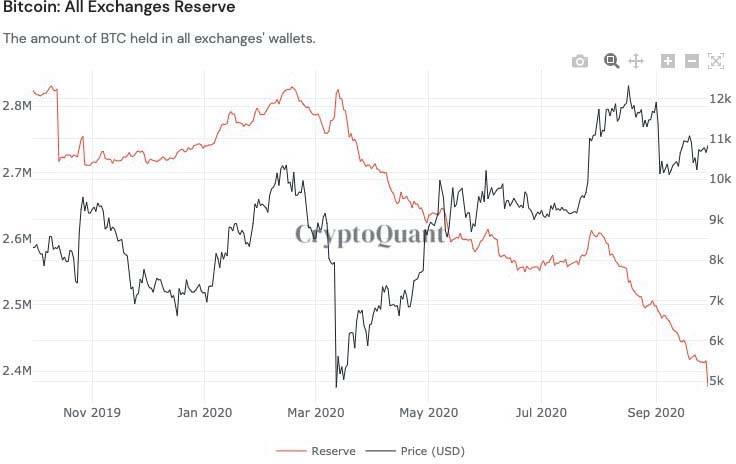
Bitcoin reserves on all exchanges throughout the past year. Source: CryptoQuant
There is a clear decrease in selling pressure from whales and retail investors
The reserves of exchanges increase when investors deposit Bitcoin. Typically, deposits or inflows are considered selling pressure, because traders have to send BTC to exchanges in order to sell.
Hence, when exchange inflows decline, it often signifies that the appetite to sell BTC by investors is declining.
Another chart from CryptoQuant depicts the trend of net inflows of Bitcoin into exchanges in the same timeframe.
Throughout the past two months, net inflows have generally remained in the negative 20,000 BTC level. Net inflows sharply dropped in recent weeks, specifically as BTC sharply rebounded from $10,300 to above $10,700.
On Sep. 26, Cointelegraph reported that large whale clusters emerged at $10,407. Whale clusters form when whales accumulate new BTC and do not touch the new holdings. Clusters usually indicate that whales are beginning to accumulate in a new area.
Considering the accumulation trend and the resilience of BTC above $10,000, investors likely have little appetite to sell.
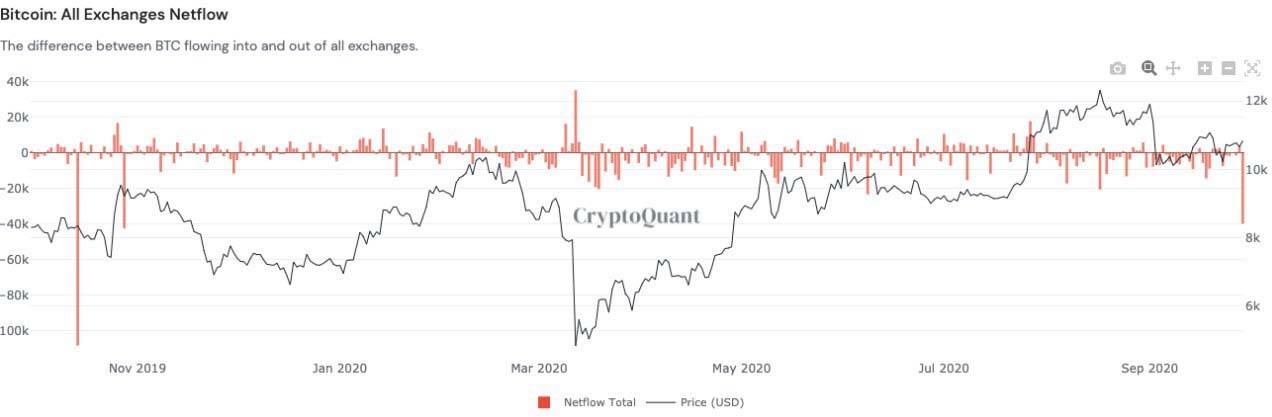
All exchange Bitcoin net inflow. Source: CryptoQuant
Due to the confluence of the lacking willingness to sell BTC at current prices and consistent accumulation, BTC is on track for a strong quarterly close.
Another possible reason behind the steep fall in exchange net flows might have been large-scale hacks. Most recently, KuCoin was reportedly hacked for $150 million after the private keys of hot wallets were compromised.
BTC on track for its second-best quarterly close
According to Skew, Bitcoin is en route to see its second-best quarterly close. BTC closed the second quarter at around $9,140. It would have to stay above $10,600 to secure the second-best quarterly close.

The quarterly closing prices of Bitcoin since 2014. Source: Skew
There are several reasons behind the strong performance of Bitcoin throughout the third quarter. Most notably, BTC rallied in tandem with gold and stocks after the U.S. approved a stimulus bill.
The initial kick start of a market-wide recovery from the stimulus, combined with a low-interest-rate environment, created a favorable macro backdrop. The analysts at Skew said:
“One more day to go and still looking like second best quarterly close for #bitcoin but it's a close call with Q2 2020.”
Throughout the year’s end, there are three key fundamental and macro factors that could buoy Bitcoin’s sentiment, namely the weakening U.S. dollar, the prospect of a stimulus package and vaccines.
Meanwhile, the U.S. dollar is continuing to show weakness against reserve currencies, in the likes of the yen, yuan and franc as the Fed has doubled down on its average inflation targeting strategy.
But while the prolonged weakness of the dollar might put the U.S. stock market at risk of underperforming against other markets, it should directly benefit Bitcoin and gold, which are priced against the USD.
Author

Cointelegraph Team
Cointelegraph
We are privileged enough to work with the best and brightest in Bitcoin.