Bitcoin analysts and traders say BTC’s low volatility is ‘a calm before the storm’

Stock markets slide toward yearly lows while Bitcoin price remains range-bound. Here’s why crypto analysts expect a sharp move from BTC soon.
If you were to hang around crypto traders this week, you would hear three phrases repeatedly muttered: “volatility,” “bond prices” and the potential of a “sharp move” in Bitcoin BTC ↑ $19,074 price.
Multiple analysts have placed emphasis on Bitcoin’s range-bound price action, leading some to question whether this is a sign of a market bottom, or even a decoupling from equities markets.
In its latest “The Week On-chain” newsletter,titled “A Calm Before The Storm,” Glassnode analysts said:
Recent weeks have seen an uncharacteristically low degree of volatility in Bitcoin prices, in stark contrast to equity, credit, and forex markets, where central bank rate hikes, inflation, and a strong US dollar continue to wreak havoc.
Research outlet Delphi Digital also chimed in on the subject, pinpointing the Bollinger Band Width Percentile (BBWP) metric as proof that there could be “a big move brewing for BTC.” According to Delphi Digital, “Historically, BBWP readings above 90 or below 5 have marked major swing points.”
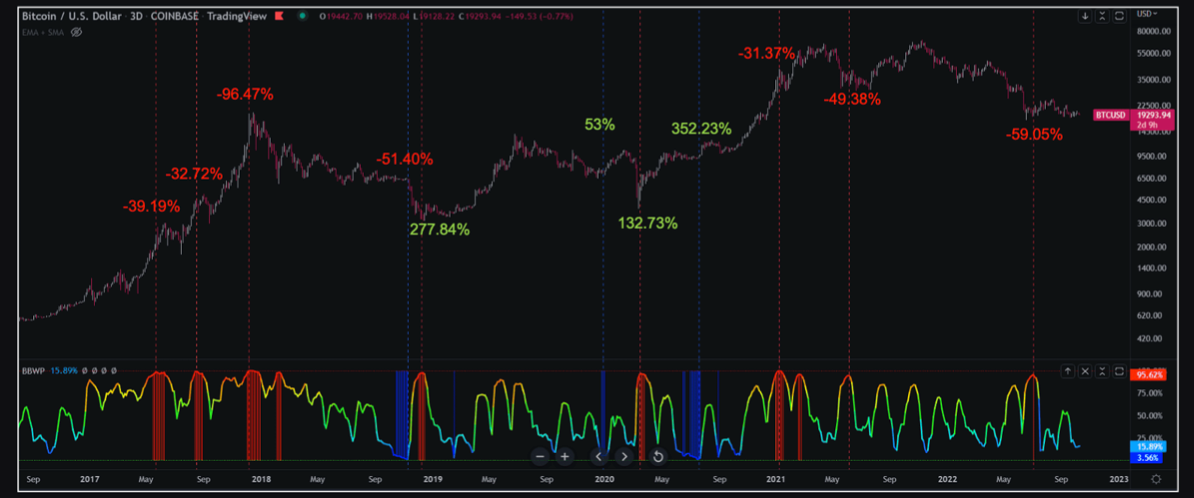
BTC price and Bollinger Band Width Percentile. Source: Delphi Digital
The BBWP has yet to dip under 5, but the researchers noted that for Bitcoin:
Since Q2 2017, BBWP readings above 90 or below 5 have previously led to an upside of 204% or a downside of -51% on average.
While it’s too early to conclude that BTC has broken its correlation with equities markets or even reached a market bottom, historical data suggests that long bouts of sideways price action have marked accumulation and distribution phases.
Glassnode’s Accumulation Trend Score, a metric that “reflects the aggregated balance change intensity of active investors over the past 30 days,” is currently in a neutral zone which denotes a state of equilibrium in Bitcoin’s accumulation structure.
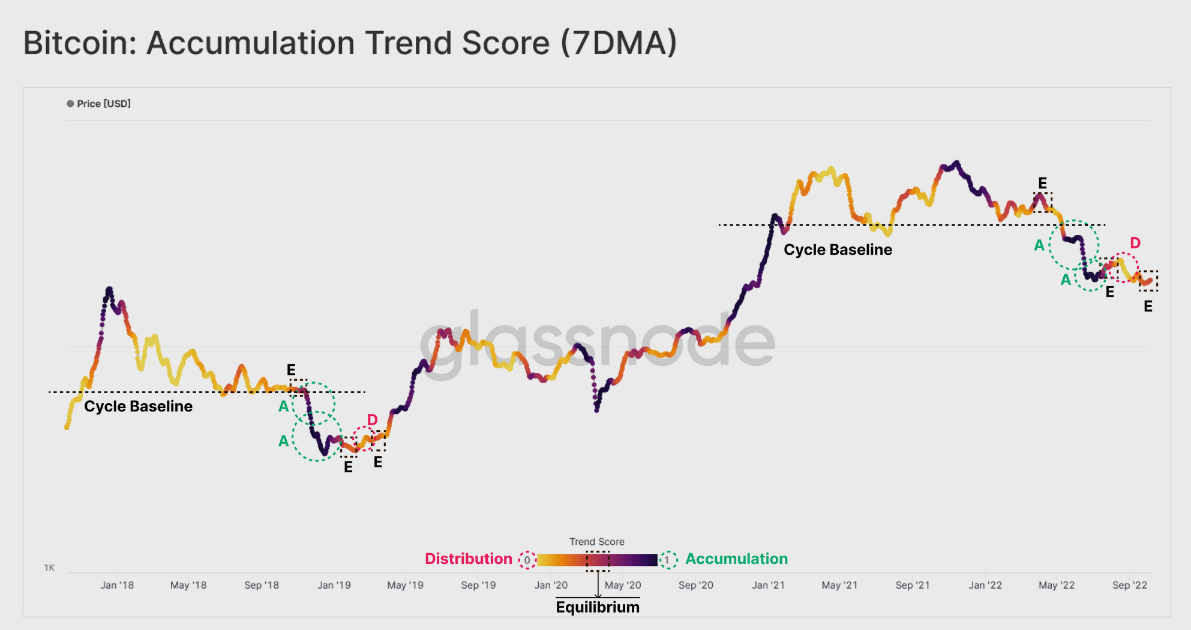
BTC Accumulation Trend Score. Source: Glassnode
The report details how from 2018 to 2019, entities with 1,000 BTC to 10,000 BTC tended to distribute their tokens as the bull market quickened its pace, whereas retail investors (less than 1 BTC) increased their Bitcoin allocation.
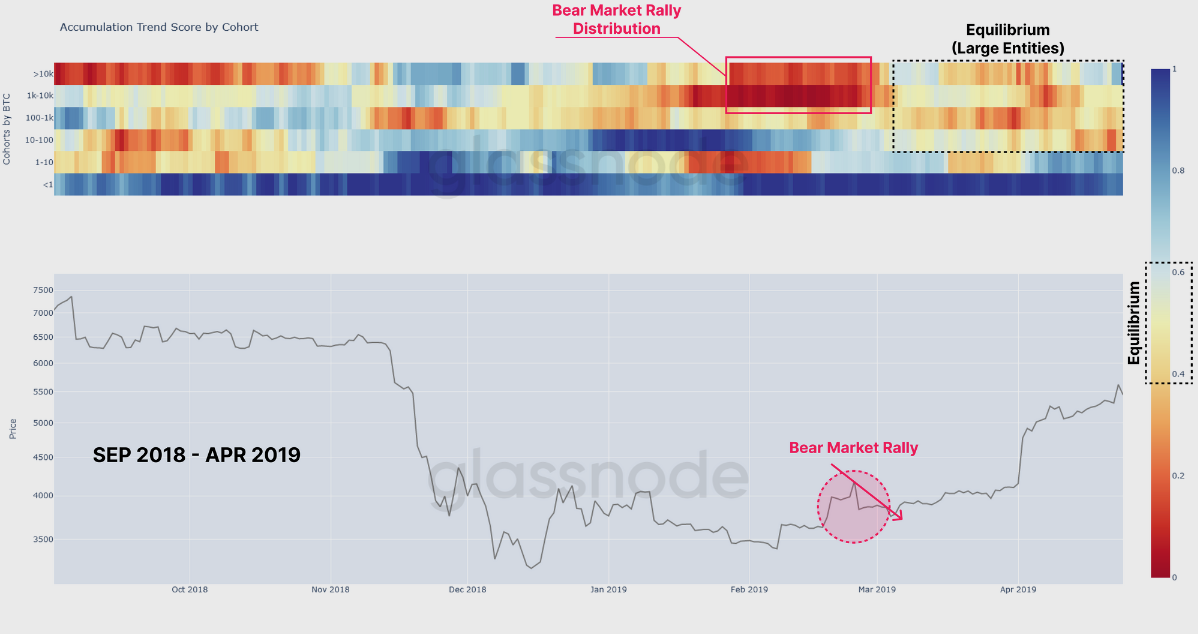
BTC accumulation trend score by cohort. Source: Glassnode
Similar investor behavior can be observed in 2022 when entities with more than 10,000 BTC sold into the bear market rally to $24,500 before switching into an accumulation mode at the next price low.
As shown in the chart below, larger-balance BTC holders (greater than 10,000 BTC) are now neutral, whereas the 1,000 to 10,000 BTC cohort is accumulating. Meanwhile, retail investors show varying degrees of equilibrium and selling.
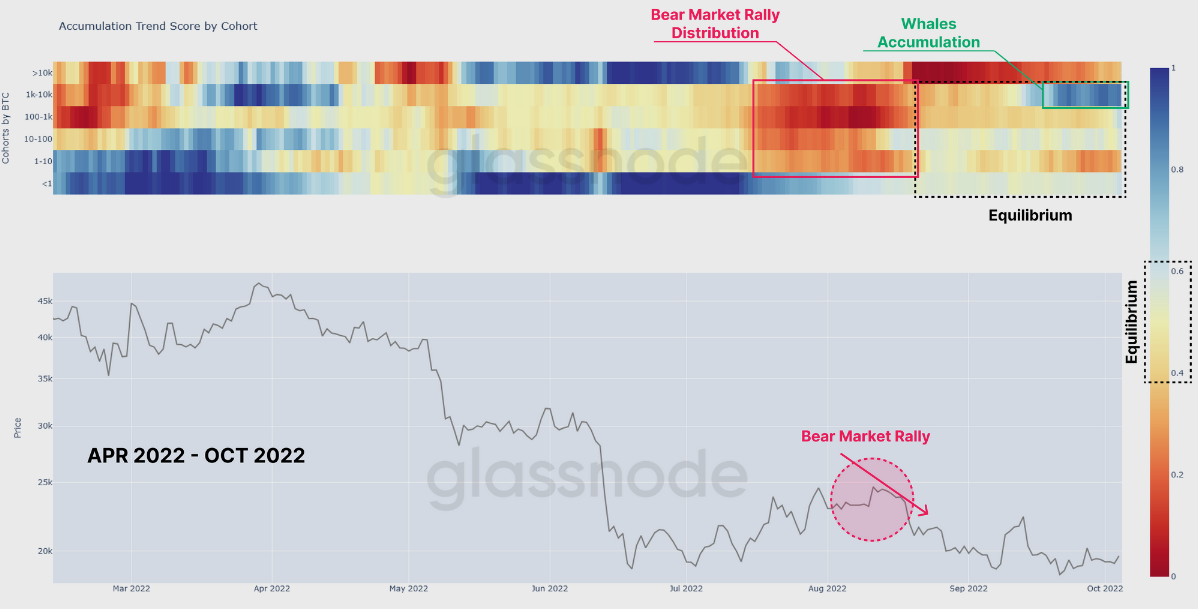
BTC accumulation trend score by cohort. Source: Glassnode
Where’s the volatility?
Bitcoin price has been trading in the $18,500–$24,500 range for the past 120 days, and as mentioned by Cointelegraph on Oct. 11, multiple factors could be responsible for the lack of fireworks.
A number of important economic events are set to take place in the next two weeks, and these could be contributing to traders’ desire to sit on their hands and watch from the sidelines.
The following events are set to occur in October:
- Oct. 12: Federal Open Market Committee (FOMC) minutes
- Oct. 12: Consumer Price Index (CPI) report
- Oct. 17: Q3 earnings season begins
- Oct. 28: Personal Consumption Expenditures (PCE) price index
Aside from a slight rebound in the Dow and S&P 500, equities markets continue to trend down, and an uptick in the conflict between Russia and Ukraine, plus the strength of the United States dollar, could also be contributing to investors’ aversion to risk assets.
By analyzing coin distribution across long-term and short-term holders, Glassnode concluded that sellers are likely exhausted and that more than 31% of the coins held by long-term holders are being held at a loss. Compared with previous market conditions, the researchers noted that
The market has been in this phase for 1.5 months, with a previous cycle duration ranging from 6 to 10 months.
While it is impossible to predict which direction Bitcoin price will take once volatility spikes, studying on-chain data to decipher the actions of market participants in near-identical market conditions could assist investors in deciding what to do once the price does start moving.
Author

Cointelegraph Team
Cointelegraph
We are privileged enough to work with the best and brightest in Bitcoin.